
discord
An experimental Discord library for MoonBit: typed APIs, a native gateway with voice (DAVE E2EE), and JS/serverless HTTP interactions.
discord
bot
gateway
api
voice
interactions
Author
Version
0.1.0
License
Apache-2.0
Repository
Last updated
15 hours ago
Downloads
2
Dependencies
- moonbitlang/async0.21.2
- hustcer/ed255190.6.0
- gaato/dave0.1.0
#discord.mbt


A Discord application library for MoonBit:
typed interaction declarations, API models, a rate-limited REST client,
JS/serverless HTTP interactions, and a native WebSocket gateway shard.
The design follows twilight:
loosely coupled packages that model the Discord API, plus an App layer for
typed interaction declarations.
Status: experimental, pre-1.0. APIs may change between releases.
Long-form guides live in src/guide/; their code
blocks compile and run as part of the test suite, so the examples cannot
drift from the library. Task-focused recipes are docstring examples on the
relevant symbols — look anything up with moon ide doc (see
Development).
#Prerequisites
On a clean machine, install git and run moon update before resolving the
module dependencies. Moon uses git to clone the package registry.
Every native build compiles the Gateway package's zlib_stream.c, which
always includes <zlib.h> even when compress=false. The zlib development
headers are therefore required for all native builds: install zlib1g-dev on
Debian/Ubuntu or zlib-devel on Fedora/openSUSE. The zlib shared library is
additionally required at runtime when Gateway zlib-stream compression is used.
#Install
moon update
moon add gaato/discord
The interaction App, REST client, and data packages support native and
JavaScript. The gateway Bot executor is native-only. Both are built on
moonbitlang/async.
#Quickstart
Build the interaction App, then pass it to the gateway Bot executor. This
example registers and answers a /echo command. See
src/examples/slash_echo for the runnable version.
///|
struct QuickstartEchoArgs {
  text : String
  times : Int
}

///|
async fn run_echo_bot(token : String) -> Unit {
  let args : @discord.Args[QuickstartEchoArgs] = @discord.Args::map2(
    @discord.arg_string(name="text", description="What to echo"),
    @discord.arg_int(
      name="times",
      description="How many times (1-5)",
      min=1,
      max=5,
    ).with_default(1L),
    (text, times) => { text, times: times.to_int(), },
  )
  let echo = @discord.slash(
    name="echo",
    description="Echo your text back",
    args~,
    handler=Immediate((_ctx, value) => {
      @discord.CommandReply::message(
        content=Array::make(value.times, value.text).join("\n"),
      )
    }),
  )
  let app = @discord.App()
  app.command(echo)
  let bot = @discord.Bot(app, token~)
  bot.on(@discord.Events::ready(), (_ctx, ready) => {
    println("ready as \{ready.user.username}")
  })
  bot.run()
}#Packages
| Package | What it is | Native | JS |
|---|---|---|---|
| gaato/discord | Facade: aliases for the types a typical application names directly | Yes | Yes* |
| gaato/discord/model | Pure data: ~24 entity domains, gateway payloads, zero IO | Yes | Yes |
| gaato/discord/telemetry | Structured REST, gateway, and dispatch observability values | Yes | Yes |
| gaato/discord/http | REST Client, routes, rate limiting, multipart uploads | Yes | Yes |
| gaato/discord/gateway | Shard: connection state machine, heartbeat, resume | Yes | No |
| gaato/discord/voice | Experimental native voice gateway v8, DAVE, RTP, and Opus send/receive | Yes | No |
| gaato/discord/interaction | Command/component builders, typed args and autocomplete data | Yes | Yes |
| gaato/discord/framework | Interaction routing, response gates, low-level response contexts | Yes | Yes |
| gaato/discord/app | Gateway-free typed commands/components/modals, HTTP endpoint, sync and policy | Yes | Yes |
| gaato/discord/bot | Native gateway executor and typed gateway event descriptors | Yes | No |
| gaato/discord/endpoint_http | Native signed-interactions HTTP server (serve_interactions) | Yes | No |
| gaato/discord/cache | Opt-in, gateway-driven in-memory cache | Yes | Yes |
| gaato/discord/util | Pure helpers: permissions, mentions, timestamps, CDN URLs | Yes | Yes |
| gaato/discord/verify | Pure MoonBit Ed25519 request verification | Yes | Yes |
| gaato/discord/ratelimit | Rate limiter trait + in-memory implementation | Yes | Yes |
| gaato/discord/queue | Identify queue trait + in-memory implementation | Yes | Yes |
| gaato/discord/coordinator | Native TCP coordinator for multi-process Identify and REST limits | Yes | No |
* The facade's gateway and HTTP-server exports exist only on native.
WebAssembly is not currently enabled or validated as an application target in
this repository.
Packages remain usable on their own. A REST-only tool needs http and model.
The dependency graph, generated from the moon.pkg declarations by
tools/package_graph and transitively reduced:
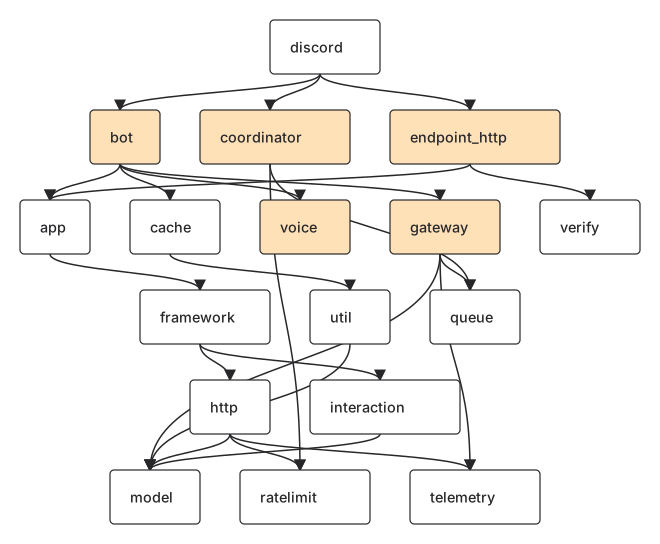
Amber nodes are native-only; every other package also runs on JS.
#Examples
Runnable programs live under src/examples/:
- slash_echo: minimal typed Gateway bot.
- kitchen_sink: subcommands, autocomplete, context menus, components, and modals.
- ping_gateway: low-level Gateway and REST use.
- low_level: manual Framework and Shard wiring.
- workers_echo: Cloudflare Workers adapter.
- interactions_http: native signed-interactions HTTP server.
- plugin_demo: a stateful feedback feature installed as a separate package.
- voice_player: join a voice channel and play an Ogg/Opus file.
- voice_recorder: record a user's voice to an Ogg/Opus file.
#App core and executors
App owns the interaction declaration: commands, components, modals,
autocomplete routes, command synchronization, and the error policy. It has no
gateway dependency. After building an App, choose an executor:
- Bot(app, token~) connects to the gateway and routes InteractionCreate events through the App.
- app.serve(group, token~) creates an InteractionEndpoint for an HTTP adapter.
Both executors use the same handlers, so an application can move between a
persistent gateway process and an HTTP or serverless deployment without
rewriting its interaction declarations.
Command[A] pairs one handler with Args[A]; the argument value drives both
Discord's registration payload and interaction decoding (build records with
Args::map1 through Args::map8). Choose a handler mode against Discord's
three-second initial-response deadline: Immediate computes and returns a
CommandReply before it, Deferred acknowledges first and continues on a
DeferredCtx, and Raw receives the underlying CommandCtx for imperative
flows. Subcommands carry their own typed Args, autocomplete attaches
directly to the focused argument, and context-menu commands, components, and
typed modals route through the same App — see the
commands and
components and modals guides.
Client, App, and Bot each accept onion-style middleware — around one
logical REST call, around routed interaction dispatch, and around gateway
event fan-out — plus structured telemetry callbacks. See the
middleware guide.
#Gateway executor
Bot adds typed gateway event subscriptions and services:
bot.on(@discord.Events::message_create(), (ctx, event) => {
  let message = event.message
  println("\{message.author.username}: \{message.content}")
})
If intents is omitted, Bot derives non-privileged intents from typed
subscriptions; pass privileged intents (members, presences, message content)
explicitly, and pass the full set when raw event handlers are used.
ctx.wait_for(...) makes one-shot typed event observations inside a handler.
The events and intents guide covers
descriptors, intent derivation, decode-error observers, opt-in zlib-stream
compression, and the gateway-driven in-memory cache.
Several shards can run in one process behind the same dispatch path, so
handlers, the cache, collectors, and telemetry observe every shard:
///|
let bot = @discord.Bot(app, token~, shards=Auto)
Identify calls honor the max_concurrency bucket rules from
GET /gateway/bot, and multi-process deployments can share Identify and REST
limits through the bundled TCP coordinator. See the
scaling guide.
#Voice (experimental)
Native builds can join voice gateway v8 calls, play 20 ms Opus frames, and
receive per-user Opus streams. Discord requires DAVE encryption, so voice
applications use the native-only
gaato/dave binding to Discord's
official libdave for MLS and media encryption. The separate Rust library in
voice-shim/ handles RTP transport AEAD only. gaato/dave currently pins
upstream v1.2.0/cpp; gaato/discord pins transport component release
voice-shim-v0.1.0. A native voice build can bootstrap and verify both
prebuilt runtimes without installing Cargo. See the
voice guide for installation and runtime limits,
the dave_probe, voice_player, and voice_recorder examples, and the accepted design in
src/voice/DESIGN.md.
#Synchronization and failures
CommandSync belongs to App and defaults to Global. The gateway executor
synchronizes after its first READY; App::serve synchronizes during startup
only when you pass sync=true. Guild and multi-guild targets are available.
Synchronization uses Discord's bulk overwrite endpoints. A required PUT
deletes commands registered outside this App from the selected scope. Use
Disabled when another process owns registration.
Install app.error_policy(...) to map failures to logs or interaction
responses; handlers raise HandlerError variants such as UserMessage or
MissingPermission for expected failures, and commands accept ordered
pre-execution checks and fixed-window cooldowns. See the
structuring bots guide.
#HTTP interactions (experimental)
App::serve(group, token~) starts the HTTP interaction executor and returns
an InteractionEndpoint that uses the App's declarations and error policy
without opening a gateway. handle accepts decoded interaction JSON and
returns callback JSON for Reply; the caller owns the task group, so
handlers that defer keep running on it after handle returns:
///|
async fn handle_http_interaction(
  app : @discord.App,
  group : @async.TaskGroup[Unit],
  token : String,
  body : Json,
) -> Json? {
  app.serve(group, token~).handle(body)
}
Serverless targets such as Cloudflare Workers are first class: adapters verify
the raw request bytes with the reusable pure MoonBit
@discord.InteractionVerifier before parsing. The workers_echo example is
tested inside Cloudflare's local workerd runtime and supports streamed
multipart callbacks for in-memory FileUpload values. On native,
@discord.serve_interactions(group, app, addr~, public_key~, token~) is a
complete signed-interactions HTTP server. See the
HTTP interactions guide and the
interactions_http and workers_echo examples.
The JavaScript REST client supports null-body 204 responses through
moonbitlang/async@0.21.2; the workers_echo workerd suite covers a deferred
interaction-response deletion end to end. Gateway and Voice transports remain
native-only.
#Typed models
Every entity decodes from real API payloads, and unknown enum values and
unknown JSON keys round-trip through Unknown(...) variants, so a new
Discord feature does not break your application. IDs are phantom-typed
snowflakes — a UserId cannot be passed where a ChannelId is expected —
that keep full precision above 2^53:
let id : @model.MessageId = @model.Id::parse("175928847299117063")
println(id.timestamp_ms()) // 1462015105796
Wire models use T? for optional fields and Nullable[T] for nullable
fields; PATCH methods expose plain optional arguments with
clear_<field>=true flags for clearing. See the
models and utilities guide.
#REST without the gateway
http.Client stands alone: typed wrappers over the routes, per-bucket rate
limiting with a global window, automatic 429 retry, multipart file uploads,
and a raw client.request(route) escape hatch for anything not wrapped yet.
Ordinary channel messages suppress @everyone and @here by default while
still parsing user and role mentions.
let client = @dhttp.Client(token)
let message = client.create_message(channel_id, content="hello")
client.create_message(channel_id, content="with reply", reply_to=message.id)
|> ignore
Every endpoint with a resource anchor is also available through client-bound
refs, which chain from parent to child resource before applying a verb:
client.guild_ref(guild_id).emoji_ref(emoji_id).edit(name="renamed") |> ignoreValidation failures raise before any I/O, request failures use
DiscordHttpError, and list endpoints expose stateful Paginator[T] values.
The REST guide covers the full ref surface,
allowed mentions, file uploads, pagination, and custom routes.
Also in the box, each with its guide chapter:
- an opt-in, gateway-driven in-memory cache — events and intents;
- pure helpers for permissions, mentions, timestamps, and CDN URLs — models and utilities;
- structured REST, gateway, and dispatch telemetry — middleware;
- a feature-installer convention for structuring larger bots — structuring bots;
- the interaction router, response gates, and no-network handler testing under App — the framework layer.
#Development
moon check --target native --deny-warn
moon check --target js --deny-warn
moon test --target native --release   # debug native builds need a working tcc setup
moon test --target js --release
moon fmt
moon -C template fmt --check
moon -C tools/package_graph fmt --check
moon info --target native             # regenerate pkg.generated.mbti (API review signal)
Look up any package, type, or symbol — including its docstring examples —
from the terminal:
moon ide doc "@discord"
moon ide doc "@http.Client::create_message"
moon ide doc "@model.Message"
moon ide doc "@util.channel_permissions"
Each package's pkg.generated.mbti is a concise public-interface snapshot;
review its diff when checking API drift.
Every MoonBit code block in this README has a compiled twin in
src/readme_native_test.mbt, and code blocks marked mbt check in the
guides and in docstrings compile and run as part of
the test suite.
#License
Apache-2.0
#discord.mbt
A Discord application library for MoonBit:
typed interaction declarations, API models, a rate-limited REST client,
JS/serverless HTTP interactions, and a native WebSocket gateway shard.
The design follows twilight:
loosely coupled packages that model the Discord API, plus an App layer for
typed interaction declarations.
Status: experimental, pre-1.0. APIs may change between releases.
Long-form guides live in src/guide/; their code
blocks compile and run as part of the test suite, so the examples cannot
drift from the library. Task-focused recipes are docstring examples on the
relevant symbols — look anything up with moon ide doc (see
Development).
#Prerequisites
On a clean machine, install git and run moon update before resolving the
module dependencies. Moon uses git to clone the package registry.
Every native build compiles the Gateway package's zlib_stream.c, which
always includes <zlib.h> even when compress=false. The zlib development
headers are therefore required for all native builds: install zlib1g-dev on
Debian/Ubuntu or zlib-devel on Fedora/openSUSE. The zlib shared library is
additionally required at runtime when Gateway zlib-stream compression is used.
#Install
moon update
moon add gaato/discord
The interaction App, REST client, and data packages support native and
JavaScript. The gateway Bot executor is native-only. Both are built on
moonbitlang/async.
#Quickstart
Build the interaction App, then pass it to the gateway Bot executor. This
example registers and answers a /echo command. See
src/examples/slash_echo for the runnable version.
///|
struct QuickstartEchoArgs {
  text : String
  times : Int
}

///|
async fn run_echo_bot(token : String) -> Unit {
  let args : @discord.Args[QuickstartEchoArgs] = @discord.Args::map2(
    @discord.arg_string(name="text", description="What to echo"),
    @discord.arg_int(
      name="times",
      description="How many times (1-5)",
      min=1,
      max=5,
    ).with_default(1L),
    (text, times) => { text, times: times.to_int(), },
  )
  let echo = @discord.slash(
    name="echo",
    description="Echo your text back",
    args~,
    handler=Immediate((_ctx, value) => {
      @discord.CommandReply::message(
        content=Array::make(value.times, value.text).join("\n"),
      )
    }),
  )
  let app = @discord.App()
  app.command(echo)
  let bot = @discord.Bot(app, token~)
  bot.on(@discord.Events::ready(), (_ctx, ready) => {
    println("ready as \{ready.user.username}")
  })
  bot.run()
}#Packages
| Package | What it is | Native | JS |
|---|---|---|---|
| gaato/discord | Facade: aliases for the types a typical application names directly | Yes | Yes* |
| gaato/discord/model | Pure data: ~24 entity domains, gateway payloads, zero IO | Yes | Yes |
| gaato/discord/telemetry | Structured REST, gateway, and dispatch observability values | Yes | Yes |
| gaato/discord/http | REST Client, routes, rate limiting, multipart uploads | Yes | Yes |
| gaato/discord/gateway | Shard: connection state machine, heartbeat, resume | Yes | No |
| gaato/discord/voice | Experimental native voice gateway v8, DAVE, RTP, and Opus send/receive | Yes | No |
| gaato/discord/interaction | Command/component builders, typed args and autocomplete data | Yes | Yes |
| gaato/discord/framework | Interaction routing, response gates, low-level response contexts | Yes | Yes |
| gaato/discord/app | Gateway-free typed commands/components/modals, HTTP endpoint, sync and policy | Yes | Yes |
| gaato/discord/bot | Native gateway executor and typed gateway event descriptors | Yes | No |
| gaato/discord/endpoint_http | Native signed-interactions HTTP server (serve_interactions) | Yes | No |
| gaato/discord/cache | Opt-in, gateway-driven in-memory cache | Yes | Yes |
| gaato/discord/util | Pure helpers: permissions, mentions, timestamps, CDN URLs | Yes | Yes |
| gaato/discord/verify | Pure MoonBit Ed25519 request verification | Yes | Yes |
| gaato/discord/ratelimit | Rate limiter trait + in-memory implementation | Yes | Yes |
| gaato/discord/queue | Identify queue trait + in-memory implementation | Yes | Yes |
| gaato/discord/coordinator | Native TCP coordinator for multi-process Identify and REST limits | Yes | No |
* The facade's gateway and HTTP-server exports exist only on native.
WebAssembly is not currently enabled or validated as an application target in
this repository.
Packages remain usable on their own. A REST-only tool needs http and model.
The dependency graph, generated from the moon.pkg declarations by
tools/package_graph and transitively reduced:
Amber nodes are native-only; every other package also runs on JS.
#Examples
Runnable programs live under src/examples/:
- slash_echo: minimal typed Gateway bot.
- kitchen_sink: subcommands, autocomplete, context menus, components, and modals.
- ping_gateway: low-level Gateway and REST use.
- low_level: manual Framework and Shard wiring.
- workers_echo: Cloudflare Workers adapter.
- interactions_http: native signed-interactions HTTP server.
- plugin_demo: a stateful feedback feature installed as a separate package.
- voice_player: join a voice channel and play an Ogg/Opus file.
- voice_recorder: record a user's voice to an Ogg/Opus file.
#App core and executors
App owns the interaction declaration: commands, components, modals,
autocomplete routes, command synchronization, and the error policy. It has no
gateway dependency. After building an App, choose an executor:
- Bot(app, token~) connects to the gateway and routes InteractionCreate events through the App.
- app.serve(group, token~) creates an InteractionEndpoint for an HTTP adapter.
Both executors use the same handlers, so an application can move between a
persistent gateway process and an HTTP or serverless deployment without
rewriting its interaction declarations.
Command[A] pairs one handler with Args[A]; the argument value drives both
Discord's registration payload and interaction decoding (build records with
Args::map1 through Args::map8). Choose a handler mode against Discord's
three-second initial-response deadline: Immediate computes and returns a
CommandReply before it, Deferred acknowledges first and continues on a
DeferredCtx, and Raw receives the underlying CommandCtx for imperative
flows. Subcommands carry their own typed Args, autocomplete attaches
directly to the focused argument, and context-menu commands, components, and
typed modals route through the same App — see the
commands and
components and modals guides.
Client, App, and Bot each accept onion-style middleware — around one
logical REST call, around routed interaction dispatch, and around gateway
event fan-out — plus structured telemetry callbacks. See the
middleware guide.
#Gateway executor
Bot adds typed gateway event subscriptions and services:
bot.on(@discord.Events::message_create(), (ctx, event) => {
  let message = event.message
  println("\{message.author.username}: \{message.content}")
})
If intents is omitted, Bot derives non-privileged intents from typed
subscriptions; pass privileged intents (members, presences, message content)
explicitly, and pass the full set when raw event handlers are used.
ctx.wait_for(...) makes one-shot typed event observations inside a handler.
The events and intents guide covers
descriptors, intent derivation, decode-error observers, opt-in zlib-stream
compression, and the gateway-driven in-memory cache.
Several shards can run in one process behind the same dispatch path, so
handlers, the cache, collectors, and telemetry observe every shard:
///|
let bot = @discord.Bot(app, token~, shards=Auto)
Identify calls honor the max_concurrency bucket rules from
GET /gateway/bot, and multi-process deployments can share Identify and REST
limits through the bundled TCP coordinator. See the
scaling guide.
#Voice (experimental)
Native builds can join voice gateway v8 calls, play 20 ms Opus frames, and
receive per-user Opus streams. Discord requires DAVE encryption, so voice
applications use the native-only
gaato/dave binding to Discord's
official libdave for MLS and media encryption. The separate Rust library in
voice-shim/ handles RTP transport AEAD only. gaato/dave currently pins
upstream v1.2.0/cpp; gaato/discord pins transport component release
voice-shim-v0.1.0. A native voice build can bootstrap and verify both
prebuilt runtimes without installing Cargo. See the
voice guide for installation and runtime limits,
the dave_probe, voice_player, and voice_recorder examples, and the accepted design in
src/voice/DESIGN.md.
#Synchronization and failures
CommandSync belongs to App and defaults to Global. The gateway executor
synchronizes after its first READY; App::serve synchronizes during startup
only when you pass sync=true. Guild and multi-guild targets are available.
Synchronization uses Discord's bulk overwrite endpoints. A required PUT
deletes commands registered outside this App from the selected scope. Use
Disabled when another process owns registration.
Install app.error_policy(...) to map failures to logs or interaction
responses; handlers raise HandlerError variants such as UserMessage or
MissingPermission for expected failures, and commands accept ordered
pre-execution checks and fixed-window cooldowns. See the
structuring bots guide.
#HTTP interactions (experimental)
App::serve(group, token~) starts the HTTP interaction executor and returns
an InteractionEndpoint that uses the App's declarations and error policy
without opening a gateway. handle accepts decoded interaction JSON and
returns callback JSON for Reply; the caller owns the task group, so
handlers that defer keep running on it after handle returns:
///|
async fn handle_http_interaction(
  app : @discord.App,
  group : @async.TaskGroup[Unit],
  token : String,
  body : Json,
) -> Json? {
  app.serve(group, token~).handle(body)
}
Serverless targets such as Cloudflare Workers are first class: adapters verify
the raw request bytes with the reusable pure MoonBit
@discord.InteractionVerifier before parsing. The workers_echo example is
tested inside Cloudflare's local workerd runtime and supports streamed
multipart callbacks for in-memory FileUpload values. On native,
@discord.serve_interactions(group, app, addr~, public_key~, token~) is a
complete signed-interactions HTTP server. See the
HTTP interactions guide and the
interactions_http and workers_echo examples.
The JavaScript REST client supports null-body 204 responses through
moonbitlang/async@0.21.2; the workers_echo workerd suite covers a deferred
interaction-response deletion end to end. Gateway and Voice transports remain
native-only.
#Typed models
Every entity decodes from real API payloads, and unknown enum values and
unknown JSON keys round-trip through Unknown(...) variants, so a new
Discord feature does not break your application. IDs are phantom-typed
snowflakes — a UserId cannot be passed where a ChannelId is expected —
that keep full precision above 2^53:
let id : @model.MessageId = @model.Id::parse("175928847299117063")
println(id.timestamp_ms()) // 1462015105796
Wire models use T? for optional fields and Nullable[T] for nullable
fields; PATCH methods expose plain optional arguments with
clear_<field>=true flags for clearing. See the
models and utilities guide.
#REST without the gateway
http.Client stands alone: typed wrappers over the routes, per-bucket rate
limiting with a global window, automatic 429 retry, multipart file uploads,
and a raw client.request(route) escape hatch for anything not wrapped yet.
Ordinary channel messages suppress @everyone and @here by default while
still parsing user and role mentions.
let client = @dhttp.Client(token)
let message = client.create_message(channel_id, content="hello")
client.create_message(channel_id, content="with reply", reply_to=message.id)
|> ignore
Every endpoint with a resource anchor is also available through client-bound
refs, which chain from parent to child resource before applying a verb:
client.guild_ref(guild_id).emoji_ref(emoji_id).edit(name="renamed") |> ignoreValidation failures raise before any I/O, request failures use
DiscordHttpError, and list endpoints expose stateful Paginator[T] values.
The REST guide covers the full ref surface,
allowed mentions, file uploads, pagination, and custom routes.
Also in the box, each with its guide chapter:
- an opt-in, gateway-driven in-memory cache — events and intents;
- pure helpers for permissions, mentions, timestamps, and CDN URLs — models and utilities;
- structured REST, gateway, and dispatch telemetry — middleware;
- a feature-installer convention for structuring larger bots — structuring bots;
- the interaction router, response gates, and no-network handler testing under App — the framework layer.
#Development
moon check --target native --deny-warn
moon check --target js --deny-warn
moon test --target native --release   # debug native builds need a working tcc setup
moon test --target js --release
moon fmt
moon -C template fmt --check
moon -C tools/package_graph fmt --check
moon info --target native             # regenerate pkg.generated.mbti (API review signal)
Look up any package, type, or symbol — including its docstring examples —
from the terminal:
moon ide doc "@discord"
moon ide doc "@http.Client::create_message"
moon ide doc "@model.Message"
moon ide doc "@util.channel_permissions"
Each package's pkg.generated.mbti is a concise public-interface snapshot;
review its diff when checking API drift.
Every MoonBit code block in this README has a compiled twin in
src/readme_native_test.mbt, and code blocks marked mbt check in the
guides and in docstrings compile and run as part of
the test suite.
#License
Apache-2.0
AllowedMentionType
A mention category Discord may derive directly from message content.
AllowedMentions
Controls which mentions Discord resolves and notifies for an outgoing
message.
Use AllowedMentions(...) so parse categories and explicit ID lists cannot
conflict. The stored arrays are copied during construction to preserve that
invariant if callers later mutate their input arrays.
AllowedMentionsError
An invalid allowed-mentions configuration rejected during construction.
App
Gateway-free application declarations, typed interaction handlers, command
synchronization, and error policy contexts.
AppConfigError
Gateway-free application declarations, typed interaction handlers, command
synchronization, and error policy contexts.
AppCtx
Gateway-free application declarations, typed interaction handlers, command
synchronization, and error policy contexts.
ApplicationEmojiRef
Convenience aliases for the types a typical bot names directly, so the
core loop can be written against @discord alone. Everything else —
entity models, REST wrappers, gateway internals, option builders —
lives in the focused packages: @discord/model, @discord/http,
@discord/gateway, @discord/interaction, @discord/framework.
ApplicationRef
Convenience aliases for the types a typical bot names directly, so the
core loop can be written against @discord alone. Everything else —
entity models, REST wrappers, gateway internals, option builders —
lives in the focused packages: @discord/model, @discord/http,
@discord/gateway, @discord/interaction, @discord/framework.
Arg
One typed command option, combining its registration definition and reader.
Args
A typed collection of command options used for registration and decoding.
ArgsDecodeError
Errors introduced by typed argument combinators.
AudioSource
Experimental native voice connection, playback, and receive APIs.
AutoModerationRuleRef
Convenience aliases for the types a typical bot names directly, so the
core loop can be written against @discord alone. Everything else —
entity models, REST wrappers, gateway internals, option builders —
lives in the focused packages: @discord/model, @discord/http,
@discord/gateway, @discord/interaction, @discord/framework.
AutocompleteCtx
Context handed to an autocomplete handler.
BotError
Native gateway executor and typed event descriptors.
ChannelRef
Convenience aliases for the types a typical bot names directly, so the
core loop can be written against @discord alone. Everything else —
entity models, REST wrappers, gateway internals, option builders —
lives in the focused packages: @discord/model, @discord/http,
@discord/gateway, @discord/interaction, @discord/framework.
CheckCtx
Gateway-free application declarations, typed interaction handlers, command
synchronization, and error policy contexts.
Client
Convenience aliases for the types a typical bot names directly, so the
core loop can be written against @discord alone. Everything else —
entity models, REST wrappers, gateway internals, option builders —
lives in the focused packages: @discord/model, @discord/http,
@discord/gateway, @discord/interaction, @discord/framework.
Command
Gateway-free application declarations, typed interaction handlers, command
synchronization, and error policy contexts.
CommandCheck
A command guard. Returning false produces HandlerError::CheckFailed;
expected denials can instead raise a more specific HandlerError.
CommandCtx
Context handed to a slash / context-menu command handler.
CommandModel
A typed view of one command invocation, decoded from its submitted
options.
Implement this by hand per command (MoonBit has no derive macro for it):
struct Echo {
  text : String
  times : Int64?
}

impl @interaction.CommandModel for Echo with fn from_options(options) {
  { text: options.string("text"), times: options.int_opt("times"), }
}
Commands with subcommands are naturally modeled as an enum whose
from_options matches on options.path().
CommandOptions
Typed reader over the options submitted with an application command.
Subcommand and subcommand-group levels are flattened away on
construction: path() reports the traversed names and the value
accessors see only the leaf options. Required accessors raise
OptionError; _opt variants return None when the option is absent
but still raise if a present option has an unexpected shape.
CommandReply
Gateway-free application declarations, typed interaction handlers, command
synchronization, and error policy contexts.
CommandSpec
A declarative description of one application command, used both to
register the command (its ToJson is the registration payload) and to
route incoming interactions by command type and name.
CommandSync
Gateway-free application declarations, typed interaction handlers, command
synchronization, and error policy contexts.
ComponentCtx
Context handed to a message-component (button / select) handler.
ComponentDeferredCtx
Gateway-free application declarations, typed interaction handlers, command
synchronization, and error policy contexts.
ComponentHandler
Gateway-free application declarations, typed interaction handlers, command
synchronization, and error policy contexts.
ComponentImmediateCtx
Gateway-free application declarations, typed interaction handlers, command
synchronization, and error policy contexts.
ComponentReply
Gateway-free application declarations, typed interaction handlers, command
synchronization, and error policy contexts.
ComponentWaiter
Executor-provided lookup behind wait_for_component: resolves the
next component interaction matching a custom id, with an optional
timeout in milliseconds.
CooldownBucket
Gateway-free application declarations, typed interaction handlers, command
synchronization, and error policy contexts.
Coordinator
Native cross-process Identify and REST rate-limit coordination.
CoordinatorError
Native cross-process Identify and REST rate-limit coordination.
DeferredCtx
Gateway-free application declarations, typed interaction handlers, command
synchronization, and error policy contexts.
EmojiRef
Convenience aliases for the types a typical bot names directly, so the
core loop can be written against @discord alone. Everything else —
entity models, REST wrappers, gateway internals, option builders —
lives in the focused packages: @discord/model, @discord/http,
@discord/gateway, @discord/interaction, @discord/framework.
EntitlementRef
Convenience aliases for the types a typical bot names directly, so the
core loop can be written against @discord alone. Everything else —
entity models, REST wrappers, gateway internals, option builders —
lives in the focused packages: @discord/model, @discord/http,
@discord/gateway, @discord/interaction, @discord/framework.
ErrorPolicy
Policy invoked for interaction, event, and service failures.
Event
A gateway dispatch event decoded by its wire event name.
Unknown event names retain both the name and payload for forward
compatibility.
EventType
Native gateway executor and typed event descriptors.
Events
Native gateway executor and typed event descriptors.
FailureCtx
Gateway-free application declarations, typed interaction handlers, command
synchronization, and error policy contexts.
FailureOrigin
Gateway-free application declarations, typed interaction handlers, command
synchronization, and error policy contexts.
FailureRaw
Gateway-free application declarations, typed interaction handlers, command
synchronization, and error policy contexts.
FileUpload
Convenience aliases for the types a typical bot names directly, so the
core loop can be written against @discord alone. Everything else —
entity models, REST wrappers, gateway internals, option builders —
lives in the focused packages: @discord/model, @discord/http,
@discord/gateway, @discord/interaction, @discord/framework.
Framework
Routes incoming interactions to declared command / component / modal
handlers, and can register the declared commands with Discord.
Registration methods return self for chaining. Feed every
InteractionCreate gateway event to process.
GatewayCtx
Native gateway executor and typed event descriptors.
GlobalCommandRef
Convenience aliases for the types a typical bot names directly, so the
core loop can be written against @discord alone. Everything else —
entity models, REST wrappers, gateway internals, option builders —
lives in the focused packages: @discord/model, @discord/http,
@discord/gateway, @discord/interaction, @discord/framework.
GuildCommandRef
Convenience aliases for the types a typical bot names directly, so the
core loop can be written against @discord alone. Everything else —
entity models, REST wrappers, gateway internals, option builders —
lives in the focused packages: @discord/model, @discord/http,
@discord/gateway, @discord/interaction, @discord/framework.
GuildInvocation
Proof that an interaction was invoked in a guild: the guild id and the
invoking member, both validated when the context was built.
GuildRef
Convenience aliases for the types a typical bot names directly, so the
core loop can be written against @discord alone. Everything else —
entity models, REST wrappers, gateway internals, option builders —
lives in the focused packages: @discord/model, @discord/http,
@discord/gateway, @discord/interaction, @discord/framework.
HandlerError
Gateway-free application declarations, typed interaction handlers, command
synchronization, and error policy contexts.
ImmediateCtx
Gateway-free application declarations, typed interaction handlers, command
synchronization, and error policy contexts.
InitialResponse
Gateway-free application declarations, typed interaction handlers, command
synchronization, and error policy contexts.
Intents
Gateway intents: the server-side event subscription bitfield sent in
Identify. Unknown bits are preserved. Wire format: JSON number.
test "compose the gateway event subscriptions a bot needs" {
  let intents = @model.Intents::guilds() |
    @model.Intents::guild_messages() |
    @model.Intents::message_content()
  inspect(
    intents.bits(),
    content=(
      #|33281
    ),
  )
  assert_true(intents.contains(@model.Intents::message_content()))
}InteractionContextError
A malformed interaction that cannot satisfy the guarantees exposed by a
typed handler context.
InteractionEndpoint
Gateway-free application declarations, typed interaction handlers, command
synchronization, and error policy contexts.
InteractionHandler
Gateway-free application declarations, typed interaction handlers, command
synchronization, and error policy contexts.
InteractionOutcome
Gateway-free application declarations, typed interaction handlers, command
synchronization, and error policy contexts.
InteractionVerifier
Pure MoonBit verification for Discord HTTP interaction signatures.
InteractionVerifierError
Pure MoonBit verification for Discord HTTP interaction signatures.
InteractionsServer
Native Discord HTTP-interactions server.
InviteRef
Convenience aliases for the types a typical bot names directly, so the
core loop can be written against @discord alone. Everything else —
entity models, REST wrappers, gateway internals, option builders —
lives in the focused packages: @discord/model, @discord/http,
@discord/gateway, @discord/interaction, @discord/framework.
InvocationScope
The context in which an interaction was invoked.
MemberRef
Convenience aliases for the types a typical bot names directly, so the
core loop can be written against @discord alone. Everything else —
entity models, REST wrappers, gateway internals, option builders —
lives in the focused packages: @discord/model, @discord/http,
@discord/gateway, @discord/interaction, @discord/framework.
MessageRef
Convenience aliases for the types a typical bot names directly, so the
core loop can be written against @discord alone. Everything else —
entity models, REST wrappers, gateway internals, option builders —
lives in the focused packages: @discord/model, @discord/http,
@discord/gateway, @discord/interaction, @discord/framework.
Modal
Gateway-free application declarations, typed interaction handlers, command
synchronization, and error policy contexts.
ModalCtx
Context handed to a modal-submit handler.
ModalDeferredCtx
Gateway-free application declarations, typed interaction handlers, command
synchronization, and error policy contexts.
ModalField
Gateway-free application declarations, typed interaction handlers, command
synchronization, and error policy contexts.
ModalFields
Gateway-free application declarations, typed interaction handlers, command
synchronization, and error policy contexts.
ModalHandle
Gateway-free application declarations, typed interaction handlers, command
synchronization, and error policy contexts.
ModalImmediateCtx
Gateway-free application declarations, typed interaction handlers, command
synchronization, and error policy contexts.
ModalOrigin
The interaction that opened a submitted modal.
ModalSubmitHandler
Gateway-free application declarations, typed interaction handlers, command
synchronization, and error policy contexts.
OggOpusError
Experimental native voice connection, playback, and receive APIs.
OggOpusSource
Experimental native voice connection, playback, and receive APIs.
OggOpusWriter
Experimental native voice connection, playback, and receive APIs.
Paginator
Convenience aliases for the types a typical bot names directly, so the
core loop can be written against @discord alone. Everything else —
entity models, REST wrappers, gateway internals, option builders —
lives in the focused packages: @discord/model, @discord/http,
@discord/gateway, @discord/interaction, @discord/framework.
RegisteredCommand
Gateway-free application declarations, typed interaction handlers, command
synchronization, and error policy contexts.
RemoteIdentifyQueue
Native cross-process Identify and REST rate-limit coordination.
RemoteRateLimiter
Native cross-process Identify and REST rate-limit coordination.
ResponsePhase
Gateway-free application declarations, typed interaction handlers, command
synchronization, and error policy contexts.
RoleRef
Convenience aliases for the types a typical bot names directly, so the
core loop can be written against @discord alone. Everything else —
entity models, REST wrappers, gateway internals, option builders —
lives in the focused packages: @discord/model, @discord/http,
@discord/gateway, @discord/interaction, @discord/framework.
ScheduledEventRef
Convenience aliases for the types a typical bot names directly, so the
core loop can be written against @discord alone. Everything else —
entity models, REST wrappers, gateway internals, option builders —
lives in the focused packages: @discord/model, @discord/http,
@discord/gateway, @discord/interaction, @discord/framework.
ShardConfig
Native gateway executor and typed event descriptors.
ShardEvent
Native Discord Gateway transport primitives.
SkuRef
Convenience aliases for the types a typical bot names directly, so the
core loop can be written against @discord alone. Everything else —
entity models, REST wrappers, gateway internals, option builders —
lives in the focused packages: @discord/model, @discord/http,
@discord/gateway, @discord/interaction, @discord/framework.
SlashChild
Gateway-free application declarations, typed interaction handlers, command
synchronization, and error policy contexts.
SoundboardSoundRef
Convenience aliases for the types a typical bot names directly, so the
core loop can be written against @discord alone. Everything else —
entity models, REST wrappers, gateway internals, option builders —
lives in the focused packages: @discord/model, @discord/http,
@discord/gateway, @discord/interaction, @discord/framework.
Spawner
type Spawner = async (async () -> Unit) -> UnitExecutor-provided function that runs a handler task concurrently on
the surrounding async runtime.
StickerRef
Convenience aliases for the types a typical bot names directly, so the
core loop can be written against @discord alone. Everything else —
entity models, REST wrappers, gateway internals, option builders —
lives in the focused packages: @discord/model, @discord/http,
@discord/gateway, @discord/interaction, @discord/framework.
SuggestCtx
Data available while producing autocomplete choices. This context is
transport-neutral and intentionally does not own an HTTP client.
TargetUser
The resolved target of a USER context-menu command.
TelemetryEvent
Structured observability events shared by REST and gateway runtimes.
TemplateRef
Convenience aliases for the types a typical bot names directly, so the
core loop can be written against @discord alone. Everything else —
entity models, REST wrappers, gateway internals, option builders —
lives in the focused packages: @discord/model, @discord/http,
@discord/gateway, @discord/interaction, @discord/framework.
UserRef
Convenience aliases for the types a typical bot names directly, so the
core loop can be written against @discord alone. Everything else —
entity models, REST wrappers, gateway internals, option builders —
lives in the focused packages: @discord/model, @discord/http,
@discord/gateway, @discord/interaction, @discord/framework.
VoiceConnection
Experimental native voice connection, playback, and receive APIs.
VoiceConnectionState
Experimental native voice connection, playback, and receive APIs.
VoiceError
Experimental native voice connection, playback, and receive APIs.
VoiceEvent
Experimental native voice connection, playback, and receive APIs.
VoiceReceiveStream
Experimental native voice connection, playback, and receive APIs.
VoiceTelemetry
Experimental native voice connection, playback, and receive APIs.
WebhookMessageRef
Convenience aliases for the types a typical bot names directly, so the
core loop can be written against @discord alone. Everything else —
entity models, REST wrappers, gateway internals, option builders —
lives in the focused packages: @discord/model, @discord/http,
@discord/gateway, @discord/interaction, @discord/framework.
WebhookRef
Convenience aliases for the types a typical bot names directly, so the
core loop can be written against @discord alone. Everything else —
entity models, REST wrappers, gateway internals, option builders —
lives in the focused packages: @discord/model, @discord/http,
@discord/gateway, @discord/interaction, @discord/framework.
WebhookTokenRef
Convenience aliases for the types a typical bot names directly, so the
core loop can be written against @discord alone. Everything else —
entity models, REST wrappers, gateway internals, option builders —
lives in the focused packages: @discord/model, @discord/http,
@discord/gateway, @discord/interaction, @discord/framework.
action_row
Build a message component row.
arg_attachment
fn arg_attachment(name~ : String, description~ : String, name_localizations? : Map[String, String], description_localizations? : Map[String, String]) -> Arg[Attachment]Define a required attachment option resolved to its attachment object.
arg_bool
Define a required boolean option.
arg_channel
fn arg_channel(name~ : String, description~ : String, channel_types? : Array[ChannelType], name_localizations? : Map[String, String], description_localizations? : Map[String, String]) -> Arg[Id[ChannelMarker]]Define a required channel option.
arg_int
fn arg_int(name~ : String, description~ : String, min? : Int64, max? : Int64, choices? : Array[CommandOptionChoice], suggest? : async (SuggestCtx, Int64) -> Array[CommandOptionChoice], name_localizations? : Map[String, String], description_localizations? : Map[String, String]) -> Arg[Int64]Define a required integer option.
arg_mentionable
fn arg_mentionable(name~ : String, description~ : String, name_localizations? : Map[String, String], description_localizations? : Map[String, String]) -> Arg[Id[GenericMarker]]Define a required mentionable option.
arg_number
fn arg_number(name~ : String, description~ : String, min? : Double, max? : Double, choices? : Array[CommandOptionChoice], suggest? : async (SuggestCtx, Double) -> Array[CommandOptionChoice], name_localizations? : Map[String, String], description_localizations? : Map[String, String]) -> Arg[Double]Define a required floating-point number option.
arg_role
fn arg_role(name~ : String, description~ : String, name_localizations? : Map[String, String], description_localizations? : Map[String, String]) -> Arg[Id[RoleMarker]]Define a required role option.
arg_string
fn arg_string(name~ : String, description~ : String, choices? : Array[CommandOptionChoice], min_length? : Int, max_length? : Int, suggest? : async (SuggestCtx, String) -> Array[CommandOptionChoice], name_localizations? : Map[String, String], description_localizations? : Map[String, String]) -> Arg[String]Define a required string option.
arg_user
fn arg_user(name~ : String, description~ : String, name_localizations? : Map[String, String], description_localizations? : Map[String, String]) -> Arg[Id[UserMarker]]Define a required user option.
attachment_option
fn attachment_option(name : String, description : String, required? : Bool, name_localizations? : Map[String, String], description_localizations? : Map[String, String]) -> CommandOptionDescribe an ATTACHMENT option.
boolean_option
fn boolean_option(name : String, description : String, required? : Bool, name_localizations? : Map[String, String], description_localizations? : Map[String, String]) -> CommandOptionDescribe a BOOLEAN option.
button
fn button(custom_id~ : String, label? : String, style? : ButtonStyle, emoji? : Emoji, disabled? : Bool) -> ComponentBuild an interactive button.
channel_option
fn channel_option(name : String, description : String, required? : Bool, channel_types? : Array[ChannelType], name_localizations? : Map[String, String], description_localizations? : Map[String, String]) -> CommandOptionDescribe a CHANNEL option.
channel_select
fn channel_select(custom_id~ : String, placeholder? : String, min_values? : Int, max_values? : Int, disabled? : Bool, channel_types? : Array[ChannelType]) -> ComponentBuild a channel select menu, optionally restricted to channel_types;
the chosen channels arrive via the component context's
selected_channels.
container
Build a container (components v2): groups child components in a rounded
box with an optional accent_color (0xRRGGBB) stripe, similar to an
embed. Reply and send layers set the required IS_COMPONENTS_V2 message
flag automatically.
dm_only
Require a direct-message invocation.
guild_only
Require a guild invocation.
int_choice
fn int_choice(name : String, value : Int64, name_localizations? : Map[String, String]) -> CommandOptionChoiceDescribe an integer-valued option choice.
integer_option
fn integer_option(name : String, description : String, required? : Bool, choices? : Array[CommandOptionChoice], min_value? : Int64, max_value? : Int64, autocomplete? : Bool, name_localizations? : Map[String, String], description_localizations? : Map[String, String]) -> CommandOptionDescribe an INTEGER option.
label
Wrap a modal component with a label and optional description. Modals
require every input to be wrapped in a label; the typed ModalField
builders do this automatically.
link_button
Build a link button.
media_gallery
Build a media gallery (components v2): a grid of 1–10 media items. Reply
and send layers set the required IS_COMPONENTS_V2 message flag
automatically.
media_item
Build one media gallery entry from an image or video url
(https://... or attachment://<filename>), for use with
media_gallery.
mentionable_option
fn mentionable_option(name : String, description : String, required? : Bool, name_localizations? : Map[String, String], description_localizations? : Map[String, String]) -> CommandOptionDescribe a MENTIONABLE option.
mentionable_select
fn mentionable_select(custom_id~ : String, placeholder? : String, min_values? : Int, max_values? : Int, disabled? : Bool) -> ComponentBuild a mentionable select menu accepting both users and roles.
message_command
fn message_command(name~ : String, handler~ : InteractionHandler[Message], default_member_permissions? : Permissions, nsfw? : Bool, integration_types? : Array[ApplicationIntegrationType], contexts? : Array[InteractionContextType], name_localizations? : Map[String, String]) -> Command[Message]Define a MESSAGE context-menu command.
modal
Define a typed modal.
test "construct and validate a typed modal" {
  let feedback = @app.modal(
    custom_id="feedback",
    title="Feedback",
    fields=@app.ModalFields::of(
      @app.text_field(custom_id="details", label="Details").optional(),
    ),
  )
  let app = @app.App(sync=Disabled)
  app.on_modal(feedback, Raw(_ => ()))
  app.validate()
  let _ : @app.ModalHandle = feedback.show(state="draft")
}number_choice
fn number_choice(name : String, value : Double, name_localizations? : Map[String, String]) -> CommandOptionChoiceDescribe a number-valued option choice.
number_option
fn number_option(name : String, description : String, required? : Bool, choices? : Array[CommandOptionChoice], min_value? : Double, max_value? : Double, autocomplete? : Bool, name_localizations? : Map[String, String], description_localizations? : Map[String, String]) -> CommandOptionDescribe a NUMBER option.
required_permissions
Require effective guild permissions supplied on the interaction member.
Discord does not provide member permissions for DM invocations.
role_option
fn role_option(name : String, description : String, required? : Bool, name_localizations? : Map[String, String], description_localizations? : Map[String, String]) -> CommandOptionDescribe a ROLE option.
role_select
fn role_select(custom_id~ : String, placeholder? : String, min_values? : Int, max_values? : Int, disabled? : Bool) -> ComponentBuild a role select menu; the chosen roles arrive via the component
context's selected_roles.
section
Build a section (components v2): up to three text displays laid out next
to an accessory (a thumbnail or button). Reply and send layers set the
required IS_COMPONENTS_V2 message flag automatically.
select_field
fn select_field(custom_id~ : String, label~ : String, options~ : Array[SelectOption], description? : String, placeholder? : String, min_values? : Int, max_values? : Int) -> ModalField[Array[String]]Define a modern label-wrapped string select.
select_option
fn select_option(label~ : String, value~ : String, description? : String, emoji? : Emoji, default? : Bool) -> SelectOptionBuild an option for a string select menu.
separator
Build a separator (components v2): vertical padding between components,
with an optional visible divider line and spacing size (1 = small,
2 = large). Reply and send layers set the required IS_COMPONENTS_V2
message flag automatically.
serve_interactions
async fn[X] serve_interactions(group : TaskGroup[X], app : App, addr~ : String, public_key~ : String, client? : Client, token? : String, application_id? : Id[ApplicationMarker], sync? : Bool, path? : String, deadline_ms? : Int) -> InteractionsServerStart a native Discord HTTP-interactions server in group.
Use port zero in addr to let the OS choose a free port, then read the
resolved address from InteractionsServer::addr.
slash
fn[A] slash(name~ : String, description~ : String, args~ : Args[A], handler~ : InteractionHandler[A], default_member_permissions? : Permissions, nsfw? : Bool, integration_types? : Array[ApplicationIntegrationType], contexts? : Array[InteractionContextType], name_localizations? : Map[String, String], description_localizations? : Map[String, String]) -> Command[A]Define a typed slash command.
test "inspect a slash-command registration spec" {
  let command = @app.slash(
    name="echo",
    description="Echo text",
    args=@interaction.Args::of(
      @interaction.arg_string(name="text", description="Text to echo"),
    ),
    handler=Raw(_ => ()),
  )
  json_inspect(command.spec().to_json(), content={
    "name": "echo",
    "description": "Echo text",
    "options": [
      {
        "type": 3,
        "name": "text",
        "description": "Text to echo",
        "required": true,
      },
    ],
  })
}slash_group
fn slash_group(name~ : String, description~ : String, children~ : Array[SlashChild], default_member_permissions? : Permissions, nsfw? : Bool, integration_types? : Array[ApplicationIntegrationType], contexts? : Array[InteractionContextType], name_localizations? : Map[String, String], description_localizations? : Map[String, String]) -> Command[Unit]Define a slash command whose children dispatch by submitted option path.
string_choice
fn string_choice(name : String, value : String, name_localizations? : Map[String, String]) -> CommandOptionChoiceDescribe a string-valued option choice.
string_option
fn string_option(name : String, description : String, required? : Bool, choices? : Array[CommandOptionChoice], min_length? : Int, max_length? : Int, autocomplete? : Bool, name_localizations? : Map[String, String], description_localizations? : Map[String, String]) -> CommandOptionDescribe a STRING option.
string_select
fn string_select(custom_id~ : String, options~ : Array[SelectOption], placeholder? : String, min_values? : Int, max_values? : Int, disabled? : Bool) -> ComponentBuild a string select menu.
sub_command
fn sub_command(name : String, description : String, options? : Array[CommandOption], name_localizations? : Map[String, String], description_localizations? : Map[String, String]) -> CommandOptionDescribe a SUB_COMMAND option.
sub_command_group
fn sub_command_group(name : String, description : String, sub_commands : Array[CommandOption], name_localizations? : Map[String, String], description_localizations? : Map[String, String]) -> CommandOptionDescribe a SUB_COMMAND_GROUP option.
subcommand
fn[A] subcommand(name~ : String, description~ : String, args~ : Args[A], handler~ : InteractionHandler[A], name_localizations? : Map[String, String], description_localizations? : Map[String, String]) -> SlashChildDefine a typed slash subcommand.
subcommand_group
fn subcommand_group(name~ : String, description~ : String, children~ : Array[SlashChild], name_localizations? : Map[String, String], description_localizations? : Map[String, String]) -> SlashChildDefine a slash subcommand group. Nested groups are retained for validation
and rejected by App::validate, never by panic or abort here.
text_display
Build a text display block (components v2): markdown content rendered
in the message body. Reply and send layers set the required
IS_COMPONENTS_V2 message flag automatically.
text_field
fn text_field(custom_id~ : String, label~ : String, style? : TextInputStyle, description? : String, placeholder? : String, min_length? : Int, max_length? : Int, value? : String) -> ModalField[String]Define a modern label-wrapped text input. value is its static prefill;
Modal::show(values=...) can override it for one response.
text_input
fn text_input(custom_id~ : String, style? : TextInputStyle, placeholder? : String, min_length? : Int, max_length? : Int, required? : Bool, value? : String) -> ComponentBuild a modal text input. style picks single-line Short (default) or
multi-line Paragraph; value prefills the field. Wrap it with label
before placing it in a modal (the typed ModalField builders handle
this).
thumbnail
Build a thumbnail accessory (components v2) from an image url
(https://... or attachment://<filename>).
user_command
fn user_command(name~ : String, handler~ : InteractionHandler[TargetUser], default_member_permissions? : Permissions, nsfw? : Bool, integration_types? : Array[ApplicationIntegrationType], contexts? : Array[InteractionContextType], name_localizations? : Map[String, String]) -> Command[TargetUser]Define a USER context-menu command.
test "inspect context-menu command kinds" {
  let user = @app.user_command(name="Inspect user", handler=Raw(_ => ()))
  let message = @app.message_command(
    name="Inspect message",
    handler=Raw(_ => ()),
  )
  json_inspect(user.spec().to_json(), content={
    "name": "Inspect user",
    "description": "",
    "type": 2,
  })
  json_inspect(message.spec().to_json(), content={
    "name": "Inspect message",
    "description": "",
    "type": 3,
  })
}user_option
fn user_option(name : String, description : String, required? : Bool, name_localizations? : Map[String, String], description_localizations? : Map[String, String]) -> CommandOptionDescribe a USER option.
user_select
fn user_select(custom_id~ : String, placeholder? : String, min_values? : Int, max_values? : Int, disabled? : Bool) -> ComponentBuild a user select menu; the chosen users arrive in
resolved and via the component context's selected_users.
verify_signature
fn verify_signature(public_key~ : String, signature~ : String, timestamp~ : String, body~ : BytesView) -> BoolVerify a Discord HTTP interaction signature without retaining the key.
This convenience function validates and expands public_key on every
call. Long-lived adapters should construct and reuse an
InteractionVerifier instead. Malformed keys and signatures return
false.
Source Files
Install
Download zipAn experimental Discord library for MoonBit: typed APIs, a native gateway with voice (DAVE E2EE), and JS/serverless HTTP interactions.
discordbotgatewayapivoiceinteractions

 0.1.0
0.1.0 Apache-2.0
 Updated 15 hours ago
 2 downloads
Dependencies
- moonbitlang/async0.21.2
- hustcer/ed255190.6.0
- gaato/dave0.1.0