 README
- ::describeAnalysisError::describe
- TCandidate
- TCausalArbitration
- TCauseHypothesis
- TDiagnosticInput
- TDiagnosticReport
- ::newEdge::new
- TEvidenceContribution
- TFaultHypothesis
- ::balancedInferencePolicy::balanced
- ::defaultInferencePolicy::default
- ::topInferenceResult::top
- TInputDocument
- TMultiFaultReport
- ::find_nodeNetwork::find_node
- ::newNetwork::new
- ::newNode::new
- ::to_stringNodeKind::to_string
- ::newObservation::new
- TPhaseFinding
- ::newPhaseReading::new
- TPhaseReport
- TPowerQualityEvent
- TPowerQualityReport
- ::to_stringPowerState::to_string
- TRestoreReport
- ::to_stringRestoreState::to_string
- TTelemetryFinding
- ::newTelemetryPoint::new
- TTelemetryReport
- ::newTelemetrySeries::new
- TTopologyAssessment
- ::describeTopologyError::describe
- ::newTopologyLinkObservation::new
- ::node_countTree::node_count
- ::parentTree::parent
- ::rootTree::root
- ::newVoltagePoint::new
- ::newVoltageSeries::new
- Vall_meter_ids
- Varbitrate_causes
- Vassess_topology
- Vbuild_tree
- Vdiagnose_phase
- Vdiagnose_power_quality
- Vdiagnose_telemetry
- Vdiagnostic_json_string
- Vdiagnostic_to_json
- Vdownstream_mask
- Vdownstream_meter_ids
- Vfault_node_for_edge
- Vinfer_faults
- Vinfer_multiple_faults
- Vnetwork_to_json
- Vobservations_to_json
- Vparse_diagnostic_input
- Vparse_input
- Vrestore_json_string
- Vrestore_to_json
- Vresult_json_string
- Vresult_to_json
- Vrun_diagnostic
- Vverify_restoration
- Vversion
griddiagnose
Multi-model low-voltage distribution diagnostic engine in MoonBit
power-systems
outage-localization
distribution-grid
power-quality
phase-loss
fault-diagnosis
edge-computing
wasm
Author
Version
0.5.0
License
Apache-2.0
Repository
Last updated
2 hours ago
Downloads
2
#GridDiagnose
Current release: 0.5.0
GridDiagnose is a MoonBit-native diagnostic engine for low-voltage distribution
networks. One shared evidence and topology layer supports four different
operational problems:
- fault-section localization and multi-fault decomposition;
- phase loss, three-phase unbalance, undervoltage, and overvoltage;
- voltage-sag and voltage-swell event detection;
- stale, frozen, out-of-order, and topologically inconsistent telemetry.
The project started as the narrower GridLatch outage locator. Version 0.2.0
retains GridLatch as a compatible diagnostic module while broadening the
project into a reusable distribution-grid diagnostic engine.
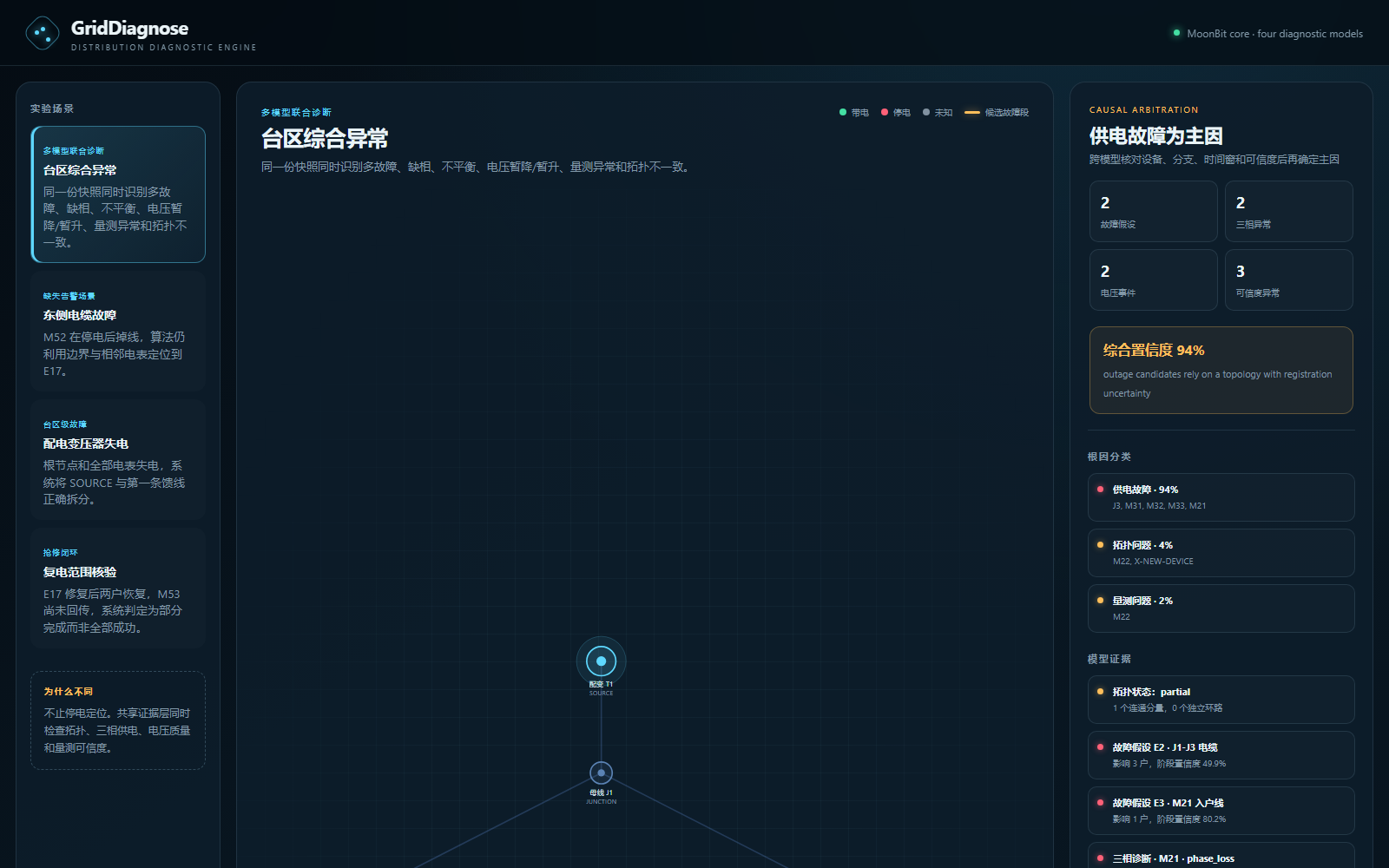
#Why GridDiagnose
Distribution operators do not receive one clean signal when equipment fails.
They receive a mixture of last-gasp messages, stale samples, phase voltages,
power-quality traces, and inaccurate topology records. Treating each alert as
an independent dashboard event creates noise; treating every incident as a
single outage model misses phase, quality, and measurement problems.
GridDiagnose provides a common diagnostic contract:
- Normalize observations, timestamps, and confidence.
- Represent devices and physical sections as a graph.
- Evaluate different scenario models against that graph.
- Return typed findings, severity, confidence, affected objects, and evidence.
The result is useful for utility dispatch, campus and park power systems,
industrial auxiliary supplies, building electrical operations, microgrids, and
commissioning teams. It is not limited to one fixed fault workflow.
#Diagnostic models
#Outage and fault-section diagnosis
The legacy GridLatch model compares proposed open edges with observed meter
states. It handles missing communication evidence, confidence decay, source
outage candidates, and restoration checks.
Version 0.2.0 added greedy multi-fault decomposition: each accepted hypothesis
must explain at least one currently unexplained outage, then its affected
subtree is masked before the next hypothesis is evaluated.
#Phase diagnosis
phase_readings provide A/B/C voltages at one or more nodes. The engine detects:
- loss of one or two phase voltages;
- voltage unbalance above warning and critical thresholds;
- sustained undervoltage;
- sustained overvoltage.
#Power-quality diagnosis
voltage_series provide timestamped voltages. The engine uses interval-aware
grouping to identify voltage-sag and voltage-swell events, duration, extreme
voltage, and relative deviation from nominal.
#Telemetry integrity diagnosis
telemetry_series and topology_links expose operational data problems that a
pure fault locator cannot explain:
- stale latest samples;
- frozen values over a configurable window;
- duplicate or decreasing timestamps;
- missing series;
- declared parent differing from an observed parent.
#Topology coverage
assess_topology classifies:
- radial: one connected component and no cycle;
- weakly meshed: one connected component with independent cycles;
- partial: unregistered relationships or isolated meter nodes;
- disconnected: multiple connected components;
- empty: no nodes.
Outage fault localization still requires a rooted tree. If the topology is not
radial, the combined report keeps the topology and other diagnostic findings and
records that outage localization was skipped rather than silently making an
unsafe approximation.
#Quick start
Install MoonBit, then run:
moon update
moon check --target wasm-gc --deny-warn
moon test --target wasm-gc --deny-warn
moon test --target js --deny-warn

# Portable JavaScript backend:
moon run cmd/griddiagnose --target js -- diagnose examples/griddiagnose_multimodel.json

# Machine-readable report:
moon run cmd/griddiagnose --target js -- diagnose examples/griddiagnose_multimodel.json --json

# Legacy outage commands remain available:
moon run cmd/griddiagnose --target js -- analyze examples/branch_fault.json
moon run cmd/griddiagnose --target js -- verify examples/restore_case.json
A Native build can be used when a C/MSVC toolchain is available:
moon run cmd/griddiagnose --target native -- diagnose examples/griddiagnose_multimodel.json#Combined input
The unified input is defined by
schema/griddiagnose-input.schema.json.
Only analysis_time is mandatory; each diagnostic section may be supplied
independently.
{
  "analysis_time": 500,
  "network": {
    "root": "T1",
    "nodes": [
      {"id": "T1", "kind": "source"},
      {"id": "J1", "kind": "junction"},
      {"id": "M1", "kind": "meter"}
    ],
    "edges": [
      {"id": "E0", "from": "T1", "to": "J1", "section": "feeder"},
      {"id": "E1", "from": "J1", "to": "M1", "section": "service M1"}
    ]
  },
  "unknown_topology_edge_ids": ["X-NEW"],
  "observations": [
    {"node_id": "M1", "state": "outage", "confidence": 0.97}
  ],
  "phase_readings": [
    {
      "node_id": "M1",
      "timestamp": 499,
      "a_voltage": 230,
      "b_voltage": 230,
      "c_voltage": 0
    }
  ],
  "voltage_series": [
    {
      "node_id": "M1",
      "nominal_voltage": 230,
      "samples": [
        {"timestamp": 490.00, "voltage": 230},
        {"timestamp": 490.01, "voltage": 178},
        {"timestamp": 490.02, "voltage": 230}
      ]
    }
  ]
}
The older outage-only contract remains available at
schema/gridlatch-input.schema.json.
#Cross-model causal arbitration
The diagnose command does not stop at concatenating independent reports. It
cross-checks object IDs across models and classifies the incident into:
- supply_fault;
- measurement_issue;
- topology_issue;
- model_inapplicable;
- mixed;
- undetermined;
- no_incident.
The arbitration uses relationships that single-threshold checks cannot express:
- supply findings supported by outage, phase, or voltage evidence are grouped into one electrical-supply hypothesis;
- a supply finding co-located with a frozen, stale, or clock-invalid series is downgraded to a measurement hypothesis when no independent outage confirms it;
- declared-vs-observed parent mismatch and unregistered topology objects create a topology hypothesis;
- a structurally unsupported model, such as a weakly meshed graph passed to the radial outage locator, creates model_inapplicable rather than incorrectly claiming a topology-registration error;
- outage results produced on a partial topology retain an explicit topology caveat;
- when distinct physical, measurement, and registration problems coexist, the primary class is mixed and each cause remains separately actionable.
- when real phase loss and a stuck zero reading are observationally equivalent, the engine emits undetermined and names the missing discriminator.
The report includes cause confidence, subject IDs, supporting models, evidence,
conflicts, and a recommended action. This is the project's core independent
contribution: it turns multiple detectors into an explainable root-cause
decision.
Scores are sums of signed feature contributions normalized with a stable
softmax. The JSON report includes the complete feature-weight trace and the
margin between the top two causes, allowing the decision to be audited rather
than trusted as an opaque label.
#Combined report
The diagnose command returns separate sections rather than combining
unrelated failure models into one opaque score:
GridDiagnose combined diagnostic report
Analysis time: 500 s
Critical findings: 6
Warnings: 3

Primary diagnosis: supply_fault (89.8%)
Decision margin: 81.5%
  [supply_fault] 89.8% -> J3, M31, M32, M33, M21
  [topology_issue] 8.3% -> M22, network, X-NEW-DEVICE
  [measurement_issue] 1.9% -> M22
  conflict: outage candidates rely on a topology with registration uncertainty

Topology: partial
  nodes=9 edges=8 components=1 cycles=0

Outage hypotheses: 2
  1. E2 [J1-J3 cable] stage confidence 49.85%
     affected: M31, M32, M33
  2. E3 [M21 service] stage confidence 80.16%
     affected: M21

Phase findings: 2
  [critical] M21 phase_loss
  [critical] M31 voltage_unbalance

Power-quality events: 2
  [critical] M33 voltage_sag
  [warning] M33 voltage_swell

Telemetry findings: 3
  [warning] M22 clock_anomaly
  [warning] M22 constant_series
  [critical] M22 topology_mismatch
A committed machine-readable result is available in
examples/griddiagnose_multimodel_output.json.
The key confusion case is covered by three contrast inputs:
- real phase loss with two sensors and zero phase current;
- stuck-sensor reading with live phase current and frozen telemetry;
- one zero-voltage report with no independent current or second sensor.
They produce supply_fault, measurement_issue, and undetermined
respectively. See
docs/CONTRAST_CASES.md.
Two further contrast groups cover sustained undervoltage and topology:
- corroborated sustained undervoltage -> supply_fault;
- flat undervoltage plus an independent normal reference -> measurement_issue;
- single flat undervoltage with no independent evidence -> undetermined;
- radial network with a wrong parent relation -> topology_issue;
- weakly meshed network with no registration mismatch -> model_inapplicable.
#Evaluation
The legacy outage benchmark contains 36 reproducible scenarios:
| Metric | Result |
|---|---|
| Overall Top-1 accuracy | 91.7% |
| Top-3 recall | 94.4% |
| Mean affected-meter Jaccard | 92.6% |
| Clean-scenario Top-1 | 100% |
| Mixed-scenario Top-1 | 91.7% |
| Severe-scenario Top-1 | 83.3% |
The multi-model benchmark contains 72 deterministic cases, 12 per model:
| Model | Passed | Accuracy |
|---|---|---|
| Multi-fault outage | 12/12 | 100% |
| Phase diagnosis | 12/12 | 100% |
| Power quality | 12/12 | 100% |
| Telemetry integrity | 12/12 | 100% |
| Causal arbitration | 12/12 | 100% |
| Contrast cases | 12/12 | 100% |
These are synthetic benchmark suites with controlled ground truth. They
demonstrate behavior and regression safety, not field accuracy on a specific
utility network.
Reproduce both:
moon build cmd/griddiagnose --target js --release

python scripts/evaluate.py \
  --bin _build/js/release/build/cmd/griddiagnose/griddiagnose.js \
  --cases 36

python scripts/evaluate_multimodel.py \
  --bin _build/js/release/build/cmd/griddiagnose/griddiagnose.js \
--cases-per-model 12#Interactive demo
moon build cmd/griddiagnose --target js --release
python scripts/build_demo_data.py
Open demo/index.html. The first scenario is a combined
diagnosis containing two independent fault sections, a missing phase, three-
phase unbalance, voltage sag and swell, a frozen/stale telemetry series, a clock
anomaly, partially unknown topology, and a confirmed topology mismatch.
#Relationship to existing MoonBit projects
- MoonElec computes electrical formulas.
- moon-power-flow and GridFlow solve steady-state power flow.
- MoonSignalKit provides general streaming statistics and CUSUM utilities.
- moon-stream-quality provides generic stream-quality rules.
- GridDiagnose applies physical distribution-network context to combine topology, outage, phase, power-quality, and telemetry evidence.
The project does not duplicate a power-flow solver, a generic statistics
library, or a generic data-quality rule engine.
#Scope and safety
GridDiagnose is decision support, not a protection relay or SCADA controller.
The current release does not perform full unbalanced power flow, protection
coordination, switching commands, or automatic dispatch.
- Outage localization supports a rooted radial topology.
- Weakly meshed and partial networks are classified, but unknown physical relationships are not guessed.
- Multi-fault decomposition is greedy and should be treated as ranked guidance.
- Phase and power-quality thresholds are configurable defaults, not universal standards.
- Operator review is required before field work or switching.
See docs/DESIGN.md,
docs/ALGORITHM.md,
docs/DEPLOYMENT.md, and
docs/EVALUATION.md for the detailed contracts.
#Repository map
- inference.mbt, multi_fault.mbt: outage and multi-fault diagnosis.
- topology.mbt, topology_assessment.mbt: radial localization and general topology classification.
- phase.mbt: phase-loss and three-phase supply diagnosis.
- power_quality.mbt: sag and swell event detection.
- telemetry.mbt: telemetry integrity and topology consistency.
- diagnostic.mbt, diagnostic_io.mbt: unified report and JSON contract.
- cmd/griddiagnose: CLI.
- examples/: hand-checkable legacy and combined scenarios.
- demo/: interactive multi-model dashboard.
- scripts/: generators, benchmarks, release checks, and demo builder.
#License
Apache-2.0. See LICENSE.
AnalysisError
pub suberror AnalysisError {
  Parse(String)
  InvalidInput(String)
  Topology(String)
}Candidate
CausalArbitration
pub struct CausalArbitration {
  primary_class : String
  overall_confidence : Double
  decision_margin : Double
  causes : Array[CauseHypothesis]
  contributions : Array[EvidenceContribution]
  conflicts : Array[String]
  independent_evidence_sources : Array[String]
  undetermined_reasons : Array[String]
}CauseHypothesis
DiagnosticInput
pub struct DiagnosticInput {
  analysis_time : Double
  network : Network?
  outage_observations : Array[Observation]
  phase_readings : Array[PhaseReading]
  voltage_series : Array[VoltageSeries]
  telemetry_series : Array[TelemetrySeries]
  topology_links : Array[TopologyLinkObservation]
  unknown_topology_edge_ids : Array[String]
}DiagnosticReport
pub struct DiagnosticReport {
  version : String
  analysis_time : Double
  topology : TopologyAssessment?
  outage : MultiFaultReport?
  phase : PhaseReport
  power_quality : PowerQualityReport
  telemetry : TelemetryReport
  arbitration : CausalArbitration
  warnings : Array[String]
  critical_count : Int
  warning_count : Int
}Edge
pub struct Edge {
  id : String
  from_id : String
  to_id : String
  section : String
}EvidenceContribution
pub struct EvidenceContribution {
  cause_class : String
  feature : String
  weight : Double
  detail : String
}FaultHypothesis
InferencePolicy
pub struct InferencePolicy {
  half_life_sec : Double
  structural_prior : Double
  outage_penalty : Double
  powered_penalty : Double
}InferencePolicy::balanced
InferenceResult
InputDocument
pub struct InputDocument {
  network : Network
  observations : Array[Observation]
  analysis_time : Double
  confirmed_fault_edge_id : String?
}MultiFaultReport
pub struct MultiFaultReport {
  faults : Array[FaultHypothesis]
  residual_outage_meter_ids : Array[String]
  iterations : Int
  warnings : Array[String]
}Network
Node
NodeKind
pub(all) enum NodeKind {
  Source
  Junction
  Meter
}Observation
pub struct Observation {
  node_id : String
  state : PowerState
  confidence : Double
  observed_at : Double
}Observation::new
fn Observation::new(node_id : String, state : PowerState, confidence : Double, observed_at : Double) -> ObservationPhaseFinding
pub struct PhaseFinding {
  node_id : String
  kind : String
  severity : String
  metric : Double
  affected_phases : Array[String]
  summary : String
}PhaseReading
pub struct PhaseReading {
  node_id : String
  timestamp : Double
  a_voltage : Double
  b_voltage : Double
  c_voltage : Double
  a_current : Double
  b_current : Double
  c_current : Double
}PhaseReading::new
fn PhaseReading::new(node_id : String, timestamp : Double, a_voltage : Double, b_voltage : Double, c_voltage : Double, a_current? : Double, b_current? : Double, c_current? : Double) -> PhaseReadingPowerQualityEvent
pub struct PowerQualityEvent {
  node_id : String
  source_id : String
  phase : String
  kind : String
  severity : String
  start_time : Double
  end_time : Double
  duration_sec : Double
  extreme_voltage : Double
  deviation_percent : Double
  minimum_voltage : Double
  maximum_voltage : Double
  variation_percent : Double
}PowerQualityReport
PowerState
pub(all) enum PowerState {
  Energized
  Outage
  Unknown
}RestoreReport
RestoreState
pub(all) enum RestoreState {
  Complete
  Partial
  UnexpectedOutage
  Indeterminate
}TelemetryFinding
pub struct TelemetryFinding {
  node_id : String
  kind : String
  severity : String
  summary : String
  metric : Double
}TelemetryPoint
pub struct TelemetryPoint {
  timestamp : Double
  value : Double
}TelemetryPoint::new
TelemetryReport
TelemetrySeries
TelemetrySeries::new
TopologyAssessment
General topology classification used by the broader diagnostic pipeline.
TopologyError
pub enum TopologyError {
  EmptyNetwork
  RootNotFound(String)
  DuplicateNodeId(String)
  DuplicateEdgeId(String)
  UnknownEndpoint(String)
  NotRadial
  Disconnected(String)
}TopologyLinkObservation
pub struct TopologyLinkObservation {
  node_id : String
  declared_parent_id : String
  observed_parent_id : String
}TopologyLinkObservation::new
fn TopologyLinkObservation::new(node_id : String, declared_parent_id : String, observed_parent_id : String) -> TopologyLinkObservationTree
VoltagePoint
pub struct VoltagePoint {
  timestamp : Double
  voltage : Double
}VoltageSeries
pub struct VoltageSeries {
  node_id : String
  source_id : String
  phase : String
  nominal_voltage : Double
  samples : Array[VoltagePoint]
}VoltageSeries::new
fn VoltageSeries::new(node_id : String, nominal_voltage : Double, samples : Array[VoltagePoint], source_id? : String, phase? : String) -> VoltageSeriesarbitrate_causes
fn arbitrate_causes(topology : TopologyAssessment?, outage : MultiFaultReport?, phase : PhaseReport, power_quality : PowerQualityReport, telemetry : TelemetryReport, phase_readings : Array[PhaseReading], voltage_series? : Array[VoltageSeries]) -> CausalArbitrationReconcile diagnostic findings by scoring three competing physical
hypotheses. Evidence compatibility and object overlap determine the score;
no single detector can assign the final primary cause by itself.
assess_topology
Assess connectedness and cycle rank without requiring a radial tree.
build_tree
Validate a radial network and orient it away from its source root.
diagnose_phase
Diagnose phase loss, unbalance, sustained undervoltage, and overvoltage.
diagnose_power_quality
fn diagnose_power_quality(series : Array[VoltageSeries], minimum_duration_sec? : Double) -> PowerQualityReportDetect persistent voltage-sag and voltage-swell intervals.
diagnose_telemetry
fn diagnose_telemetry(series : Array[TelemetrySeries], links : Array[TopologyLinkObservation], analysis_time : Double, stale_after_sec? : Double, stuck_window_sec? : Double, constant_tolerance? : Double) -> TelemetryReportDiagnose stale series, delayed timestamps, duplicate samples, frozen values,
and declared-vs-observed topology mismatches.
downstream_mask
Mark the supplied node and every node below it in the rooted tree.
downstream_meter_ids
fault_node_for_edge
infer_faults
fn infer_faults(network : Network, observations : Array[Observation], analysis_time : Double, policy? : InferencePolicy) -> InferenceResult raise AnalysisErrorRank fault candidates from noisy outage evidence using topology-aware
likelihood scoring. The function is deterministic and does not mutate its
inputs.
infer_multiple_faults
fn infer_multiple_faults(network : Network, observations : Array[Observation], analysis_time : Double, max_faults? : Int, minimum_confidence? : Double) -> MultiFaultReport raise AnalysisErrorGreedy multi-fault decomposition. Each accepted hypothesis must explain at
least one currently unexplained outage and exceed the confidence threshold.
Explained observations are masked as unknown before the next iteration.
parse_diagnostic_input
parse_input
Parse the public JSON input contract used by the CLI and demo.
run_diagnostic
Run every supplied diagnostic model through one report.
verify_restoration
fn verify_restoration(network : Network, fault_edge_id : String, observations : Array[Observation], analysis_time : Double) -> RestoreReport raise AnalysisErrorInstall
Download zipMulti-model low-voltage distribution diagnostic engine in MoonBit
power-systemsoutage-localizationdistribution-gridpower-qualityphase-lossfault-diagnosisedge-computingwasm

 Apache-2.0

 Updated 2 hours ago
 2 downloads