 README
- TAnalysis
- TCallEdge
- TCallGraph
- TCallKind
- TCallSite
- TEdgeKind
- TElementSegment
- TExport
- TFunctionBody
- TFunctionStat
- TIndirectSite
- TInstruction
- ::nameOpcode::name
- ::operandsOpcode::operands
- TOperands
- TOptions
- ::at_endReader::at_end
- ::newReader::new
- ::positionReader::position
- ::read_bitsReader::read_bits
- ::read_byteReader::read_byte
- ::read_bytesReader::read_bytes
- ::read_reftypeReader::read_reftype
- ::read_signed_lebReader::read_signed_leb
- ::read_u32_lebReader::read_u32_leb
- ::read_valtypeReader::read_valtype
- ::remainingReader::remaining
- ::seekReader::seek
- TRetainedSize
- TSection
- ::from_idSectionId::from_id
- ::is_customSectionId::is_custom
- ::nameSectionId::name
- TSections
- TTableType
- TWasmError
- TWasmModule
- VDEFAULT_TOP
- Vanalyze
- Vbuild
- Vcollect_function_stats
- Vcount_imported_functions
- Vdecode_instruction
- Vdecode_instructions
- Vdescribe_error
- Vdisplay_name
- Vfind_sections
- Vformat_report
- Vfunction_stats
- Vindirect_targets
- Vmodule_of
- Vparse_code_section
- Vparse_count
- Vparse_element_section
- Vparse_export_section
- Vparse_module
- Vparse_name_section
- Vparse_options
- Vparse_start_section
- Vparse_table_section
- Vreachable_from_roots
- Vrender_dead_code
- Vrender_dot
- Vrender_graph
- Vrender_html
- Vrender_json
- Vrender_module_summary
- Vrender_retained
- Vrender_top_functions
- Vretained_sizes
- Vroots_of
- Vsame_kind
- Vscan_calls
- Vusage
moonsize
A Wasm size profiler for MoonBit — section breakdown, function ranking, call graph and retained-size analysis
wasm
webassembly
size
profiling
cli
Author
Version
0.1.0
License
MIT
Repository
Last updated
8 days ago
Downloads
12
Dependencies
- moonbitlang/x0.5.5
#moonsize
A size analyzer for WebAssembly, built for MoonBit's output. It reads a .wasm
file, measures every section, attributes the code section to named functions,
follows the call graph, and reports what could be deleted.
The analysis model follows Twiggy: sizes
are attributed to individual functions, functions are grouped by package, and
reachability from the module's roots decides what is really used.
Chinese version: README.zh.md.
#Building
moon build --release
./_build/native/release/build/cmd/main/main.exe app.wasm#Usage
moonsize <file.wasm> [--top <n>] [--retained] [--dead-code]
                     [--call-graph <path>] [--html <path>]

  --top <n>            how many functions to rank (default 10)
  --retained           what deleting each function would free
  --dead-code          functions no root can reach
  --call-graph <path>  write the call graph as .dot or .json
  --html <path>        write the charts as a self-contained HTML report
Without flags it prints the section table, the heaviest functions and the
per-package roll-up. --retained and --dead-code add their sections and can
be combined. --call-graph and --html each write a file instead of printing
a report, so they are used on their own:
moonsize app.wasm --retained --dead-code        # the full text report
moonsize app.wasm --html report.html            # charts, opens in a browser
moonsize app.wasm --call-graph graph.dot # for Graphviz#Analysis
Everything below is built on one idea: a function's bytes only matter if
something can call it.
#The call graph
The decoder walks every function body instruction by instruction — the full MVP
instruction set, the 0xFC saturating and bulk-memory opcodes, the exception
handling and tail-call opcodes MoonBit emits, and the 0xFB garbage-collection
opcodes its wasm-gc backend uses. Each body contributes:
- call x — a precise edge to x;
- ref.func x — a reference, which counts as reachable because the function may run later as a closure;
- call_indirect — a conservative edge to every function any element segment places in that table. The table's contents are not known statically, so the candidates are all of them; a missing edge would mean a missing function and a function wrongly reported dead, which is the one mistake worth avoiding here.
A function is a root if the outside world can reach it: it is exported, it is
the start function, or it sits in a table. Everything reachable from those roots
is live; everything else is dead.
#Retained size
SIZE is a function on its own. RETAINED is what deleting it would actually
free: its own bytes plus every function that becomes unreachable with it, with
DIES counting how many that is.
That set is exactly the functions the deleted one dominates — those every path
from a root has to pass through. Taking the module's graph, adding a virtual root
above the real ones, and computing the dominator tree gives every function's
retained size in one pass. Cycles fall out of the fixpoint rather than needing a
special case, and the answer is exact rather than an approximation from local
predecessor counts: if two branches both call a function, deleting one branch
does not free it, but deleting the point where both branches meet does.
Reading the table:
- RETAINED == SIZE — the function is load-bearing only for itself. Deleting it saves its own bytes and nothing more.
- RETAINED ≫ SIZE with a high DIES — a good candidate. Removing it takes a whole subtree with it.
- IND — the function can be reached through a call_indirect, so removing it is only safe if no table entry and no indirect call expects it.
Both numbers are printed on purpose. SIZE says how much the compiler could win
by making the function smaller; RETAINED says how much it wins by removing it,
which is usually the cheaper change.
#Dead code
Anything unreachable from the roots cannot run: no export reaches it, no start
function, no table entry, and no chain of calls from any of those. Its bytes are
already paid for and never used, so the list is a deletion list.
MoonBit's compiler does dead-code elimination well, so a small program usually
reports none — that is a finding too.
#Judging what can be deleted
- Start with --dead-code. Every row there is free to remove; check that nothing outside the module calls it by name (an exported name would have made it a root, so this is already accounted for).
- Then look at --retained for large RETAINED values with DIES above zero. Those are the functions whose removal cascades.
- Treat IND rows with care: an indirect candidate can only be removed when the table entry and the call sites go with it.
#HTML report
--html <path> writes the same analysis as one self-contained page: no server,
no build step, no network. Open the file and the four charts are there.
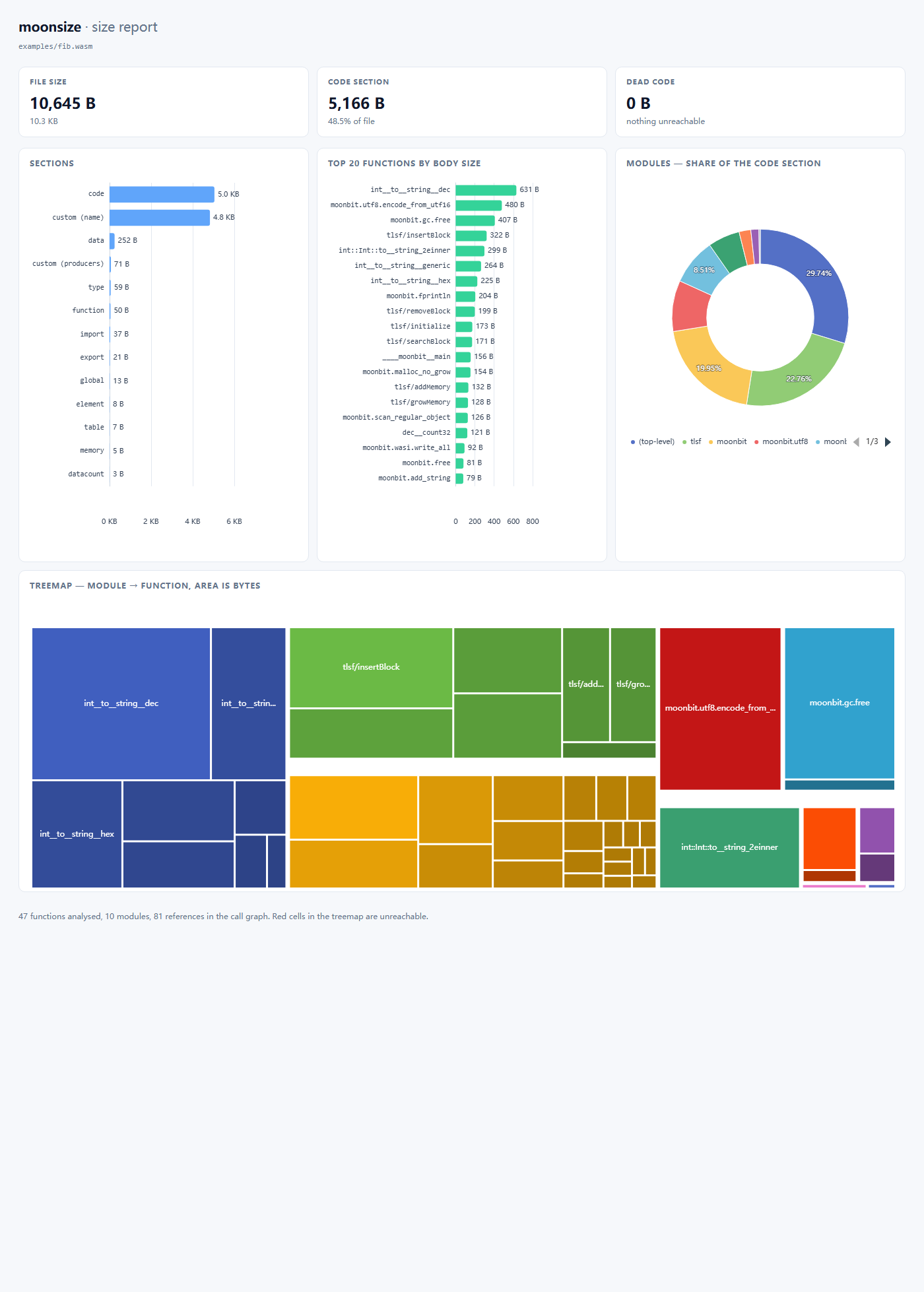
A worked example is checked in at examples/report.html,
generated from examples/fib.wasm — a 10,645-byte MoonBit
program. It is one file: the chart library is inlined, so it can be moved,
emailed or opened from anywhere.
Three headline numbers. File size, the code section, and how much of the file
is unreachable. The third card turns red when there is anything to delete, which
is the one number most people open the report for.
Sections — a horizontal bar per section, widest first, with the share of the
file in the tooltip. This is the stage-one section table, drawn. Both bar charts
are sized to their row count, so every row keeps its label; a fixed-height box
makes ECharts drop most of them, and the rows that survive look like headings for
the unlabelled ones below.
Top 20 functions by body size — what the compiler could shrink. Body size is
used rather than the encoded size so that the ranking answers "where is the
code", not "where are the size prefixes".
Modules — a donut of how the code section divides between packages, as a
share of the code section rather than of the file, so the slices mean "which
package is responsible for the code". Slices below half a percent are rolled
into a single other slice, named on hover: a slice that thin cannot carry a
label, and leaving it in draws a sliver nobody can read or aim at. Labels sit
inside the ring, so they never collide with the legend.
Treemap — module → function, where area is bytes. This is the one chart that
shows the whole binary at once: the big cells are the functions worth looking at,
and cells are drawn red when the function is unreachable.
Hovering any bar, slice or cell shows the exact bytes and percentage. Every
number in the page comes from the same Analysis the text report uses, so the
two cannot disagree.
The library is vendored in assets/echarts.min.js and inlined
into the page. When that file is not next to the working directory — running a
installed binary from elsewhere, say — the page falls back to a CDN <scriptsrc> tag instead and the command says so; that report needs a network
connection to draw.
#Example output
A 10,645-byte MoonBit program (--target wasm, debug), reduced to the analysis
sections:
Retained size

    #  INDEX  SIZE  RETAINED  DIES    SHARE  IND  FUNCTION
    1     47   158      5162    46    48.4%       ____moonbit__main
    2     39   301      1773    10    16.6%       int::Int::to__string_2einner
    3     37    24       887     8     8.3%       println
    4     34     9       819     5     7.6%       moonbit.println
    5     33   206       810     4     7.6%       moonbit.fprintln
    6     28    49       717     7     6.7%       moonbit.decref
    7     29   409       668     6     6.2%       moonbit.gc.free
    8     43   633       633     0     5.9%       int__to__string__dec

  DIES counts the other functions that become unreachable with this one.
  IND marks a function a call_indirect could reach.

Dead code

  0 of 47 functions are unreachable from the roots
  0 bytes (0.0% of file)

  every function is reachable
____moonbit__main retains 5,162 bytes — 48.4% of the file, 46 functions — which
is what a program with a single entry point looks like: everything hangs off it.
int__to__string__dec is the largest single function at 633 bytes but retains
only itself, so shrinking it is a compiler problem rather than a deletion.
--call-graph graph.dot writes the same graph for Graphviz, with dead functions
dashed and indirect edges dotted; --call-graph graph.json writes it with the
roots, every edge and every indirect site's candidate set.
#Development
moon check --target native --deny-warn
moon test
The test suite covers the instruction table one opcode at a time — every entry
carries a canonical encoding and the length the specification gives it — and pins
three real MoonBit function bodies, including one whose locals use two-byte
garbage-collection reference types, so a wrong immediate width fails a test
instead of quietly producing a wrong call graph.
Analysis
pub struct Analysis {
parsed : WasmModule
stats : Array[FunctionStat]
graph : CallGraph
roots : Set[Int]
reachable : Set[Int]
retained : Array[RetainedSize]
indirect : Set[Int]
}A parsed module with its sizes, call graph and reachability resolved.
CallEdge
One edge of the call graph.
CallGraph
The reference graph between functions.
CallSite
One call found in a function body.
ElementSegment
One entry of the element section.
Export
pub struct Export {
  name : String
  kind : Int
  index : Int
}
One entry of the export section.
FunctionBody
pub struct FunctionBody {
  index : Int
  body_size : Int
  total_size : Int
  offset : Int
}
One function body decoded out of the code section.
The spec stores a body as a size-prefixed blob, so an entry costs its own
length prefix on top of the body itself. Both numbers are kept: the body is
what a compiler can shrink, the total is what the file actually spends.
FunctionStat
pub struct FunctionStat {
  index : Int
  name : String
  module_name : String
  body_size : Int
  total_size : Int
}
One function's byte budget, with the name and package the binary gives it.
IndirectSite
pub struct IndirectSite {
  caller : Int
  table_index : Int
  type_index : Int
  offset : Int
  candidates : Array[Int]
}
A call_indirect, with the targets its table could supply.
Instruction
A decoded instruction: what it is, where it starts and what it carries.
Opcode
pub enum Opcode {
  Unreachable
  Nop
  Block
  Loop
  If
  Else
  Try
  Catch
  Throw
  Rethrow
  ThrowRef
  End
  Br
  BrIf
  BrTable
  Return
  Call
  CallIndirect
  ReturnCall
  ReturnCallIndirect
  CallRef
  ReturnCallRef
  Drop
  Select
  Delegate
  CatchAll
  SelectT
  LocalGet
  LocalSet
  LocalTee
  GlobalGet
  GlobalSet
  TableGet
  TableSet
  I32Load
  I64Load
  F32Load
  F64Load
  I32Load8S
  I32Load8U
  I32Load16S
  I32Load16U
  I64Load8S
  I64Load8U
  I64Load16S
  I64Load16U
  I64Load32S
  I64Load32U
  I32Store
  I64Store
  F32Store
  F64Store
  I32Store8
  I32Store16
  I64Store8
  I64Store16
  I64Store32
  MemorySize
  MemoryGrow
  I32Const
  I64Const
  F32Const
  F64Const
  I32Eqz
  I32Eq
  I32Ne
  I32LtS
  I32LtU
  I32GtS
  I32GtU
  I32LeS
  I32LeU
  I32GeS
  I32GeU
  I64Eqz
  I64Eq
  I64Ne
  I64LtS
  I64LtU
  I64GtS
  I64GtU
  I64LeS
  I64LeU
  I64GeS
  I64GeU
  F32Eq
  F32Ne
  F32Lt
  F32Gt
  F32Le
  F32Ge
  F64Eq
  F64Ne
  F64Lt
  F64Gt
  F64Le
  F64Ge
  I32Clz
  I32Ctz
  I32Popcnt
  I32Add
  I32Sub
  I32Mul
  I32DivS
  I32DivU
  I32RemS
  I32RemU
  I32And
  I32Or
  I32Xor
  I32Shl
  I32ShrS
  I32ShrU
  I32Rotl
  I32Rotr
  I64Clz
  I64Ctz
  I64Popcnt
  I64Add
  I64Sub
  I64Mul
  I64DivS
  I64DivU
  I64RemS
  I64RemU
  I64And
  I64Or
  I64Xor
  I64Shl
  I64ShrS
  I64ShrU
  I64Rotl
  I64Rotr
  F32Abs
  F32Neg
  F32Ceil
  F32Floor
  F32Trunc
  F32Nearest
  F32Sqrt
  F32Add
  F32Sub
  F32Mul
  F32Div
  F32Min
  F32Max
  F32Copysign
  F64Abs
  F64Neg
  F64Ceil
  F64Floor
  F64Trunc
  F64Nearest
  F64Sqrt
  F64Add
  F64Sub
  F64Mul
  F64Div
  F64Min
  F64Max
  F64Copysign
  I32WrapI64
  I32TruncF32S
  I32TruncF32U
  I32TruncF64S
  I32TruncF64U
  I64ExtendI32S
  I64ExtendI32U
  I64TruncF32S
  I64TruncF32U
  I64TruncF64S
  I64TruncF64U
  F32ConvertI32S
  F32ConvertI32U
  F32ConvertI64S
  F32ConvertI64U
  F32DemoteF64
  F64ConvertI32S
  F64ConvertI32U
  F64ConvertI64S
  F64ConvertI64U
  F64PromoteF32
  I32ReinterpretF32
  I64ReinterpretF64
  F32ReinterpretI32
  F64ReinterpretI64
  I32Extend8S
  I32Extend16S
  I64Extend8S
  I64Extend16S
  I64Extend32S
  RefNull
  RefIsNull
  RefFunc
  RefEq
  RefAsNonNull
  BrOnNull
  BrOnNonNull
  I32TruncSatF32S
  I32TruncSatF32U
  I32TruncSatF64S
  I32TruncSatF64U
  I64TruncSatF32S
  I64TruncSatF32U
  I64TruncSatF64S
  I64TruncSatF64U
  MemoryInit
  DataDrop
  MemoryCopy
  MemoryFill
  TableInit
  ElemDrop
  TableCopy
  TableGrow
  TableSize
  TableFill
  StructNew
  StructNewDefault
  StructGet
  StructGetS
  StructGetU
  StructSet
  ArrayNew
  ArrayNewDefault
  ArrayNewFixed
  ArrayNewData
  ArrayNewElem
  ArrayGet
  ArrayGetS
  ArrayGetU
  ArraySet
  ArrayLen
  ArrayFill
  ArrayCopy
  ArrayInitData
  ArrayInitElem
  RefTest
  RefTestNull
  RefCast
  RefCastNull
  BrOnCast
  BrOnCastFail
  AnyConvertExtern
  ExternConvertAny
  RefI31
  I31GetS
  I31GetU
}
Every instruction the decoder recognises, one variant per mnemonic.
The set covers the MVP, the sign-extension, saturating-truncation, bulk-memory
and reference-type extensions MoonBit's linear-memory backend emits, and the
garbage-collection instructions its wasm-gc backend emits.
Opcode::name
The spec mnemonic for an opcode, spelled as the text format writes it.
Operands
pub enum Operands {
  None_
  BlockType
  Label
  LabelTable
  FunctionIndex
  CallIndirect
  LocalIndex
  GlobalIndex
  TableIndex
  TagIndex
  MemoryIndex
  MemoryArg
  I32Const
  I64Const
  F32Const
  F64Const
  HeapType
  RefType
  TypeIndex
  TypeFieldPair
  TypePair
  TypeCountPair
  TypeDataPair
  TypeElemPair
  DataIndex
  ElemIndex
  DataMemoryPair
  MemoryPair
  ElemTablePair
  TablePair
  CastPair
  TypeVector
}
How the bytes after an opcode are laid out.
The shapes named <a><b>Pair read a then b, in encoding order. Naming
them here rather than inlining the reads keeps every immediate width in one
table that can be reviewed — and tested — against the specification.
Options
pub struct Options {
  path : String
  top : Int
  retained : Bool
  dead_code : Bool
  call_graph : String?
  html : String?
}
What to analyze, how much of it to show, and which reports to produce.
Reader
pub struct Reader {
  data : Bytes
  pos : Int
}
A forward-only cursor over a byte buffer.
The shape follows jtenner/starshine's src/binary decoder, where a decode
step takes (bytes, offset) and reports how far it advanced, so callers can
walk a stream without hidden global state.
Reader::read_bits
Read a little-endian bit pattern of count bytes as a single integer.
Floating point constants have no structural meaning for a size analyzer, so
they are kept as the bits the file holds rather than converted and back.
Reader::read_byte
Read a single byte, or report the offset that ran out of input.
Reader::read_bytes
Read count raw bytes and advance past them.
A view is enough for every caller here: names are decoded straight from it
and section payloads are skipped by size rather than copied.
Reader::read_reftype
Consume a reference type.
A reference type is either a one-byte shorthand such as funcref (0x70),
or one of the two constructors 0x63/0x64 followed by a heap type. The
shorthand byte is returned, or 0 when the two-byte form was used.
Reader::read_signed_leb
Read a signed LEB128 integer of at most bits significant bits.
Block types, heap types and the i32.const/i64.const immediates are all
signed, and the sign lives in the last group's bit 6, so leaving it out would
turn a small negative constant into a large positive one. The bits bound is
what makes a non-terminating encoding malformed: a group may only continue
while fewer than bits bits have been consumed.
Reader::read_u32_leb
Read an unsigned LEB128 integer of at most 32 significant bits.
WebAssembly encodes section payload lengths, vector counts and custom
section name lengths this way. Five groups of seven bits cover u32, so a
sixth continuation bit means the value is malformed.
Reader::read_valtype
Consume a value type, whose width is not always one byte.
Numeric and vector types are a single byte, but a garbage-collection
reference type is the two-byte 0x63/0x64 form followed by a heap type.
Reading one byte per type desynchronises the stream on the first struct-typed
local, so every value type goes through here.
RetainedSize
pub struct RetainedSize {
  index : Int
  own_size : Int
  retained : Int
  retained_functions : Int
}
What deleting one function would free.
Section
pub struct Section {
  id : Int
  kind : SectionId
  offset : Int
  payload_size : Int
  total_size : Int
  custom_name : String?
}
One decoded section header, with the byte budget it accounts for.
SectionId
pub enum SectionId {
  Custom
  Type
  Import
  Function
  Table
  Memory
  Global
  Export
  Start
  Element
  Code
  Data
  DataCount
  Tag
}
The section identifiers defined by the WebAssembly core specification.
SectionId::from_id
Map a raw section id byte to its meaning, or None when unassigned.
SectionId::is_custom
Custom sections are the only ones that carry a name, and they are worth
telling apart from the numbered sections.
Sections
The sections the analysis passes need, picked out of the section table once.
A well-formed module holds at most one of each numbered section, so the last
one seen wins. Several custom sections are legal, and name is the only one
this tool reads.
TableType
pub struct TableType {
  element_type : Int
  minimum : Int
  maximum : Int?
}
A table declared by the table section.
WasmError
pub enum WasmError {
  UnexpectedEnd(Int, Int)
  BadMagic
  InvalidSectionId(Int)
  LebOverflow(Int)
  InvalidImportKind(Int)
  UnknownOpcode(Int, Int)
  UnknownPrefixedOpcode(Int, Int, Int)
}
Every failure mode the decoder can report, with the offset that explains it.
WasmModule
A decoded module preamble plus its section table.
analyze
Analyse a module: names and sizes, then the call graph and what it implies.
build
fn build(data : Bytes, bodies : Array[FunctionBody], elements : Array[ElementSegment]) -> Result[CallGraph, WasmError]Build the call graph of a module.
Every body is decoded once: call gives a precise edge, ref.func gives a
reference edge, and call_indirect gives one conservative edge per function
its table can hold plus a record of the site itself.
collect_function_stats
fn collect_function_stats(parsed : WasmModule, data : Bytes) -> Result[Array[FunctionStat], WasmError]Read a module's function names and sizes.
A convenience over analyze for callers that only want the size table; the
two share function_stats, so they cannot disagree about attribution.
count_imported_functions
Count the function imports of a module.
Imported functions occupy the first slots of the function index space, so
this count is what turns a code-section position into the index that the
name section and every call instruction actually use.
decode_instruction
Decode the instruction that starts at offset.
An unassigned opcode is an error rather than a skip: silently stepping over
one byte would turn a decoding bug into a wrong call graph, and every number
downstream of this function is a size.
decode_instructions
fn decode_instructions(bytes : Bytes, body_offset : Int, body_size : Int) -> Result[Array[Instruction], WasmError]Skip a function body's local declaration and decode the expression.
body_offset is the first byte after the body's size prefix, so the locals
vector comes first. The declared body_size is a hard bound: an instruction
that would run past it is reported rather than read out of the next body,
which is what keeps a wrong immediate width from quietly becoming a wrong
call graph.
describe_error
A one-line explanation for a failed parse.
display_name
fn display_name(name : String) -> StringThe name to print for a symbol: demangled when the binary mangles it,
otherwise left exactly as the producer wrote it.
find_sections
Pick the interesting sections out of a parsed section table.
format_report
The user-facing report: one line per section, each with its byte count.
The result carries no trailing newline, so the caller decides how to end it.
function_stats
Attribute a body to a name and a package.
Attribution is best effort by design: a release binary keeps no function
names, and the sizes are still worth reporting, so unnamed functions come
back labelled (unnamed) rather than failing the run.
indirect_targets
The functions any call_indirect could reach, for labelling report rows.
module_of
fn module_of(name : String) -> StringThe package a symbol belongs to.
Everything in the name except the final segment is the package, so
demo::sample::src::fib lands in demo::sample::src and tlsf/searchBlock
in tlsf. Names with no package at all are grouped under (top-level),
which keeps the roll-up honest instead of inventing one bucket per function.
parse_code_section
fn parse_code_section(data : Bytes, section : Section, base_index? : Int) -> Result[Array[FunctionBody], WasmError]Decode the code section into one record per function body.
base_index is the number of imported functions, so the returned index
values line up with the function index space. Bodies are measured and
skipped, never interpreted, which keeps this a structural pass like
parse_module.
parse_count
fn parse_count(text : String) -> Int?Parse a non-negative decimal integer, or None for anything else.
This toolchain's core library ships no string-to-Int parser, and the only
number the CLI accepts is --top, so the grammar stays deliberately narrow:
one or more ASCII digits, saturating into a rejection rather than an
overflow.
parse_element_section
fn parse_element_section(data : Bytes, section : Section) -> Result[Array[ElementSegment], WasmError]Decode the element section.
The eight encodings differ only in whether a table index, an offset
expression, an element kind or a reference type is present, so the shared
tail — a vector of function indices or of constant expressions — is read once
after the mode byte has been handled.
parse_export_section
Decode the export section.
parse_module
Decode the module preamble and walk every section header.
Payloads are measured but not interpreted, which keeps this step a pure
structural pass over the file.
parse_name_section
Decode the function names out of a name custom section.
The result is keyed by function index. None means the section is not a
name section at all; Some of an empty map is a real answer, because
names are optional producer metadata and a stripped binary simply has none.
Subsection ids other than 1 (locals, labels, types) are skipped whole,
and a malformed subsection ends the walk without discarding earlier names.
parse_options
Parse a full argv, including the program name in slot zero.
The grammar is moonsize <file.wasm> [--top <n>] [--retained] [--dead-code][--call-graph <path>] [--html <path>]: exactly one positional path, and a
repeat of a flag keeps the last value. Anything else is reported as an error
so a typo never silently analyses the wrong thing.
--call-graph and --html each write a file rather than a report, so
combining either with another output mode is rejected instead of quietly
ignoring one of them.
parse_start_section
The function the module runs at instantiation, from the start section.
parse_table_section
Decode the table section.
reachable_from_roots
Everything reachable from roots, the roots included.
An explicit stack rather than recursion: real modules nest thousands of calls
deep, and the depth of the graph should not be the depth of the C stack.
render_dead_code
fn render_dead_code(stats : Array[FunctionStat], reachable : Set[Int], file_size : Int, top : Int) -> StringThe dead-code section: functions no root can reach.
This is the report that pays for the analysis. Anything listed here cannot
run: no export, no start function, no table entry and no path of calls leads
to it, so its bytes are already paid for and never used.
render_dot
Render the call graph as Graphviz DOT.
Dead functions are drawn dashed, which is what makes the picture useful: the
solid part is the program, the dashed part is what could be deleted. Indirect
edges are dotted, because they are candidates rather than certainties.
render_graph
Render a graph export, choosing the format from the target file's extension.
The extension is the only signal available and the one a user already thinks
in: .json means JSON, anything else means DOT, which is what Graphviz
tooling expects from a file called graph.dot.
render_html
Render the whole analysis as one HTML document.
echarts is the chart library's source. Passing it inlines the library, so
the report opens from any directory with no network and no sibling file;
leaving it empty emits a CDN <script src> instead, which keeps the command
working for someone who has the binary but not the repository around it. The
library does no I/O, so reading assets/echarts.min.js is the caller's job.
render_json
fn render_json(path : String, stats : Array[FunctionStat], graph : CallGraph, roots : Set[Int], reachable : Set[Int], retained : Array[RetainedSize]) -> StringRender the call graph, the roots and the retained sizes as JSON.
render_module_summary
The per-package roll-up of every function in the binary.
render_retained
fn render_retained(stats : Array[FunctionStat], retained : Array[RetainedSize], indirect : Set[Int], file_size : Int, top : Int) -> StringThe retained-size table: what deleting each function would free.
SIZE is the function on its own and RETAINED is that plus every function
that becomes unreachable with it, with DIES counting how many others that
is. A row where the two sizes match is load-bearing only for itself; a row
where RETAINED dwarfs SIZE is a good place to look when shrinking a
binary, because removing it takes everything underneath with it.
render_top_functions
The Top-N function table, heaviest first.
Shares are of the whole file, so a row here can be read against the section
table above it. top is clamped to the number of functions available.
retained_sizes
fn retained_sizes(graph : CallGraph, sizes : Map[Int, Int], roots : Set[Int]) -> Array[RetainedSize]The retained size of every reachable function.
Deleting a function makes exactly the functions it dominates unreachable:
those every path from a root has to pass through. Computing that with an
explicit "remove it and see what dies" walk would be correct but quadratic,
and it would still need cycle handling; the dominator tree answers the same
question for every function at once, and cycles fall out of the fixpoint
without a special case.
roots_of
The roots of a module: what the outside world can reach without going through
code the module already has.
Exported functions are the module's public surface, the start function runs
at instantiation, and anything an element section puts in a table can be
called from outside or through call_indirect.
same_kind
True when two section ids are the same variant.
Section ids carry no payload and this toolchain derives no Eq for them, so
the comparison is written out once here rather than spelled at each call site
that has to pick a section out of the table.
scan_calls
Collect every call a function body makes.
Only call and call_indirect count here. ref.func is a reference rather
than a call, and the call graph picks those up separately.
usage
fn usage() -> StringPrinted when the tool is invoked without a file, or with arguments it cannot
make sense of.
Install
Download zipA Wasm size profiler for MoonBit — section breakdown, function ranking, call graph and retained-size analysis
wasmwebassemblysizeprofilingcli

 MIT

 Updated 8 days ago
 12 downloads
Dependencies
- moonbitlang/x0.5.5