 README
- ::equalTideError::equal
- ::not_equalTideError::not_equal
- ::equalCommand::equal
- ::not_equalCommand::not_equal
- ::to_jsonCommand::to_json
- ::equalConfig::equal
- ::not_equalConfig::not_equal
- ::to_jsonConfig::to_json
- ::equalDelta::equal
- ::not_equalDelta::not_equal
- ::to_jsonDelta::to_json
- ::applyEngine::apply
- ::checkpointEngine::checkpoint
- ::correctableEngine::correctable
- ::eventsEngine::events
- ::frozen_countEngine::frozen_count
- ::latenessEngine::lateness
- ::newEngine::new
- ::rowsEngine::rows
- ::runEngine::run
- ::versionEngine::version
- ::watermarkEngine::watermark
- ::within_latenessEngine::within_lateness
- ::equalEvent::equal
- ::fieldEvent::field
- ::measureEvent::measure
- ::not_equalEvent::not_equal
- ::to_jsonEvent::to_json
- TMeasure
- ::equalMeasureResult::equal
- ::not_equalMeasureResult::not_equal
- ::to_jsonMeasureResult::to_json
- ::equalMeasureWindow::equal
- ::not_equalMeasureWindow::not_equal
- ::to_jsonMeasureWindow::to_json
- ::equalMutation::equal
- ::not_equalMutation::not_equal
- ::to_jsonMutation::to_json
- ::equalOutcome::equal
- ::not_equalOutcome::not_equal
- ::to_jsonOutcome::to_json
- ::to_jsonReplay::to_json
- ::equalTrigger::equal
- ::not_equalTrigger::not_equal
- ::to_jsonTrigger::to_json
- ::applyView::apply
- ::newView::new
- ::rowsView::rows
- ::versionView::version
- ::max_timeWatermarkTracker::max_time
- ::newWatermarkTracker::new
- ::observeWatermarkTracker::observe
- ::valueWatermarkTracker::value
- ::equalWindow::equal
- ::not_equalWindow::not_equal
- ::to_jsonWindow::to_json
- ::equalWindowSpec::equal
- ::not_equalWindowSpec::not_equal
- ::to_jsonWindowSpec::to_json
- Vaggregate
- Vassign_fixed
- Vaverage_measure
- Vconfig
- Vcount_measure
- Vdecode_commands
- Vdecode_config
- Vmax_measure
- Vmeasure
- Vmeasure_window
- Vmin_measure
- Vreplay
- Vreplay_json
- Vrestore
- Vresume_json
- Vstream_json
- Vsum_measure
- Vvalidate_event
tideweave
Generic embeddable event-time windowing library: windows, watermarks, UDAFs, triggers and state cleanup, plus a correction layer (retraction rebuild, finality guards, before-image validation) for amended facts. Structured events supported.
event-time
retraction
session-window
streaming
changelog
Author
Version
0.2.4
License
MIT
Repository
Last updated
5 hours ago
Downloads
43
#TideWeave
通用、可嵌入的事件时间窗口处理库:窗口、水位线、UDAF、触发与状态清理,对标 Flink 能力;在此之上提供一般窗口库不具备的事实更正层(撤回重建、终结保护、before-image 校验)。事件支持任意结构化字段,数值度量可按字段配置。
MoonBit 事件时间窗口与修正日志引擎。迟到事件可以合并会话,撤回桥接事件可以重新拆分会话;每次原子修正输出 before/after 变更,显式水位线保护已终结事实,下游按版本检查漏接与旧值冲突。

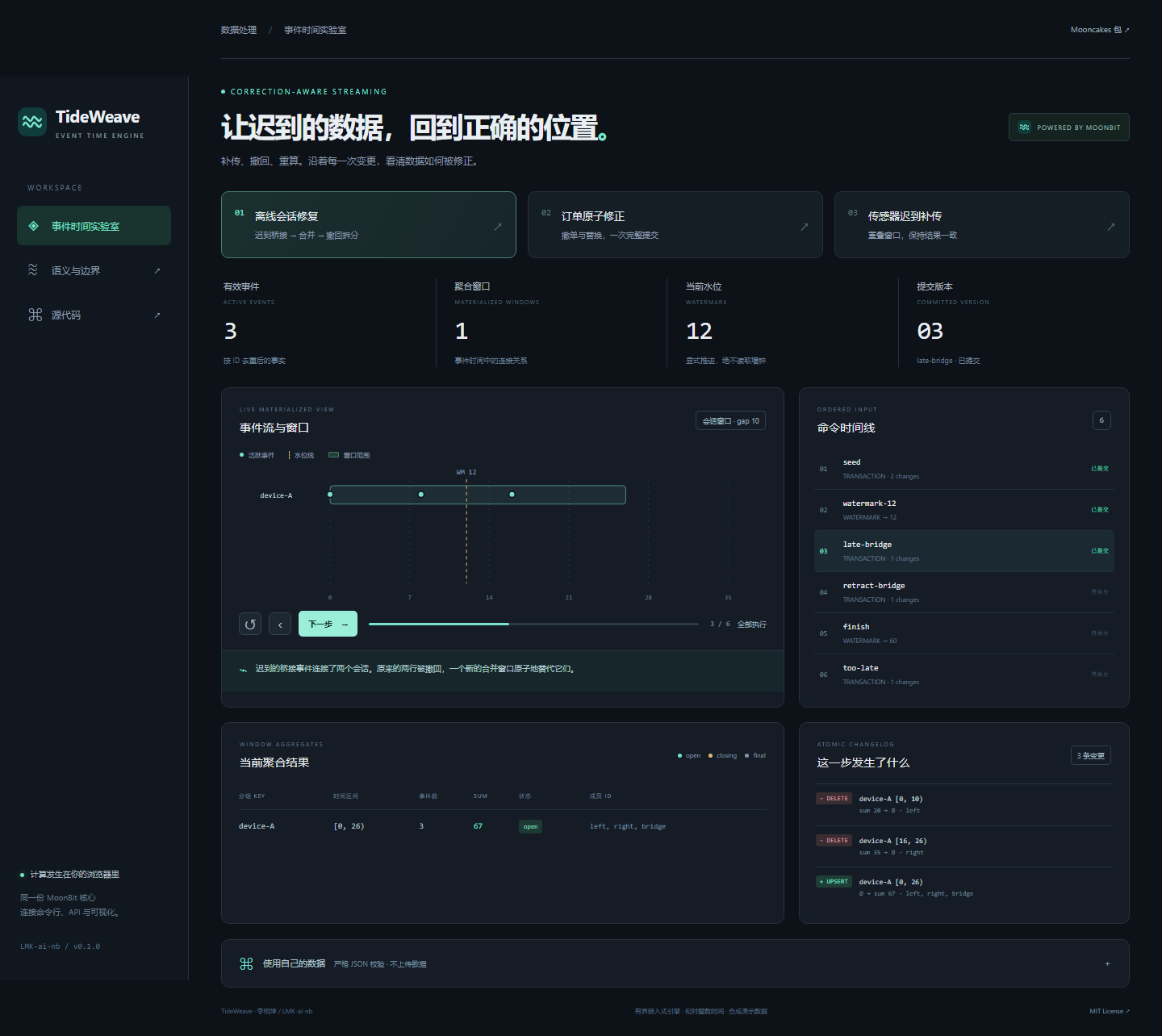
#一个容易出错的真实问题
同一设备先上报 at=0 和 at=16 的两条记录,gap=10,因此它们属于两个会话。设备恢复网络后补传 at=8 的记录,两个会话应合并。随后发现该记录有误并撤回,窗口必须再次拆分。只对 SUM 做加减会留下错误的边界、成员与 min/max。
TideWeave 将每次修正视为原子状态变更:计算候选事实 → 重建受影响 key → 校验终结约束 → 提交版本 → 输出完整变更。事务若失败,窗口、事件索引、去重状态与版本一起保持原状。
#已实现
- 滚动、带相位偏移的滑动与会话窗口;半开区间;负窗口起点的数学 floor 对齐。
- 按事件 ID 插入、替换、撤回,支持跨 key 移动与多项原子事务。
- 会话迟到合并、撤回拆分,count / Int64 sum / min / max 与完整成员来源。
- 显式水位线推进与 allowed-lateness 迟到容忍;WatermarkTracker 提供有界乱序水位生成;within_lateness 探针。
- 可插拔自定义聚合(UDAF):Measure + measure_window,内置 count/sum/min/max/avg。
- 任意结构化事件:事件可携带 fields 键值属性并随检查点与变更日志完整保留(扁平键值,单事件 ≤32 项,嵌套结构请序列化为字符串);配置 value_field 后,任意整数字段即可作为窗口度量(事件无需再带固定 value)。
- 可配置触发:Watermark 或 Count(n) 提前发射;结果以 before/after changelog 输出,下游 View 原子校验。
- 显式状态清理:Forget 封存已终结事实、释放活动容量、拒绝后续修正,且可经 checkpoint 精确回放。
- open → closing → final;保护已终结窗口及原始事件,拒绝将旧事实重新打开。
- 成功命令幂等、冲突检测;可重放检查点恢复后继续去重。
- 稳定顺序的 before/after 日志,以及校验版本连续性、旧值与原子应用的下游 View。
- 严格 JSON 协议,拒绝重复解码键、未知字段、被浮点舍入掩盖的小数和不适用参数。
- Node CLI、六个可重现示例、交互式浏览器实验室(六个场景),共用 MoonBit 核心。
能力与 Apache Flink 事件时间窗口体系的逐条对照见 Flink 能力对照。
#为什么不直接用 Flink
Flink 是分布式集群运行时,解决的是大规模、长期、多租户流的吞吐问题。TideWeave 解决的是另一个问题:已经发生的事实被更正时,如何给出可核对、可回放、可被下游验证的修正。这不是营销话术,而是行为差异:
| 场景 | Flink 的典型做法 | TideWeave |
|---|---|---|
| 撤回桥接事件后的会话边界 | retract 流交给下游自行消化;窗口边界不会自动重新拆分 | 按连通分量重新拆分会话,输出完整 delete + upsert |
| 已终结窗口被迟到数据改写 | 依赖 allowed lateness 与下游幂等,边界语义分散 | final 窗口与其成员事实显式保护,等 SUM 也无法绕过 |
| 下游漏接或拿到旧值 | 需自建版本校验 | View 原子校验版本连续性、before-image 与行身份 |
| 部署形态 | JVM 集群、状态后端、checkpoint 存储 | 单进程嵌入式,确定性回放,无外部依赖 |
Flink 有的窗口、水位线、UDAF、触发、状态清理我们逐项对标实现;Flink 做起来最痛的"撤回后重建 + 终结保护 + 下游校验"是独立贡献。两者是不同部署层级,不是替代关系。
#在 MoonBit 中使用
要求编译器 0.10.16 或更新兼容版本。
moon add LMK-ai-nb/tideweave@0.2.4在消费项目的 moon.pkg 加入:
import { "LMK-ai-nb/tideweave" @tide }在可抛出错误的函数中:
let cfg = @tide.config(@tide.Session(gap=10), lateness=20, value_field=Some("watts")) // 度量取自 fields.watts
let engine = @tide.Engine::new(cfg)
let view = @tide.View::new()
let outcome = engine.apply(@tide.Transact(id="batch-1", changes=[
  @tide.Put({ id: "left", key: "device-A", at: 0, value: 20, fields: Some([("watts", "20")]) }),
  @tide.Put({ id: "right", key: "device-A", at: 16, value: 35, fields: Some([("watts", "35")]) }),
]))
view.apply(outcome)
let restored = @tide.restore(engine.checkpoint())
assert_true(restored.rows() == engine.rows())
完整公开接口由 moon info 生成,见 pkg.generated.mbti。aggregate 可批处理;Engine 可持续接收容量内的修正;replay_json / resume_json 提供严格文本边界。
#什么场景才用得到:三个具体场合
先说清楚这个库不做什么:它不负责"把一条已入库的记录改对",那是 UPDATE 的活。它负责的是另一件事——当"事实被更正"本身是一条流时,窗口结果如何保持一致,以及如何向对账方交代到底改了什么。三个具体场合:
| 场合 | 数据库/业务系统的做法 | 为什么不够 |
|---|---|---|
| 设备网关、边缘控制器、桌面工具、CI 测试夹具 | 没有数据库可改 | 现场只有一个进程,既没有 DB 也没有集群;但迟到合并、撤回拆分、窗口边界一样要算对 |
| 广告计费、退款回冲、订单撤改 | 定时全量重算,或 UPDATE 后另补一张报表 | 更正不是一次性动作:无效流量撤回、退款、补传各自成流,乱序且会重复;照命令日志重放会二次扣减 |
| 对账、审计、风控要求"交代改了什么" | 行级 after 值,或翻 binlog | 给不出成员级 before/after,也给不出"这两个会话本该拆开"的拓扑结论;下游没法在应用前拦下旧值 |
反过来,下面几种情况不必用这个库,用了反而更麻烦:只要每天出一张报表、允许全量重算的,用数仓;追求集群吞吐与多租户隔离的,用 Flink;需要跨机共享状态与高可用的,本项目是单进程嵌入,不合适。
同一套窗口、水位与撤回语义,已经跑通三个互不相干的域——设备会话(session-correction)、订单(order-amendment)、广告计费(ad-billing)。差别只在 fields 与 value_field,引擎本身不认领域,只认 (key, at, 结构化字段)。
用数据库完成同样的事,需要物化视图、触发器、自研撤回流与版本校验,事件时间语义散落在应用层;而且 UPDATE 本身不可重放,要幂等还得另建一层命令去重——这层去重、终结保护与变更日志,正是本库提供的东西。
#与社区同类项目的关系(主动披露)
八月初审的多份驳回通知指出"社区已有类似项目、申报未说明扩展关系"。本项目主动披露检索结果与边界,详见 同类项目披露。
检索到的 MoonBit 同类包各有明确分工:moonwatermarkkit 做水位判定与窗口分配原语(无状态聚合、无撤回);moon-stream-quality 做数据质量规则与迟到策略;moon-distinct-sketch 做近似统计;mooncep 做复杂事件模式检测(其文档明确声明不支持事件修正/撤回)。
TideWeave 与它们无代码复用、不是任何项目的分支或扩展,独立实现窗口分配、水位推进、聚合、修正与检查点。差异集中在修正层:撤回后重建会话、原子多事件事务、终结保护、before-image 校验。需要"水位判定"或"数据质量规则"时,上述专门包更合适;需要"已记录事实被更正后仍保持一致"时用 TideWeave。
#两种接入方式:库内嵌,或管道直连
不需要先写一套集成代码:
- 库内嵌:moon add LMK-ai-nb/tideweave,在 MoonBit 程序中直接调用 Engine::apply,见上一节。
- 管道直连:stream 子命令读取 NDJSON(首行配置,其后每行一条命令),逐行输出结果,末尾输出 summary 与 checkpoint。任何能产出换行 JSON 的进程都能直接驱动:
cat examples/session-stream.ndjson | node bin/tideweave.mjs stream
node bin/tideweave.mjs stream examples/session-stream.ndjson --checkpoint saved.json
同一核心同时提供 MoonBit 类型化 API、严格 JSON 协议、CLI 与浏览器实验室;宿主按需选择接入层,不必重写业务逻辑。更多宿主侧示例见 接入指南。
#运行与验证
moon version --all
moon check --target all --deny-warn
moon test --target wasm-gc,wasm,js --deny-warn
moon build --target wasm-gc,wasm,js --deny-warn
moon fmt --check
moon info
node scripts/check_identity.mjs
moon run cmd/demo
node scripts/build.mjs
node --test tests/cli.test.mjs
node scripts/serve.mjs
浏览器打开 http://127.0.0.1:4174。Node 要求 22+;没有第三方 npm 依赖。
这里刻意只列 wasm-gc / wasm / js 三个目标——任何机器都能跑。--target all 会带上 native,需要本机有平台 C 工具链(Windows 为 MSVC Build Tools + Windows SDK),没有时 moon test --target all 会直接报 requires an MSVC compiler/linker driver。native 由 CI 在三个系统上分别验证。
node bin/tideweave.mjs run examples/order-amendment.json --checkpoint checkpoint.json
node bin/tideweave.mjs run examples/session-correction.json
node scripts/benchmark.mjs

# 恢复:checkpoint 不能直接喂给 resume,要嵌进请求
node -e "const c=require('./checkpoint.json');require('fs').writeFileSync('resume.json',JSON.stringify({schema_version:1,checkpoint:c,commands:[]}))"
node bin/tideweave.mjs resume resume.json
CLI 退出码:0 表示所有命令 accepted/duplicate;1 表示存在 rejected/conflict(演示中有意触发);2 表示输入/IO/运行错误。resume 接收的是请求对象 {schema_version:1,checkpoint:<保存的对象>,commands:[...]},把裸 checkpoint 文件直接传进去会得到 unknown or inapplicable field。完整格式见 FORMAT.md。
可选浏览器检查:安装 Python Playwright 和 Chromium 后,在预览服务运行时执行 python tests/browser.py。CI 在 Linux 实际运行此检查。
#质量与边界
67 个 MoonBit 测试包括独立区间枚举 oracle、独立图连通 oracle、混合 key 状态差分、原子回滚、终结保护、检查点恢复、自定义聚合、水位生成、触发与状态封存。10 个 Node 集成测试覆盖公共协议与真实 CLI;Chromium 检查交互、导出、注入文本与 390px 手机布局。GitHub CI 在 Linux、macOS、Windows 检查 wasm、wasm-gc、js、native 四个目标。
这是有界、同步、单进程的可嵌入状态机,适用于离线对账、边缘批次及流处理回归测试。最多 5000 活跃事件、10000 成功命令、20000 窗口、2 Mi 规范 journal 单元。状态清理是显式的:Forget 封存已终结事实并释放活动容量,封存事实冻结为可回放的不可变历史,不做静默驱逐。连续无限流需要宿主设计分区/批次生命周期,宿主还负责消息 IO、持久化、授权与外部消费一致性。这里不提供分布式运行时或外部 exactly-once 承诺。
Windows / Node 24 合成基准:4096 事件、64 key、32 批次,包含解析、状态修正、日志、检查点和完整 JSON 输出,10 次样本中位约 84 ms。环境、范围与复现命令见 BENCHMARK.md,不将其外推为生产吞吐承诺。
#可核对证据
每条主张都能定位到可运行的代码或测试,不必只读文字:
| 主张 | 证据 |
|---|---|
| 撤回后重建会话(不是数值减法) | node scripts/compare_naive.mjs;examples/session-correction.json |
| 终结窗口与成员事实保护 | boundary_wbtest.mbt、engine_wbtest.mbt |
| 自定义聚合(UDAF) | aggregate.mbt、aggregate_wbtest.mbt |
| 水位生成与迟到判定 | watermark.mbt、watermark_wbtest.mbt |
| 触发(Watermark / Count) | trigger_wbtest.mbt |
| 状态封存与确定性回放 | forget_wbtest.mbt;moon run cmd/demo 末行 frozen=2, active=0 |
| NDJSON 流式驱动 | examples/session-stream.ndjson、tests/cli.test.mjs |
| 结构化事件与可配置度量 | structured_wbtest.mbt;examples/structured-events.json;API.mbt.md(随测试编译) |
| 同一引擎跨域通用(设备/订单/广告计费) | examples/session-correction.json、order-amendment.json、ad-billing.json 三个不相干域共用同一套窗口与撤回语义 |
| 提交身份归属 | node scripts/check_identity.mjs |
全部测试:moon test --target wasm-gc(70 项)、node --test tests/cli.test.mjs(10 项)。
#原创性与申报
维护者:李明坤 / LMK-ai-nb。独立新仓库与新业务实现,不复用 submit-guard、permscope 或 AgentCanary 的核心。事件时间、窗口和 changelog 是已有概念;本项目的独立贡献是修正、会话拆分、事务终结保护、下游旧值校验和重启去重的组合实现,不声称发明流处理。
开发使用 AI 辅助;维护者须理解实现并承担验证责任。原创代码 MIT,标准库编译分发保留许可与 NOTICE,所有示例为合成数据,见 第三方说明。
TideError
Command
Config
pub(all) struct Config {
  window : WindowSpec
  lateness : Int
  max_events : Int
  max_operations : Int
  trigger : Trigger
  value_field : String?
} derive(Eq)Delta
Engine
Opaque mutable engine. Public queries and outcomes return detached arrays.
Engine::apply
All failures leave state, version, successful IDs and journal unchanged.
Engine::checkpoint
A portable validated replay checkpoint, not a signed proof of history.
Engine::correctable
True when the event is still active and none of its current windows is
final. This mirrors the freeze predicate used by Forget. A correction
that moves the event to another key or timestamp can still be rejected by
finality in the destination windows.
Engine::events
Active (still correctable) events, sorted by ID. Sealed finalized facts are
excluded: they are frozen and can no longer be inserted, replaced or removed.
Engine::frozen_count
Number of frozen (finalized) facts still retained for replay.
Engine::rows
Detached, sorted materialized view. Mutating its arrays cannot alter state.
Engine::run
Resume on an existing engine; commands are processed in supplied order.
Engine::within_lateness
True when an event timestamp is not more than allowed_lateness behind the
current watermark: at + allowed_lateness >= watermark. This is the
Flink-style "late event" heuristic hosts use to decide whether to forward a
correction. It is not a correctness guarantee: window finality is the
authoritative gate, and a timestamp behind the watermark can still land in
a window whose end lies in the future (and thus remain correctable). For an
exact answer about a specific fact, use correctable.
Event
Event ID is global within one engine. Keys and IDs are opaque Unicode.
fields carries arbitrary structured attributes as sorted key/value
pairs; value is the numeric measure the built-in aggregates consume
(either supplied directly, or derived from Config.value_field).
Event::field
Look up one structured field. Fields are stored sorted, so this is a
linear scan over at most 32 entries.
Event::measure
The numeric measure this event contributes to built-in aggregates: its
value, or — when the engine is configured with value_field — the
structured field of that name parsed as a plain decimal integer.
Measure
pub(all) struct Measure {
  name : String
  identity : Int64
  step : (Int64, Int64) -> Int64
  finish : (Int64, Int64) -> Int64
}
A pluggable scalar aggregate (user-defined aggregate function, UDAF).
step folds one event measure (its value, or the configured structured field) into the accumulator; finish turns the
accumulator and the event count into the emitted measure value. Because
measure_window recomputes a window from its full member list on every
call, measures stay correct under late arrivals and retractions without a
separate subtractive pass — the window members are the source of truth.
MeasureResult
A named, computed measure value.
MeasureResult::not_equal
MeasureWindow
pub(all) struct MeasureWindow {
  key : String
  start : Int
  end : Int
  count : Int
  measures : Array[MeasureResult]
  phase : String
} derive(Eq, ToJson)
A window summarized by caller-chosen measures instead of the fixed
count/sum/min/max profile. Uses the same assignment, session grouping and
phase rules as the stateful engine.
MeasureWindow::not_equal
Mutation
Outcome
Replay
Trigger
When a window is emitted early (marked closing) before the watermark
finalizes it. Watermark is the default and keeps the original behavior;
Count(n) additionally marks a window closing once it holds n events.
Trigger affects emission/phase only — finality still depends on the
watermark plus allowed lateness, so early-fired windows stay correctable.
View
A downstream materialized view that rejects gaps and stale before-images.
View::apply
Validates transport consistency; authenticity is the host's responsibility.
WatermarkTracker
pub struct WatermarkTracker {
  max_time : Int
  allowed_lateness : Int
}
A bounded-out-of-orderness watermark generator, the counterpart of Flink's
BoundedOutOfOrdernessWatermarks: the watermark trails the largest observed
event timestamp by exactly allowed_lateness. Feed every observed event
timestamp into observe, then advance the engine with the returned value.
WatermarkTracker::new
WatermarkTracker::observe
Record an observed event timestamp and return the current watermark.
WatermarkTracker::value
The current watermark: max(0, max_time - allowed_lateness).
Window
WindowSpec
pub(all) enum WindowSpec {
  Tumbling(size~ : Int, offset~ : Int)
  Sliding(size~ : Int, slide~ : Int, offset~ : Int)
  Session(gap~ : Int)
} derive(Eq)
Window parameters use caller-defined integer time units.
impl ToJson for WindowSpecaggregate
Batch aggregation API. Validates the same bounds used by the state machine.
assign_fixed
Return start/end pairs in ascending order, including negative starts.
average_measure
Arithmetic mean, truncated toward zero (integer arithmetic).
config
fn config(window : WindowSpec, lateness? : Int, max_events? : Int, max_operations? : Int, trigger? : Trigger, value_field? : String?) -> Config raise TideErrormeasure
fn measure(name~ : String, identity~ : Int64, step~ : (Int64, Int64) -> Int64, finish~ : (Int64, Int64) -> Int64) -> MeasureA custom measure: identity seeds the fold, step accumulates one event
value, finish derives the result from the accumulator and member count.
measure_window
Compute caller-chosen measures for every window of the supplied events,
reusing the engine's window assignment, session grouping and phase rules.
Validate the same bounds as the stateful engine.
replay_json
Validate all input before running; domain rejections are report steps.
resume_json
Resume input has a checkpoint object and an array of new commands.
stream_json
Process newline-delimited JSON (NDJSON) in one incremental pass.
The first non-blank line is a session header:
{"schema_version":1,"config":{...}}. Every later non-blank line is one
command object, exactly as it would appear in a replay commands array.
The result is one outcome line per command followed by a final
{"summary":{...}} line, so the engine can be driven by any line-oriented
producer without writing MoonBit or re-parsing a whole batch.
Install
Download zipGeneric embeddable event-time windowing library: windows, watermarks, UDAFs, triggers and state cleanup, plus a correction layer (retraction rebuild, finality guards, before-image validation) for amended facts. Structured events supported.
event-timeretractionsession-windowstreamingchangelog

 MIT

 Updated 5 hours ago
 43 downloads