 README
moon-stage
Type-safe HTML-in-Canvas scene graph for MoonBit: pure scheduler with camera, named groups, clipping, visibility and opacity; canvas and DOM-overlay runners
html-in-canvas
canvas
scene-graph
webgpu
ui
Author
Version
0.1.0
License
Apache-2.0
Repository
Last updated
4 hours ago
Downloads
4
#moon-stage
Type-safe HTML-in-Canvas scene graph for MoonBit — the first MoonBit
package wrapping the WICG HTML-in-Canvas API.
Chrome 158 exposes it without flags (verified on macOS); older builds need
chrome://flags/#canvas-draw-element or an origin-trial token.
Real DOM stays real: text remains searchable (Ctrl+F), inputs focusable,
content accessible — while the scene graph decides where and how every
element is painted into <canvas content="drawable">.
#What it looks like
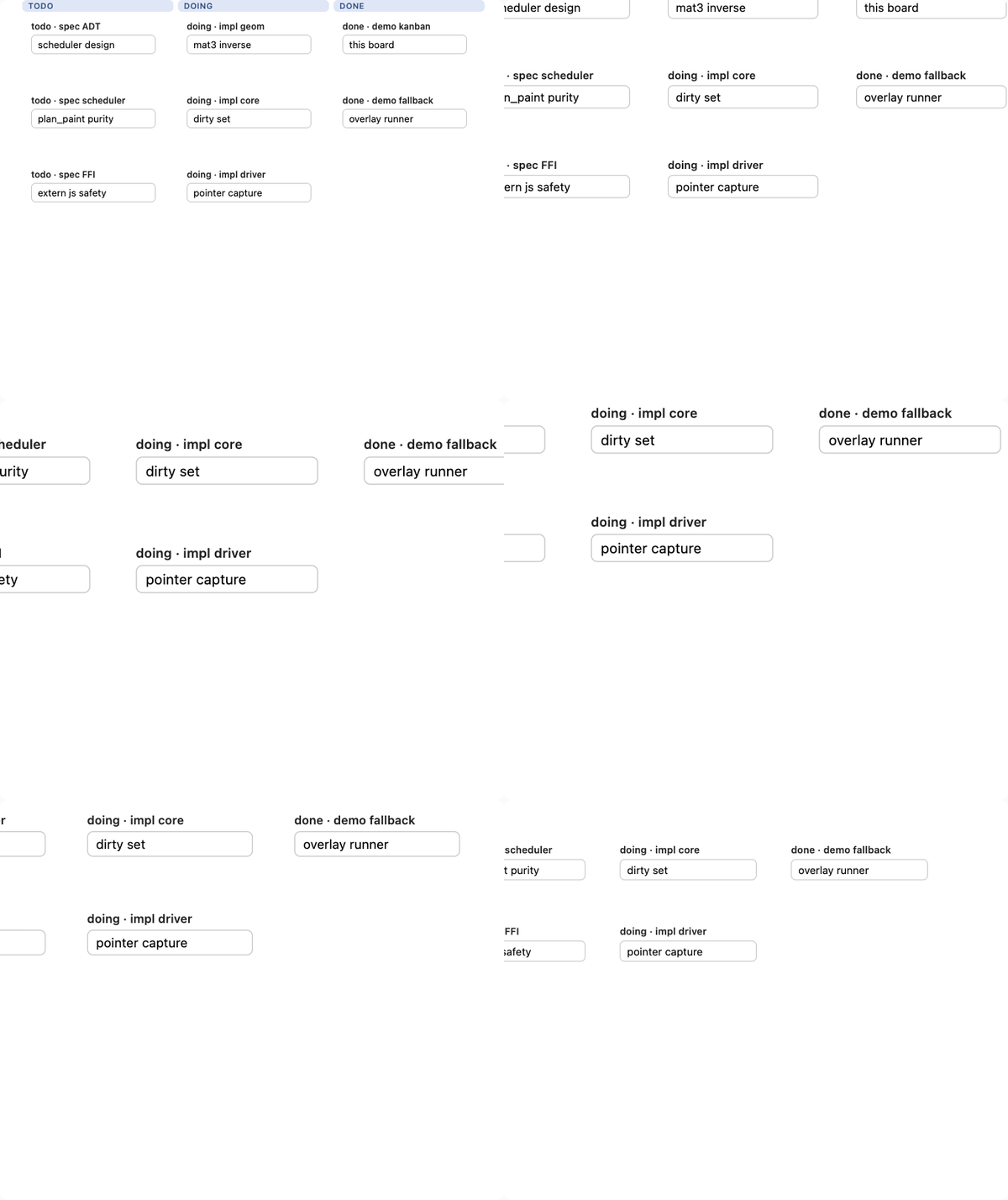
cmd/kanban: the cards are real DOM inside <canvas content="drawable"> —
type in them, search with Ctrl+F, drag a card or a column header, right-drag to
pan, wheel over empty space to zoom.
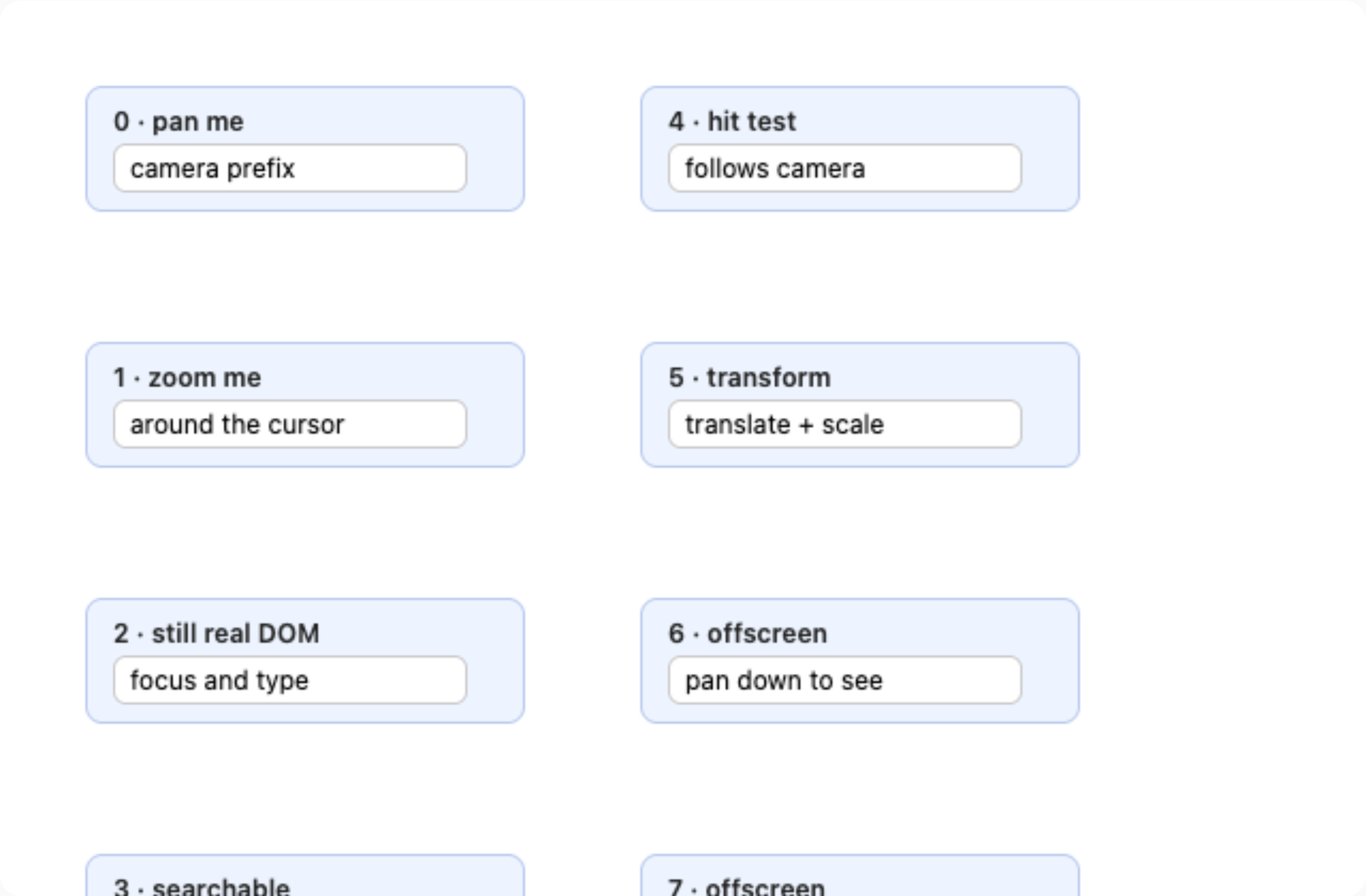
cmd/camera: one scene under a camera, plus a named column group and a clip
group (?clip=1). Screenshots and the GIF are produced by e2e/shots.mjs and
e2e/make_gif.py against a headless Chrome, not mocked up.
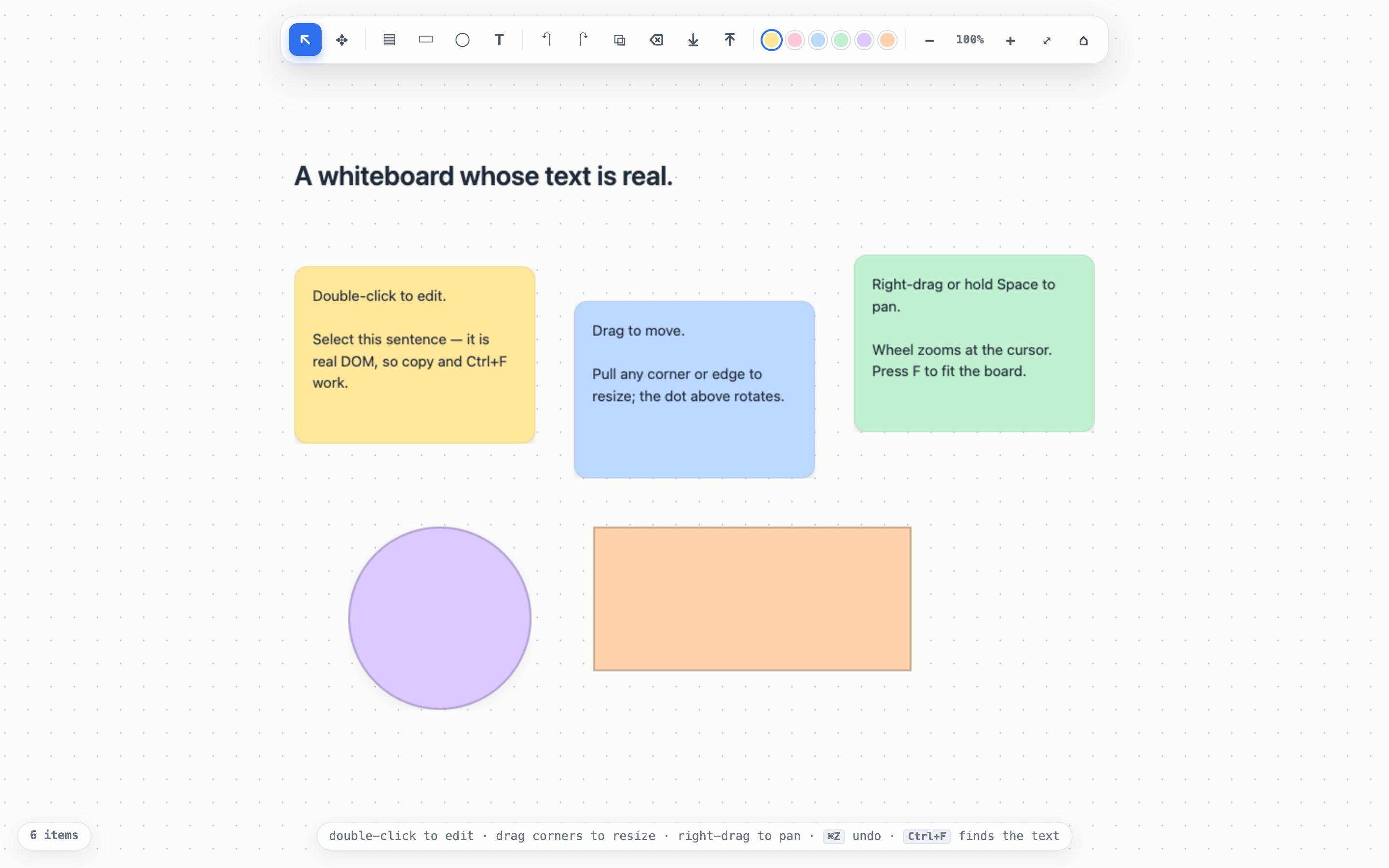
cmd/whiteboard: an infinite board where notes, shapes and text are real DOM
inside the canvas — double-click to edit, drag a marquee, resize from any
handle, rotate, undo, and reload with the board intact (localStorage).
#Architecture
geom     Mat3/Vec2/Rect — pure 2D affine math, DOMMatrix-aligned
core     SceneNode ADT (Html / Group / Clip) + plan_paint — PURE scheduler
driver   extern "js" FFI shell (drawElementImage, updateElementGeometry,
         paint/pointer/wheel/resize bridges, feature detection)
stage    Stage facade — mount/set_scene/set_props(_many)/hit_test/set_camera,
         per-element layout observation, rotated draw path
fallback OverlayStage — the SAME PaintPlan executed as DOM overlay
         (CSS transforms); `mount_any` picks canvas or overlay
The scheduler is a pure function of its inputs, (Scene, Viewport) ->PaintPlan, and has no outside-world effects: the only per-frame mutation is
consuming the dirty set, and node updates land in an override table rather
than rebuilding the tree. Plans are plain data, which makes them property-testable
without a browser, runnable by two backends (canvas snapshots / DOM overlay),
and reviewable as a formal API via generated .mbti interfaces.
#Quick start
moon add allenli178/moon-stage#Build a scene and schedule a frame
///|
test {
  let builder = @core.SceneBuilder::new()
  let card = builder.html(
    @core.HtmlProps::make(size={ width: 200.0, height: 80.0, }),
  )
  let scene = @core.Scene::new(
    root=@core.SceneBuilder::group(@geom.Mat3::translate(40.0, 30.0), [card]),
  )
  let plan = scene.plan_paint({
    size: { width: 800.0, height: 600.0, },
    dpr: 2.0,
  })
  debug_inspect(plan.ops.length(), content="1")
  match plan.ops[0] {
    @core.DrawElement(dest~, ..) =>
      debug_inspect(dest, content="{ x: 80, y: 60, width: 400, height: 160 }")
    _ => fail("expected DrawElement")
  }
}
Destination rects come out in canvas grid (device pixel) coordinates; the
scheduler keeps canvasTransform values in canvas CSS pixel space per the
spec. The 2D path lets the browser auto-sync geometry (hit testing + a11y),
so a plain card needs only one DrawElement op.
#Transforms compose child-first
///|
test {
  let m = @geom.Mat3::translate(3.0, 4.0).mul(@geom.Mat3::scale(2.0, 2.0))
  let p = m.apply({ x: 1.0, y: 1.0, })
  assert_true(p.approx_eq({ x: 5.0, y: 6.0, }))
}#Dragging: replace props, get geometry sync for free
///|
test {
  let builder = @core.SceneBuilder::new()
  let card = builder.html(
    @core.HtmlProps::make(
      size={ width: 50.0, height: 30.0, },
      transform=@geom.Mat3::translate(10.0, 20.0),
      preserve_hit_order=true,
    ),
  )
  guard card.id() is Some(id) else { fail("html node has id") }
  let scene = @core.Scene::new(root=card)
  let viewport : @core.Viewport = {
    size: { width: 400.0, height: 300.0, },
    dpr: 2.0,
  }
  // Frame 1 marks everything dirty: preserve_hit_order nodes get an
  // explicit UpdateGeometry (canvasTransform in CSS px) + a draw with
  // preserveElementGeometry=true, so their hit-stack position survives.
  let plan1 = scene.plan_paint(viewport)
  debug_inspect(plan1.ops.length(), content="2")
  // Frame 2 is clean: draw only — hit-stack position preserved.
  debug_inspect(scene.plan_paint(viewport).ops.length(), content="1")
  // Moving the card re-dirties it:
  let _ = scene.replace_props(
    id,
    @core.HtmlProps::make(
      size={ width: 50.0, height: 30.0, },
      transform=@geom.Mat3::translate(30.0, 40.0),
      preserve_hit_order=true,
    ),
  )
  debug_inspect(scene.plan_paint(viewport).ops.length(), content="2")
}#Layout follows the DOM
Stage::bind tags each element and observes its border box, so a reflow
(text wrap, responsive rules, an input that grows) updates props.size, the
dest rect and the hit box without rebuilding the scene. A burst of
observations is coalesced into one repaint (kanban/?sizes=1).
#Rotation and skew
An axis-aligned transform keeps the fast AABB draw path. Rotation/shear
emits DrawElementTransformed: the snapshot is drawn in element space under
the context transform, the browser records the rotated quad for hit
testing/a11y, and Stage::hit_test inverse-maps the point into element space
(kanban/?rotate=1 checks pixels, geometry and hits). dest_of still returns
the AABB for rotated nodes — use hit_test for exactness.
#Camera and named groups
The scene has a camera (Stage::set_camera) applied before the root, so pan
and zoom are one matrix update and dest_of/hit_test describe what is on
screen. Mat3::around_point builds zoom-at-cursor transforms. Columns and
panels built with SceneBuilder::group_named get an NodeId and can be moved
later with Stage::set_group_transform, without touching each child's props
(camera/?selftest=1, camera/?group=1).
#Clip groups
SceneBuilder::clip(m, rect, children) (or clip_named) clips a subtree to a
rectangle in its local space; nested clips intersect. The scheduler emits
balanced PushClip/PopClip ops, the canvas runner clips with ctx.clip(),
and the overlay runner applies an element-local clip-path polygon. Clipped
elements also get a canvasClip, so native hit testing and a11y geometry stop
at the clip instead of only the painted pixels (camera/?clip=1,
fallback/?backend=overlay&clip=1).
#Visibility
Named groups can be shown/hidden with set_group_visible. Hidden subtrees
emit no draw ops, and elements that were drawn before get a ClearGeometry,
so browser hit testing and a11y drop them too; showing the group re-adds
everything on the next frame. The overlay runner maps this to CSS
visibility (kanban/?hide=1, fallback/?backend=overlay&hide=1).
#Opacity
set_group_opacity(id, alpha) multiplies the drawing alpha for a group
subtree; nested groups multiply. Hit testing and a11y are intentionally
unchanged, matching CSS opacity. Canvas applies globalAlpha per element, so
overlapping children are not composited as a single layer; the overlay maps
the product to per-card CSS opacity (kanban/?opacity=1,
fallback/?backend=overlay&opacity=1).
#Group drags
set_props writes into an O(1) props override table; set_props_many
applies a whole selection with a single repaint. The kanban group drag uses
the batched call instead of one repaint per selected card.
#Choosing a backend
@fallback.mount_any(canvas~, overlay~) mounts the canvas runner when the API
exists and the overlay runner otherwise; Mounted forwards bind,
set_scene, set_props(_many), hit_test, dest_of and unmount, so scene
code never branches on the backend. The overlay host must be positioned
exactly over the canvas, and pointer tracking goes through
Element::track_pointer (down on the host, move/up on the document) because
overlay cards are real DOM above the canvas.
#Browser wiring (demo)
let stage = @stage.Stage::mount(canvas) // feature detection + RO wiring
stage.bind(id~, element=form)           // NodeId -> drawable element
stage.set_scene(root~)                  // marks dirty, paints, requestPaint
stage.set_props(id~, props~)            // drag/scale hot path (O(1))
stage.set_props_many(updates)           // group drag: one repaint
stage.set_camera(m)                     // pan/zoom the whole scene
stage.set_group_transform(gid, m)       // move a named column/panel
// fit/reset are demo-level math over Stage::dest_of + Stage::set_camera
stage.hit_test({ x, y })                // local hit model (front-most first, quad-aware)
stage.unmount()                         // disconnect observers + paint handler
DOM mutations belong in input handlers, never inside paint (they apply on
the NEXT rendering update per the spec) — set_props repaints synchronously
and forces requestPaint because a transform change does not alter the
element snapshot.
Pointer and wheel bridges deliver coordinates in canvas CSS pixels derived
from clientX/clientY minus the canvas border box. Do not switch them to
offsetX/offsetY: once browser hit testing pierces into the drawable
subtree, the event target is the card's own input, so offsetX is measured
from that element while the event still bubbles to the canvas.
#Demos (js target, served over http)
| demo | command | shows |
|---|---|---|
| hello | moon build --target js cmd/hello | form painted into canvas, input stays live |
| drag | moon build --target js cmd/drag | pointer drag + wheel scale, scripted selftest |
| fallback | moon build --target js cmd/fallback | mount_any canvas/overlay switch; ?backend=overlay forces the DOM runner, ?selftest=1 drags card0, ?clip=1 clip parity, ?hide=1 visibility parity, ?opacity=1 opacity parity |
| camera | moon build --target js cmd/camera | pan/zoom camera, zoom-at-cursor, named column group, clip group; ?selftest=1 ?group=1 ?clip=1 |
| kanban | moon build --target js cmd/kanban | rubber-band multi-select, card/column drag, camera pan+zoom+fit, Ctrl+F; ?selftest=1 ?diff=1 ?hit=1 ?sizes=1 ?rotate=1 ?columns=1 ?cam=1 ?fit=1 ?hide=1 ?opacity=1 |
| whiteboard | moon build --target js cmd/whiteboard | infinite canvas: notes/shapes/text, marquee, handle resize+rotate, undo/redo, z-order, localStorage; ?selftest=1 (26 checks) |
| bench | moon build --target js cmd/bench | ?n=1000 / ?n=5000 throughput; ?spread=1 spreads the cards over a wide board to separate draw cost from overdraw |
| glass | moon build --target js cmd/glass | WebGPU texture path, manual geometry sync (I5-3D) |
Chrome 158 runs these without flags (verified on macOS). On older Chrome,
enable chrome://flags/#canvas-draw-element or register an origin-trial
token (the trial covers Chrome ≤ 154). Serve over http.
#Verification matrix
| # | invariant | where |
|---|---|---|
| I1 | plan == hand derivation; deterministic | pure MoonBit, 48 tests |
| I2 | Mat3 associativity / identity / inverse roundtrip / affine interpolation | pure MoonBit |
| I3 | hit stack follows draw order; preserveHitTestOrder keeps an existing slot (pure model + tests) | pure MoonBit |
| I4 | browser getElementTransform == derived CSS transform (11/11 nodes: 8 cards + 3 column headers) | headless Chrome 158 (kanban/?selftest=1) |
| I5 | manual updateElementGeometry -> getBoundingClientRect match; also on the animated WebGPU path (I5-3D) | headless Chrome 158 (kanban/?selftest=1), I5-3D on Edge |
| I6 | trusted pointer events pierce into the drawable subtree, and the canvas-relative coords land inside the card (I6-COORD) | headless Chrome 158, CDP Input — PASS |
| I7 | element reflow (CSS-only width change) reaches props.size, the dest rect and the hit box | headless Chrome 158 (?sizes=1) — PASS |
| I8 | rotated node: geometry matrix rotated, pixels rotated (AABB corner empty), quad-accurate hit test | headless Chrome 158 (?rotate=1) — PASS |
| I9 | auto backend selection plus trusted drag on both runners | headless Chrome 158 (cmd/fallback, canvas + ?backend=overlay) — PASS |
| I10 | camera pan/zoom: dests follow the matrix, zoom keeps the cursor hit | headless Chrome 158 (camera/?selftest=1) — PASS |
| I11 | named group transform moves its subtree only | headless Chrome 158 (camera/?group=1) — PASS |
| I12 | clip group: pixels clipped, local hits filtered, canvasClip bounds native hits/a11y | headless Chrome 158 (camera/?clip=1) — PASS |
| I13 | overlay clip: element-local clip-path polygon and clipped hit testing | headless Chrome 158 (fallback/?backend=overlay&clip=1) — PASS |
| I14 | column header drag moves its named group only | headless Chrome 158 (kanban/?columns=1) — PASS |
| I15 | right-drag pan + cursor-anchored zoom in the real board | headless Chrome 158 (kanban/?cam=1) — PASS |
| I16 | fit frames every card inside the viewport; reset restores the origin | headless Chrome 158 (kanban/?fit=1) — PASS |
| I17 | hiding a named group drops dest/hit/pixels and restores on show | headless Chrome 158 (kanban/?hide=1) — PASS |
| I18 | overlay group visibility: DOM visibility plus hit filtering | headless Chrome 158 (fallback/?backend=overlay&hide=1) — PASS |
| I19 | group opacity dims pixels and keeps the hit target | headless Chrome 158 (kanban/?opacity=1) — PASS |
| I20 | overlay opacity maps to per-card CSS opacity, hits unchanged | headless Chrome 158 (fallback/?backend=overlay&opacity=1) — PASS |
| I21 | whiteboard: hit/drag, handle geometry + resize, rotate, undo/redo, delete-restore, persistence, cursor-anchored zoom, DOM text edit | headless Chrome 158 (whiteboard/?selftest=1, 26 checks) — PASS |
Differential test: the same scene runs through BOTH backends (canvas
snapshots and DOM overlay); element positions agree 4/4, before and after a
drag (kanban/?diff=1).
e2e/accept.mjs runs the whole matrix against a headless Chrome over CDP
(Node ≥ 22 for the built-in WebSocket; one command after serving the repo and
opening a debugging port). It skips
the canvas checks when drawElementImage is missing and always exercises the
overlay runner, so the fallback stays covered on browsers without the API.
.github/workflows/ci.yml runs moon check --deny-warn, moon test, the JS
build and that suite on every push/PR.
Benchmark (real-clock, CDP; initial headless-Edge run, then re-run on
Chrome 158 / macOS): 1000 cards = 0.8 / 0.86 ms per frame (1000
drawElementImage + full replan), cold start 8.7 / 10.4 ms; 5000 cards =
20 / 4.5-5.0 ms per frame, cold start 17.4 / 21.5-27.2 ms. Platform
difference is large at this scale; treat these as submission costs (plan plus
draw calls inside the input handler). Raster/composite happens asynchronously
and is not included, and fps_est is capped at 60 rather than measured.
Artifact size: kanban demo 36.8 KB gzipped, no runtime dependencies.
The default layout piles every card into a 5x4 spot grid, so above ~2k it
mostly measures overdraw. ?spread=1 lays the same cards out as a wide board
and tracks draw cost alone (Chrome 158 / macOS, M5): 10k = 13.4 ms,
20k = 29.9 ms, 50k = 87.6 ms per frame — linear in N, i.e. ~1.3-1.8 µs per
element for replan + drawElementImage. hit_stack_next is linear too; the
previous copy-per-move implementation made the 5k piled run 154 ms instead of
8 ms.
#Known boundaries
- extern "js" is js-backend-only in the current toolchain; geom/core are backend-agnostic and compile under wasm-gc/native.
- Hit testing: Chrome 158 pierces trusted pointer events into the drawable subtree (I6 PASS). Browsers that stop events at the canvas still work through Stage::hit_test, but native focus/typing inside a card requires the pierce.
- WebGPU: the element-texture path requires a paint record that a webgpu-context canvas cannot obtain yet (the glass demo degrades to geometry-sync-only and reports this precisely).
- preserveHitTestOrder is modeled by hit_stack_next (pure, tested): auto geometry pushes, preserveHitTestOrder keeps an existing slot, and clearElementGeometry removes. The DOM-overlay runner hit-tests in visual paint order because the flag has no meaning there.
- The local stack is reset by set_scene. With a stable element set it mirrors the browser; if a caller keeps browser geometry across a rebuild, it should clear/re-bind those elements.
- Rotated nodes are painted through the context transform; the snapshot is not re-rastered at the rotated resolution, so extreme scales soften.
- Clip groups clip rendering, local hit testing and native canvasClip on both backends. Rotated clips are exact for local hits; the browser-facing canvasClip is their AABB, so native piercing can still reach a corner just outside a rotated clip. Group opacity is not implemented, and viewport clipping still relies on the canvas bitmap bounds.
#API stability
0.1 freezes the surface the demos and the acceptance suite exercise:
| frozen | notes |
|---|---|
| SceneNode | Html(id, props), Group(id?, transform, children), Clip(id?, transform, rect, children) |
| HtmlProps | size, transform, z, clip, preserve_hit_order |
| PaintPlan | DrawElement, DrawElementTransformed, UpdateGeometry, ClearGeometry, preserve-aware hit_stack |
| Scene | camera, replace_props(_many), replace_group, set_group_visible, set_group_opacity, hit-stack model |
| runners | Stage, OverlayStage, Mounted expose the same scene API |
| hit testing | front-most first, quad-aware for rotation, preserve-aware on canvas |
Deferred to 0.2+ (additive unless noted):
- true group compositing (offscreen layer) for opacity; the current implementation is per-element alpha;
- viewport culling and batched FFI calls — internal performance work;
- OffscreenCanvas/worker snapshots;
- keyboard focus model and multi-pointer gestures.
cmd/whiteboard is the showcase demo, built on this frozen surface: items,
selection, handles, history and persistence exercise the scene API without
changing it.
See CHANGELOG.md for the 0.1.0 feature set.
#License
Apache-2.0
Source Files
Install
Download zipType-safe HTML-in-Canvas scene graph for MoonBit: pure scheduler with camera, named groups, clipping, visibility and opacity; canvas and DOM-overlay runners
html-in-canvascanvasscene-graphwebgpuui

 Apache-2.0

 Updated 4 hours ago
 4 downloads