 README
- ::adminApp::admin
- ::cacheApp::cache
- ::deleteApp::delete
- ::dispatchApp::dispatch
- ::getApp::get
- ::handleApp::handle
- ::listenApp::listen
- ::middlewareApp::middleware
- ::patchApp::patch
- ::postApp::post
- ::putApp::put
- ::static_filesApp::static_files
- ::wsApp::ws
- ::bodyContext::body
- ::haltContext::halt
- ::headerContext::header
- ::htmlContext::html
- ::jsonContext::json
- ::paramContext::param
- ::pathContext::path
- ::query_paramContext::query_param
- ::request_headerContext::request_header
- ::statusContext::status
- ::textContext::text
- ::verbContext::verb
- TRoute
- ::closeWsConn::close
- ::recv_textWsConn::recv_text
- ::send_textWsConn::send_text
- TWsHandler
- ::broadcastWsHub::broadcast
- ::joinWsHub::join
- ::leaveWsHub::leave
- ::newWsHub::new
- Vnew
- Vrun_ws
- Vsqlite
moonway
A full-stack web framework for MoonBit
web
framework
fullstack
Author
Version
0.11.7
License
MIT
Repository
Last updated
10 days ago
Downloads
37
#moonway
The road to the moon.
A full-stack web framework for MoonBit — routing,
database, caching, WebSocket, an auto-generated admin dashboard, and more.
Everything a modern web app needs, designed to work together from your first
moon new.


#Why moonway?
MoonBit is fast, type-safe, and a joy to write — but assembling a real web
application today means picking a router, wiring a database client, bolting on
a cache, and writing the glue yourself. moonway is batteries-included: one
cohesive framework where the pieces of a modern web app are designed to fit
together, so you can go from idea to running application in minutes.
The name is the mission: moon + way — the road to the moon.
#Features
- HTTP routing — expressive routes with path parameters and a composable middleware pipeline.
- Database layer — a typed data abstraction with migrations and a fluent query API. SQLite works out of the box.
- Caching — Redis-backed response caching with a configurable TTL (app.cache(...)); requests are served untouched when Redis is unavailable.
- WebSocket — first-class support for realtime features like chat and live updates.
- Admin dashboard — a CRUD admin UI generated from your models. Zero frontend work required.
- REPL console — an interactive console to query data and poke at your running app.
- Code generator — scaffolding for models, handlers, and more, so boilerplate never slows you down.
- Frontend included — an integrated Preact workflow for the client side of your app.
#Quick start
Install the MoonBit toolchain, then:
moon new hello-moonway
cd hello-moonway
# moonway is a server-side framework: switch the project to the native backend
awk '{sub(/preferred_target = "wasm"/, "preferred_target = \"native\"")} 1' moon.mod > moon.mod.tmp && mv moon.mod.tmp moon.mod
moon add daqing/moonway
# register the dependency in the main package too
printf 'import {\n  "daqing/moonway",\n}\n' >> cmd/main/moon.pkg
Give your app a route:
///|
fn main {
  let app = @moonway.new()
  app.get("/", ctx => ctx.text("Hello, moonway!"))
  app.listen(3000)
}
Run it:
moon run cmd/mainOpen http://localhost:3000. You're on the road. 🌙
#The full stack, in one file
Replace cmd/main/moon.pkg with (the link flags are required — moon add
does not inherit them from dependencies; Linux also needs
apt install libsqlite3-dev, macOS ships SQLite):
import {
  "daqing/moonway",
  "daqing/moonway/db",
  "moonbitlang/core/json",
}

supported_targets = "native"

pkgtype(kind: "executable")

options(
  link: { "native": { "cc-link-flags": "-lsqlite3" } },
)
Then replace cmd/main/main.mbt with:
///|
struct Post {
  id : Int32
  title : String
  body : String
} derive(ToJson, FromJson)

///|
let posts : @db.Table = @db.table("posts", [
  @db.column("id", @db.IntT, primary=true),
  @db.column("title", @db.TextT),
  @db.column("body", @db.TextT),
])

///|
fn main {
  let app = @moonway.new()
  let db = @moonway.sqlite("app.db")
  if !db.migrate([@db.migration(1, "create posts", [posts.create_sql()])]) {
    abort("migrations failed")
  }
  app.get("/posts", ctx => {
    let items : Array[Json] = db.select_raw(posts, "1=1", [], limit=100)
    ctx.json(Json::array(items))
  })
  app.post("/posts", ctx => {
    let row : Json? = Some(@json.parse(ctx.body())) catch { _err => None }
    match row {
      Some(Object(fields)) =>
        if db.insert_raw(posts, fields) {
          ctx.status(201).json(Json::object(fields))
        } else {
          ctx.status(500).text("insert failed")
        }
      _ => ctx.status(400).text("invalid JSON body")
    }
  })
  // A ready-to-use admin UI for your data, served at /admin
  app.admin(db, [posts])
  app.listen(3000)
}#The toolkit
#Generator
moonway generate scaffold Post title:string body:stringcreated models/post.mbt
created handlers/posts.mbt
created migrations/001_create_posts.mbt
updated admin registryThe moonway CLI ships with the framework — install it with moon install daqing/moonway.
#Admin dashboard
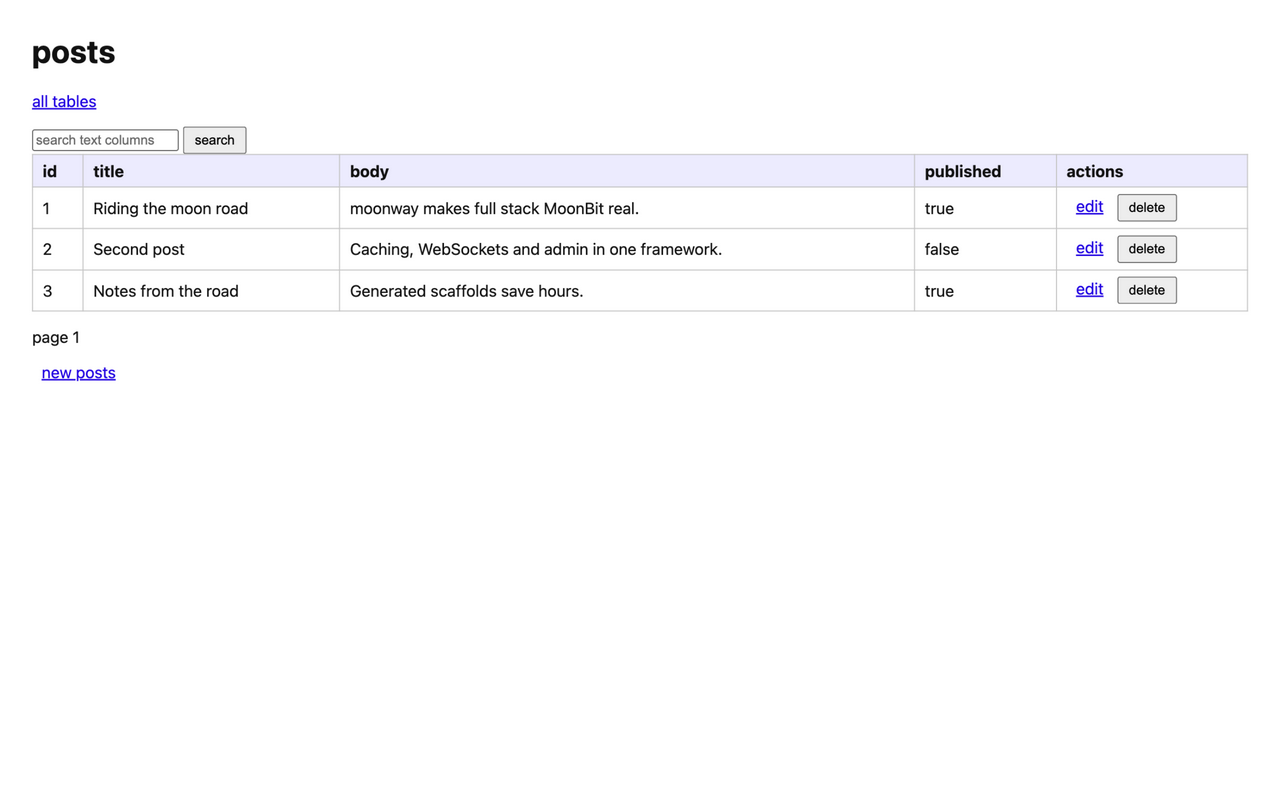
Every registered model gets a searchable, paginated CRUD interface at
/admin — create, edit, and inspect your data without writing a line of
frontend code.
#REPL console
$ moonway console
moonway 0.1.0 · connected to sqlite://app.db
moonway> Post.count()
42#Roadmap
moonway is being built in the open for the October 2026 MoonBit hackathon
(final submission: October 31, 2026).
#Contributing
Contributions are welcome! Open an issue to talk about what you'd like to
build, or submit a pull request directly.
Before committing, install the git hooks (formatting and tests run on every
commit):
git config core.hooksPath .githooks#License
MIT © 2026 David Zhang
App
pub struct App {
routes : Array[Route]
middlewares : Array[(Context) -> Context]
cache_policy : CachePolicy[RedisClient]?
ws_routes : Array[WsRoute]
static_dir : String?
}App::admin
Mount the admin dashboard at prefix (default /admin) for tables,
reading and writing through db. When token~ is non-empty, every
admin request must carry it as ?token=... (or the hidden form field
on POSTs) — basic protection, not production-grade auth.
App::cache
Enable response caching for GET requests through a Redis client: hits
are served before middlewares and handlers (X-Cache: HIT); 200 responses
are stored with the configured TTL (X-Cache: MISS). Cache failures
degrade to plain dispatch.
App::handle
App::middleware
Register a middleware. Middlewares run in registration order, before the
matched route handler; each receives and returns the context. A
middleware may short-circuit the pipeline with ctx.halt(): later
middlewares and the route handler are skipped.
App::static_files
Serve static files from dir as a fallback for unmatched GET requests:
/ maps to index.html, directories to their index.html, and
path-traversal attempts are rejected. Dynamic routes always win.
Context
Context::halt
Short-circuit the middleware pipeline: later middlewares and the route
handler are skipped, and the response built so far is returned as-is.
Context::query_param
Look up a query-string parameter (?name=value) by name.
WsConn
A WebSocket connection handed to user handlers.
WsConn::recv_text
Receive the next message as text. Binary messages are decoded lossily.
Raises when the connection closes.
WsHandler
Event handlers for a WebSocket connection. The framework runs the
receive loop: on_message fires per text message, and on_close fires
exactly once when the connection closes or errors.
WsHub
A broadcast hub: register connections as they open and broadcast text to
all of them. Runs inside the single-threaded event loop, so no locking
is needed. Failed sends are dropped silently.
run_ws
Drive the event loop of a single WebSocket connection with a handler.
Used by App::ws; exposed for tests and custom serving setups.

 MIT

 Updated 10 days ago
 37 downloads