vibe-map
DAG-based progress visualization for vibe coding — Lean 4 region map style
dag
visualization
vibe-coding
progress
Author
Version
0.7.2
License
MIT
Repository
Last updated
4 months ago
Downloads
67
English | 简体中文
#vibe-map
A goal DAG that coding agents maintain and humans watch — Lean 4 region map style, rendered as a live .vmap/vibe-map.html.
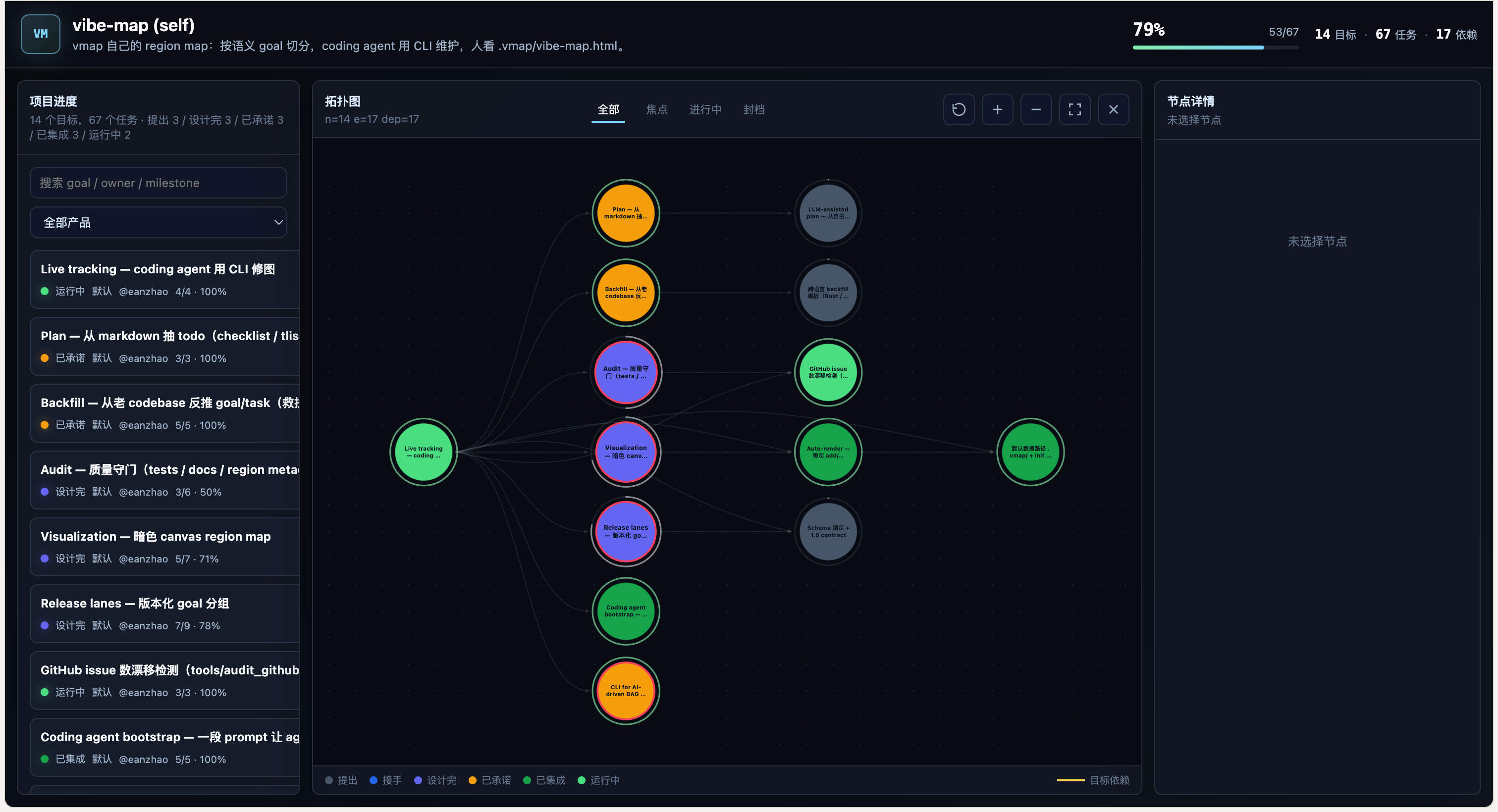
The screenshot is vibe-map's own self-map. examples/dag.html is the live version — open it locally.
#Vision
In the vibe-coding era the AI is the primary author and the human watches and steers. Two pieces of state matter constantly: where are we? and what would break if we shipped the next thing? Neither GitHub issues nor a flat todo list answer them.
vibe-map ships as a vmap CLI plus a bundle of skills. The CLI is small. The artifact the user actually consumes is a single file — .vmap/vibe-map.html — a live execution map of the goal DAG: what's done, what's next, what's blocked, and what the next ship would break.
The long-term picture (much of it still unfinished):
- Coding-agent first. This whole project is for coding agents. No PM UI, no IDE plugin, no daemon. Just a CLI an agent can exec plus skills it can read.
- Greenfield → DAG. For a brand-new project, the agent brainstorms with the user (paired with skills like gstack), then uses vibe-map to decompose the resulting docs into goals and tasks — producing an actionable .vmap/vibe-map.html.
- Brownfield → DAG. For a project that already has some code, the agent uses vibe-map to recover the goals it has already shipped, and continues forward from there.
- Regression suite per goal. Every goal carries the tests that prove it works. The user can run the full regression suite at any time. When a new goal breaks an older one, vibe-map points at exactly which goal regressed — the user (or the agent on their behalf) fixes per vibe-map's hint, or adjusts the goal definition if reality has moved.
- End-to-end loop. Once the user's idea has been refined enough — polished through gstack, or just thoroughly self-recorded — they hand it to a coding agent. vibe-map turns it into a DAG, the agent ships it goal by goal, and the loop only stops when the original idea is delivered.
- Open. Issues, forks and PRs welcome.
Where each point stands today is summarized in Status.
#Install
# macOS arm64 / Linux x86_64 / Linux arm64 — prebuilt
curl -fsSL https://raw.githubusercontent.com/eanzhao/vibe-map/master/install.sh | bash
This drops vmap into ~/.local/bin/ and skills into ~/.vmap/skills/. If ~/.local/bin is not on your $PATH, the installer prints the line to add to your shell rc.
Intel Mac (darwin-x86_64) is not in the prebuilt matrix yet (GitHub Actions macos-13 queue is too slow). Build from source for now.
From source (MoonBit toolchain + local hacking):
git clone https://github.com/eanzhao/vibe-map && cd vibe-map
moon install && moon build --target native --release
./install.sh --local "$PWD"
Distribution design: docs/distribution.md.
#Drop this prompt into any coding agent
Paste the block below into Claude Code, Codex, Cursor — whichever agent you use. It will install vmap, read the rules, and start maintaining the DAG inside your project.
Help me track this project's progress with vibe-map (vmap).

If vmap isn't installed yet:
  curl -fsSL https://raw.githubusercontent.com/eanzhao/vibe-map/master/install.sh | bash
  # If ~/.local/bin isn't on PATH, follow the script's hint and source your shell rc

Read the rules (required):
  cat ~/.vmap/skills/SKILL.md
  ls ~/.vmap/skills/playbooks/

Initialize at the project root (if .vmap/ doesn't exist):
  vmap init --name "<my project>"
  # Add .vmap/ to .gitignore

From then on, every piece of progress goes through the vmap CLI:
  - I describe a requirement → you extract goals at the PRD level (semantic, not by code package!) with vmap add goal
  - You break work into tasks: vmap add task --deps ...
  - You finish a task: vmap update <id> --status done
  - You promote a goal: vmap update <goal> --closure scoped/public/...
  - At key checkpoints: vmap audit, then fix tests/docs per the violations

Constraints:
  - A goal is a "user-perceivable capability" on the PRD, not a code package
  - closure is monotonic (seed → obligation → scoped → public → bridged → mature), never regress
  - Never hand-edit .vmap/vibe-map.json — everything goes through the vmap CLI
  - Exit codes: 1 = business error / 2 = bad args / 3 = audit violation

Playbook lookups in ~/.vmap/skills/playbooks/:
  new-feature.md / audit-fix-loop.md / release-shipping.md / daily-progress.md
  codex-goal-implement-loop.md / codex-architecture-refactor-loop.md
Command cheatsheet: ~/.vmap/skills/cheatsheet.md.

Every mutating vmap command auto-refreshes .vmap/vibe-map.html, which I'll keep open. Go.
Longer version with debugging tips: skills/vibe-map-bootstrap.md. If your repo already has .claude/skills/vibe-map-bootstrap/SKILL.md (vibe-map ships one), Claude Code auto-loads it — no copy-paste needed.
#Delegated Codex loops
vibe-map can also guide a controller agent that delegates the actual code changes to Codex CLI:
- codex-goal-implement-loop.md uses the DAG as a task queue: controller reads a vmap task, materializes the docs/tests/architecture context, runs codex exec in a worktree, reviews the diff, then updates vmap.
- codex-architecture-refactor-loop.md turns AGENTS.md, CLAUDE.md, and architecture docs into an explicit rule set, asks Codex to audit violations, writes each refactor cluster back as a vmap task, and loops through implement/review/verify.
The important split: the controller owns vmap state and git/PR topology; Codex subprocesses own source edits. The rendered .vmap/vibe-map.html stays the human-visible status surface.
#What vibe-map models
Progress lives as a DAG:
- goal — a semantic deliverable on the PRD ("users can log in", "supports release lanes") — not a code package
- task — the concrete steps that deliver a goal; tasks routinely span multiple source files / packages
- release — a version boundary ("0.5.2") that groups goals and tells the agent what this version is about
- edges are at the semantic layer — not the source-code-import layer
The coding agent edits the graph through CLI calls; the human watches the rendered HTML — region-map styled, finished work in solid color, in-flight nodes glowing, future scope fading into the background.
Terminology: goal / task rather than milestone / issue to avoid collision with GitHub's own concepts. The "region map" visual is borrowed from Lean 4 — goal / focus / closure are the same family of ideas.
#Designed for coding agents
Every command has --json output and a stable exit code:
| code | meaning |
|---|---|
| 0 | success |
| 1 | business validation failed (cycle, duplicate id, unknown node, release validation, ...) |
| 2 | CLI argument error |
| 3 | audit violations (drives the fix-and-retry loop) |
All state lives in a single vibe-map.json. No MCP, no daemon, no IDE plugin — just a binary the agent can exec.
#Three ways to load data
In decreasing order of importance:
#1. Live tracking — primary
The agent records as it reads the PRD / design docs. This is the canonical workflow:
vmap init --name "<my project>"
vmap add goal --id g-login --title "users can log in"
vmap add task --id t-auth --goal g-login --title "auth middleware" --regression-testable
vmap update t-auth --status done --tests "src/auth/middleware_test.mbt"#2. Plan — secondary (extract todos from markdown)
Scan markdown and synthesize goals/tasks:
vmap plan --docs ROADMAP.md docs/         # default: extract `- [ ]` checklist items
vmap plan --docs TODOS.md --format tlist  # extract `## T<N> — title` + `**Status:**`
Code blocks and already-checked items are skipped; reruns are idempotent.
Today plan only handles explicit checklists. Pulling semantic goals from free-form PRD text is on the 1.0.0 roadmap (goal-llm-plan) — and unblocks vision point 2.
#3. Backfill — rescue tool (recover goals from existing code)
For codebases that already exist but were never tracked. One goal per package, one done task per file:
vmap backfill --src . --template moonbit      # built-in: moonbit | typescript | dotnet
vmap backfill --src . --template-file path.json
⚠️ Useful only for retroactive recovery. Product capability dependencies ≠ code package structure — backfilled goals are package-shaped, not PRD-shaped. Once the project is running, the main entry point should return to live tracking.
#Release lanes
The thing vibe-coding gets wrong most often: AI has no sense of version boundary and won't stop adding scope. Release lanes model that:
vmap release add 0.5.2 --label-en "publish to mooncakes.io" --label-zh "发布到 mooncakes.io" \
                       --target 2026-05-20 --status open
vmap release assign 0.5.2 --goals goal-publish,goal-licensing
vmap status --release 0.5.2           # text, filtered to one release
vmap status --release 0.5.2 --json    # AI-loop friendly
vmap release list [--json]
status is a monotonic state machine: planned → open → closed, no regressions (ReleaseStatusRegression). Goals reference a release via milestone. Soft validation — only enforced when releases is non-empty, so legacy milestone="anything" data isn't blocked.
#Quality gate: vmap audit
vmap audit               # text
vmap audit --json        # JSON
echo $?                  # 0 clean / 3 violations
Today's rules:
- regression_testable: true but tests: [] → missing_tests
- status != todo but docs: [] → missing_docs
- goal missing region metadata (closure / owner / issue_count / focus / archived / promoted_at / gh_query) → missing_region_metadata
GitHub issue drift is checked by a separate script (depends on gh CLI):
python3 tools/audit_github.py --file vibe-map.json [--strict] [--markdown]The agent's audit loop looks roughly like:
vmap audit --json > /tmp/v
# parse violations → write tests for each missing_tests / write docs for each missing_docs / fill region metadata
# vmap update <id> --tests ... / --docs ... / --owner ...
# audit again until exit 0
Today audit checks that tests are listed. Actually running the regression suite and gating on it — vision point 4 — is goal-regression-runner, not yet started.
#Visualization
vmap render --out examples/dag.html
open examples/dag.html- Dark canvas goal DAG with glowing nodes, dotted background, drag / zoom / fit-to-view
- Canvas shows only goals; tasks are collapsed into the goal detail panel
- Color = closure tier: seed → obligation → scoped → public → bridged → mature
- Size = issue_count; red border = current focus; semi-transparent = archived
- Left progress panel (per goal) + search + product filter + status buttons (all / focus / in-progress / archived)
- Right node detail: closure / formal / owner / product / milestone / promoted_at / tests / docs / notes per task
- Click a node → highlight its full transitive dependency chain
- Single self-contained HTML — no CDN, no framework runtime
examples/dag.html is vibe-map's own self-map.
#CLI at a glance
vmap init                              create vibe-map.json
vmap add goal …                        add a goal
vmap add task …                        add a task
vmap update <id> …                     edit any field (unset flags don't touch existing values)
vmap rm <id>                           remove a goal or task
vmap rename <old> <new>                rename id (rewrites deps + task.goal refs)
vmap show <id> [--json]                full detail for one node (tasks / upstream / downstream)
vmap list goals [filters] [--json]     list goals with filtering
vmap list tasks [filters] [--json]     list tasks with filtering
vmap deps <id> [--upstream/--downstream/--json]  transitive deps graph
vmap context <id>                      JSON minimal context: files + ancestorGoals
vmap import --in <path>                bulk-load a hand-written vibe-map.json (validate + write)
vmap render --out X.html               render visualization HTML
vmap status [--json] [--release K]     summary text / JSON (optionally per release)
vmap audit [--json]                    quality gate
vmap coverage [--json]                 how much of docs / src / issues the DAG references
vmap doctor [--json]                   health alerts (density / lane / orphan / mismatch)
vmap backfill --src DIR                rescue tool: recover goals from source
vmap plan --docs F,…                   extract from markdown
vmap release add <key>                 add a release lane
vmap release list [--json]             list releases
vmap release update <key> --status/--target/--label-en/--label-zh/--notes
vmap release assign <key> --goals      assign goals to a release
vmap release unassign <key> [--goals]  remove goals from a release (default: all)
vmap release rm <key> [--force]        delete a release (--force if it has members)
vmap version [--check]                 print version
vmap upgrade                           print the upgrade command (pipe through bash to run)
Full flags via --help on each subcommand.
vmap update <id> fields (general + per-kind):
- general: --title, --regression-testable, --tests a,b,c (replace), --add-test/--remove-test, --docs/--add-doc/--remove-doc, --deps a,b,c (replace), --add-dep/--remove-dep
- goal only: --description, --closure, --formal, --product, --milestone, --owner, --issue-count, --focus/--archived, --promoted-at key=date,…, --gh-query
- task only: --status, --notes, --goal <new-goal> (move task between goals)
closure is monotonic (no regression). add-dep runs cycle detection. rename rewrites every deps reference and task.goal pointer.
#Data model
State lives in vibe-map.json. The agent reads it directly:
{
  "config": { /* products / closure_tiers / formal_levels / ui */ },
  "project": { "name": "...", "description": "..." },
  "releases": [
    { "key": "0.5.2", "label": {"en":"publish to mooncakes.io","zh":"发布到 mooncakes.io"},
      "target": "2026-05-20", "status": "planned|open|closed", "closed_at": null }
  ],
  "goals": [{
    "id": "goal-login",
    "title": "users can log in",
    "deps": ["goal-schema"],            // cross-goal deps at the semantic layer
    "closure": "scoped",                // seed → obligation → scoped → public → bridged → mature (monotonic)
    "formal": "checked",                // none / sop / checked / audited
    "product": "default",
    "milestone": "0.5.2",               // points at release.key (soft-validated)
    "owner": "eanzhao",
    "issue_count": 3,
    "focus": true,
    "archived": false,
    "promoted_at": { "scoped": "2026-05-19" },
    "gh_query": "is:issue label:goal-login",
    "regression_testable": true,
    "tests": [], "docs": []
  }],
  "tasks": [{
    "id": "t-auth", "goal": "goal-login",
    "title": "auth middleware",
    "status": "todo | in-progress | blocked | done",
    "deps": [],                         // same-layer task deps
    "notes": "",
    "regression_testable": true,
    "tests": [], "docs": []
  }]
}
Older JSON missing newer fields still loads (Option fields default to None). closure monotonicity is enforced in set_goal_closure. Release lanes are soft-validated: keys are only checked against releases when that list is non-empty.
vmap context <id> derives its slice from existing schema fields only: deps
defines the ancestor graph, and docs / tests are the node-owned file lists.
The command returns deterministic JSON:
{ "files": ["..."], "ancestorGoals": ["..."] }#Status
Machine-friendly: vmap release list --json. Human-friendly below.
#Currently in flight — 0.4.0 (release modeling + audit + viz polish, target 2026-06-15)
| Goal | State |
|---|---|
| goal-release-modeling — release lanes (data + CLI) | Stage 1 ✓ (add/list/update/assign/unassign/rm, status --release, release_progress); Stage 2 pending (release status / close) |
| goal-cli-dag-mgmt — CLI surface the agent uses to drive the DAG | ✓ update --deps/--add-dep/--remove-dep/--goal/--notes/--description/--add-test/--remove-test/--add-doc/--remove-doc, show <id>, list goals/tasks (filtering), deps <id> (transitive), rename <old> <new> |
| goal-audit — audit rule expansion | Base rules ✓; pending: release_blocked / release_unknown / audit --release filtering |
| goal-viz — release dimension in the viz | Base viz ✓; pending: release dropdown filter, group-by-release on the left panel |
#Planned — 0.6.x → 1.0.0 (and the vision)
| Goal | Vision link | Notes |
|---|---|---|
| goal-llm-plan | point 2 (greenfield → DAG) | Upgrade vmap plan: extract semantic goals from free-form PRD text, not just - [ ] checklists |
| goal-regression-runner | point 4 (regression suite per goal) | Actually run the tests attached to every goal, gate new ships on them, point at the exact regressed goal when something breaks. Today audit only checks tests are listed, not that they pass. |
| goal-greenfield-bootstrap | point 2 | Tighter loop between brainstorm-style skills (gstack and similar) and vmap plan — agent walks the user from raw idea to a full DAG without manual copy-paste |
| goal-cross-language | — | Rust / Go / Python templates for backfill (rescue tool broadcast) |
| goal-schema-freeze | — | schema_version field + upgrade path + stable schema doc |
#Shipped
| Release | Date | Contents |
|---|---|---|
| 0.1.0 | 2026-05-15 | Live tracking: init / add goal / add task / update / rm, JSON persistence, cycle detection, stable exit-code contract |
| 0.2.0 | 2026-05-17 | Plan (checklist + tlist), Backfill (moonbit / typescript / dotnet templates), base visualization (HTML, product/search/status filters, node detail), base Audit (tests / docs / region metadata), GitHub issue drift script |
| 0.3.0 | 2026-05-18 | Terminology rename: Milestone → Goal, Issue → Task (isolating from GitHub's concepts) |
| 0.5.0 | 2026-05-19 | The all-in-one coding-agent experience: install.sh (curl | bash) + skills bundle (SKILL.md / cheatsheet / playbooks / vibe-map-bootstrap) + .vmap/ default path + auto-render of .vmap/vibe-map.html on every mutating command + vmap version / vmap upgrade + 12 cli-dag-mgmt commands + release lanes (base) + node detail modal |
| 0.5.1 | 2026-05-19 | Skill refresh: agent now reads GitHub issues (gh issue list) as a PRD signal during bootstrap |
| 0.5.2 | 2026-05-20 | vmap coverage (docs/src/issues coverage) + vmap doctor (density / lane / orphan / mismatch warnings); published to mooncakes.io under MIT |
| 0.5.3 | 2026-05-20 | vibe-map.html frontend: double-click a sidebar goal row to open its detail modal, GitHub URLs across the page become new-tab links, double-click an expanded task card for a dedicated task detail modal |
| 0.6.0 | 2026-05-21 | Release modeling Stage 2, Audit Stage 2, Visualizer Stage 3 & AI Regression Context: vmap release status / close CLI subcommands (with target-specific FFI date retrieval), vmap audit --release filtering, core release audit rules (release_unknown & release_blocked), HTML visualizer sidebar release grouping & filter dropdown, and vmap regression prompt to compile structured markdown diagnostics context for external AI agents |
| 0.6.1 | 2026-05-22 | Regression Probes Dashboard & Runner: Added automated regression sweep runner vmap regression run (cross-platform FFI command execution), left progress sidebar tab-switcher to display Probes status dashboard (Passed/Failed/Missing/Pending), and detailed execution stats/warnings rendering inside vibe-map.html |
| 0.7.1 | 2026-05-23 | Delegated Codex loops: added codex-goal-implement-loop and codex-architecture-refactor-loop playbooks, prompt templates, and a cross-platform spawn-codex.sh wrapper so a controller agent can delegate implementation/review/refactor work to Codex CLI while keeping vmap as the visible state surface |
| 0.7.2 | 2026-06-03 | Minimal agent context slices: added vmap context <id> to emit deterministic { files, ancestorGoals } JSON from existing DAG deps, docs, and tests, with core tests for goal and task slices |
#Contributing
Issues, forks and PRs are welcome — file at github.com/eanzhao/vibe-map. The project is bilingual (English / 简体中文); either is fine.
If you're proposing a new direction, opening an issue first saves rework — the long-term shape (see Vision) is opinionated.
#Build
moon install                # fetch moonbitlang/x
moon build --target native  # outputs _build/native/debug/build/cmd/vmap/vmap.exe
moon test                   # 63 tests
moon fmt && moon check#License
MIT — see LICENSE.
Install
Download zipDAG-based progress visualization for vibe coding — Lean 4 region map style
dagvisualizationvibe-codingprogress

 MIT
MIT
 Updated 4 months ago
 67 downloads