 README
- UBatchCase
- UBatchResult
- UDiagnostic
- UFinding
- UInputChange
- UInputIssue
- UIssueCode
- ULesionKind
- UMeasurement
- UObservation
- UPreflightReport
- UReportLanguage
- UResolvedMeasurement
- UReviewNotice
- URuleCheck
- UStudy
- UTargetLesion
- UTargetResponse
- UTrackRevision
- UTrajectory
- UVisit
- UVisitAssessment
- UVisitImpact
- Vcompare_tracks
- Vexplain_assessment
- Vformat_diameter_mm
- Vinput_template_files
- Vparse_batch_json
- Vparse_diameter_mm
- Vparse_followup_cells
- Vparse_followup_csv
- Vparse_study_json
- Vpreflight_inputs
- Vpreflight_track
- Vrender_audit_csv
- Vrender_audit_html
- Vrender_audit_html_in
- Vrender_audit_json
- Vrender_audit_manifest
- Vrender_audit_markdown
- Vrender_audit_markdown_in
- Vrender_batch_index_html
- Vrender_batch_index_json
- Vrender_bundle_manifest
- Vrender_lesion_trends_svg
- Vrender_preflight_json
- Vrender_preflight_markdown
- Vrender_revision_html
- Vrender_revision_json
- Vrender_revision_markdown
- Vrender_trajectory_svg
- Vrender_trajectory_svg_in
- Vrender_validation_json
- Vreplay_track
- Vreview_artifacts
- Vsha256_hex
- Vvalidate_study
- Vvalidate_track
- Vverify_bundle
lesion-followup
Offline target-lesion follow-up review with explicit baseline, nadir and measurement evidence
clinical
oncology
recist
target-lesions
follow-up
Author
Version
0.2.0
License
Apache-2.0
Repository
Last updated
4 hours ago
Downloads
5
#lesion-followup
An offline MoonBit library for reviewing manually measured CT target lesions.
It keeps baseline and historical-minimum references explicit and returns each
target category together with the measurements and rules that support it.
靶病灶随访复核:保留每次计算的基线、历史最低值和测量依据。
This project implements a documented RECIST 1.1 target-lesion subset for
software review and education. It does not read images, choose targets, evaluate
non-target disease or new lesions, assign overall response, or recommend
treatment. All included cases are synthetic. A target CR/PR/SD/PD is not an
overall CR/PR/SD/PD.
#Run the demos
Install the MoonBit toolchain, then run
from this checkout:
moon run --target native cmd/demo -- --scenario nadir-boundary
moon run --target native cmd/demo -- --scenario node-resolution --format json
moon run --target native cmd/demo -- --scenario missing-visit --format svg
moon run --target native cmd/demo -- --study examples/study.json --input examples/followup.csv --format html --output review.html
moon run --target native cmd/demo -- --study examples/study.json --input examples/followup.csv --check-input --format json
moon run --target native cmd/demo -- --scenario nadir-boundary --bundle review-bundle
moon run --target native cmd/demo -- --init-example new-inputs --template multi --lang zh-CN
moon run --target native cmd/demo -- --study new-inputs/study.json --input new-inputs/followup.csv --format html --lang zh-CN --output new-inputs/review.html
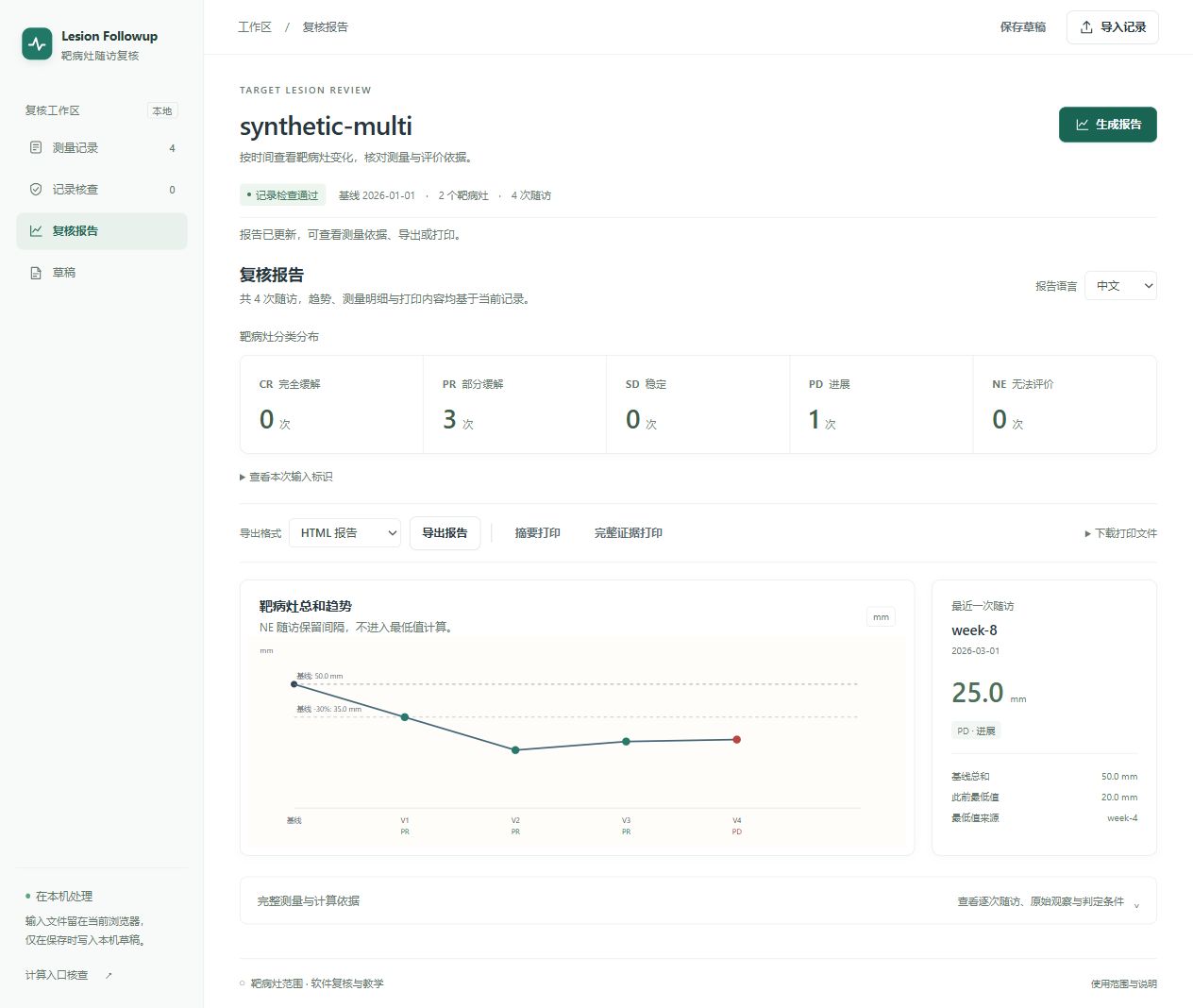
Open the saved example report locally for an immediate
preview. It contains inline CSS and SVG with no JavaScript or external assets.
Category cards and ledger rows link to the relevant visit evidence.
The Chinese example report includes the same
quantities and categories, translated explanations and individual-target trends.
The complete review collection covers multiple
targets, missing observations, changed acquisition identifiers and revision
effects, with hand-calculated expectations and importable workbench drafts:
python scripts/reproduce_examples.py --output _build/review-examplesVersion 0.2.0 candidate packaging, compatibility and installation checks are
documented in the release guide. Windows and Linux CI run the
same acceptance suite from clean checkouts, including independent consumption of
the extracted candidate package. Registry publication is recorded separately.
The current workbench also provides direct selection of the complete synthetic
examples, fixed-reference revision comparison and portable two-version review
sessions. See the workbench guide for saving both original
source pairs and restoring them for a fresh comparison. Saved sessions can be
reviewed as an independent batch, exported as native-compatible report ZIPs and
checked again through the browser's bundle-integrity view. A separate human-review
checklist retains viewing states and comments, with input-bound note files and
independent HTML/Markdown explanations; core findings and categories stay intact.
Complete handoff ZIPs carry both input versions, native reports and optional
notes, with full report regeneration before explicit workspace restoration.
Whole-visit editing adds blank observations for every baseline target, updates
shared visit information and removes visits after preview. Current-input undo
and redo retain exact text within a bounded in-memory history; see the
editing contract.
The per-target form records one visit's observation states, measured diameters
or reader limitations together, with a change preview and atomic save.
External projects can follow the integration guide,
which distinguishes extracted-candidate validation from registry installation.
#Prepare and check inputs
--init-example NEW_DIRECTORY creates study.json, followup.csv and filling
instructions in README.md. Choose --template single (default) or multi.
The parent directory must exist. Initialization requires a new directory and
never merges into an existing file, directory or symlink. Both templates contain
matched, directly runnable synthetic data. Initialization accepts only
--template and --lang alongside its destination.
--check-input separates parsing errors, structural errors and reader-review
hints. Hints include omitted/explicitly missing measurements, reader limitations,
the explicit 5.0 mm default, technique changes and persistent context gates.
It reuses the replay engine's findings and returns no response categories.
Structural errors carry CSV cell positions or JSON field paths. An omitted
target uses the visit's first row as an anchor with a null field, because no
measurement cell exists. No input is sorted, repaired or overwritten.
The JSON validation envelope keeps schema_version, valid, visit_count,
diagnostics and input_issues, and adds review_hints and source locations.
valid: true means parse and structural checks passed; review hints can still be
present. Exit status remains 0 for valid input and 2 for input errors.
#Display language and individual observations
--lang en (default) or --lang zh-CN selects HTML, Markdown, SVG and human CLI
presentation, including preflight and template instructions. Machine-readable
JSON/CSV bytes and stable codes remain language independent. Reader notes and
identifiers are retained verbatim, escaped for the output format. Diagnostic
summaries are translated while retaining the original detailed diagnostic.
HTML and Markdown add an individual-target observation ledger. HTML also adds
one plot per target with an independent vertical scale and labels for longest
diameter or node short axis. A square marks the explicit 5.0 mm default; a cross
has no diameter. A hollow marker preserves an available observation from an NE
visit. Lines stop at NE or missing visits. These observations do not make that
visit eligible for the sum trend or nadir. The standalone svg CLI format
continues to export the sum chart.
#Explain calculations and compare revisions
HTML and Markdown now expand the exact conditions for each visit. JSON adds
rule_checks with integer operands, an operator, a nullable result and active.
S is the current sum, B the baseline, and N the prior eligible minimum.
The trace shows 5*S >= 6*N, S-N >= 50 and 10*S <= 7*B in 0.1 mm units,
plus completeness, technique/context gates and per-target CR conditions.
An inactive comparison can be numerically true without selecting a category;
earlier gates and rule priority still apply. Findings explain NE requirements.
Compare two independent replays of the same exact baseline profile:
moon run --target native cmd/demo -- --study examples/study.json --input examples/followup.revised.csv --compare-study examples/study.json --compare-input examples/followup.csv --format html --lang zh-CN --output revision.htmlThe revised files use --study and --input; original files use
--compare-study and --compare-input. Output supports JSON, Markdown and HTML.
Both tracks must have identical study identity, baseline, acquisition metadata
and ordered baseline target set. Visits and observations are aligned by IDs.
Input additions, removals and changed fields are separate from downstream
assessment changes. Identical input gives an empty difference. All four source
paths are protected from output replacement.
The saved Chinese comparison changes week-4 T1
from 10.0 to 9.0 mm. The minimum becomes 19.0 instead of 20.0 mm; week-6's
24.0 mm sum then meets both PD conditions, and week-8 requires post-PD review.
#Verify bundles and review batches
moon run --target native cmd/demo -- --study examples/study.json --input examples/followup.csv --bundle review-bundle
moon run --target native cmd/demo -- --verify-bundle review-bundle --format json
moon run --target native cmd/demo -- --batch examples/batch.json --bundle new-batch-reviews --lang zh-CN
New bundles use manifest schema 2: software/rule versions, language, semantic
input fingerprints, raw-file SHA-256 when file inputs were used, and exact UTF-8
artifact lengths and SHA-256. There are no timestamps or local source paths.
Verification checks the four fixed artifact names, contents, semantic input
fingerprints and summary against audit.json; it rejects missing files,
modified bytes, unknown profiles/versions and unsafe names. It does not modify
the bundle. Hashes check integrity; they are not signatures or proof of author
identity. Original-file fingerprints are recorded, not rechecked against absent
source files. The legacy render_audit_manifest API still emits metadata-only
schema 1; use render_bundle_manifest for the verifiable schema 2.
The batch manifest uses schema 1 and a cases array of
id, study and input. Relative paths are resolved against that manifest's
directory. IDs are portable ASCII letters/digits/underscore/hyphen, at most
64 characters, unique ignoring case; device names and path components are
rejected. The list accepts 1–1000 cases. Use synthetic identifiers.
Batch output requires a new directory. Each successful case gets its own
verifiable bundle, and index.json/index.html retain every case, including
input and I/O failures. A failure does not stop later cases. Exit code 3 means
one or more cases failed; a global manifest error remains 2, and a global I/O
failure remains 1. Valid NE or PD reports still count as successful processing.
| Synthetic scenario | What it demonstrates | Ordered target categories |
|---|---|---|
| nadir-boundary | Baseline 100.0 mm, then 20.0, 24.0, 25.0; PD needs both relative and absolute growth | PR, PR, PD |
| node-resolution | Node short axis 10.0 vs 9.9 mm; reappearance needs overall context | PR, CR, NE |
| missing-visit | An unmeasured visit cannot lower the nadir | PR, NE, PR, PD |
--format accepts markdown, json, csv, svg, or html. Without --output,
the report goes to standard output. Output parents must already exist. Existing
output files are replaced, except resolved source input paths are protected.
--bundle creates a directory containing report.html, audit.json, audit.csv,
chart.svg, and manifest.json; repeating the same input produces identical
artifact bytes. It replaces those named files in the selected directory.
CLI exit codes are 0 for valid input (including NE or PD observations), 2 for
arguments, parsing or structural validation errors, and 1 for I/O failures.
Batch partial failure uses 3 as described above.
--check-input validates schema and track structure and highlights review
requirements; the reader still determines clinical comparability.
#Public API
Consumers import the root package as lib:
import { "impart563/lesion-followup" @lib }The following example is compiled and tested with the library:
///|
test "exact target PD boundary through the public facade" {
  let study : @lib.Study = {
    id: "synthetic-example",
    baseline_date: "2026-01-01",
    technique_id: "ct-5mm",
    slice_thickness_tenths_mm: 50,
    targets: [
      { id: "T1", organ: "liver", kind: NonNodal, baseline_tenths_mm: 200, },
    ],
  }
  let visit : @lib.Visit = {
    id: "week-4",
    date: "2026-02-01",
    technique_id: "ct-5mm",
    measurements: [{ lesion_id: "T1", observation: Measured(250), }],
  }
  guard @lib.replay_track(study, [visit]) is Ok(trajectory) else {
    fail("valid example was rejected")
  }
  assert_eq(trajectory.assessments[0].response.code(), "PD")
  assert_eq(trajectory.assessments[0].nadir_visit_id, "baseline")
}
The root exports Study, TargetLesion, LesionKind, Visit, Measurement,
Observation, Trajectory, VisitAssessment, findings, issues and diagnostics;
validate_study, validate_track, replay_track; study-JSON and follow-up-CSV
parsers; and all public report renderers. The library uses no file or network I/O.
The native CLI uses moonbitlang/async@0.19.4 for file and stream access.
New presentation APIs retain the original English entry points:
render_audit_html_in, render_audit_markdown_in and render_trajectory_svg_in
accept ReportLanguage (English or SimplifiedChinese).
render_lesion_trends_svg exports the individual-target plots.
input_template_files returns matched in-memory files;
preflight_inputs and preflight_track return a PreflightReport, whose
is_valid() checks blocking errors separately from review_hints.
render_preflight_json and render_preflight_markdown format that report.
explain_assessment exposes typed RuleCheck values; compare_tracks returns
TrackRevision with input changes and affected assessments. The bundle and
batch parsing/rendering APIs remain pure; filesystem operations stay in the CLI.
replay_track rejects structurally invalid tracks as a whole. Successful replay
snapshots the supplied arrays and preserves visit order. Missing or unsupported
observations are retained in NE assessments. Renderers expect a trajectory
returned by successful replay; callers should not mutate its arrays.
The quickstart exercises the facade directly.
A separate consumer module verifies
external type construction, methods and reporting through a local workspace:
moon run --target native examples/quickstart
moon -C examples/downstream-consumer run --target native .#Offline browser workbench
Build the local workbench, JavaScript ES module and synthetic smoke page:
python scripts/build_browser.py_build/browser/browser.js exports evaluate(request_json: string): string.
The workbench in _build/browser/index.html imports paired JSON/CSV files,
edits baseline targets and follow-up observations, locates input problems and
previews the current target-only report. Input changes invalidate earlier
reports. Explicit local/portable drafts preserve unfinished records; summary and
full-evidence layouts support A4 printing and standalone HTML export.
The versioned JSON boundary supports review, preflight, templates and editable
text cells, revision comparison, report bundles, bundle validation and batch
indexes, using the existing MoonBit core. Input errors retain source locations;
valid NE observations remain successful evaluations. The adapter itself has no
file, network or storage access. Browser-side file selection, downloads and
explicit draft persistence belong to the workbench.
See the workbench guide for local serving and the review
workflow, or the browser contract for application
integration. The build loads only local assets; it requires a local HTTP server
for browser module imports. No server-side computation or external service is
needed.
#Exact inputs and evidence
Study JSON declares schema_version: 1, a baseline date,
a comparable technique ID, CT slice thickness, and a fixed one-to-five target
set. Non-nodal targets use longest diameter; nodes use short axis. All nodes use
the single organ group lymph_nodes. Callers supply canonical organ groups and
must combine paired organs consistently. Each group may have at most two targets.
Diameters are unsigned decimal strings with at most one decimal place in
JSON, and plain decimal fields in CSV. The API uses tenths of a millimetre.
No input values are rounded. CT slices must be 0.1–5.0 mm; baseline target minima
are 10.0 mm for non-nodal lesions and 15.0 mm for nodes. The software limit per
diameter is 1000.0 mm. MRI, thicker CT slices and other acquisition methods are
outside this version's input contract.
The long-form CSV has this exact header:
visit_id,date,technique_id,lesion_id,state,diameter_mm,noteRows for one visit must be contiguous and repeat identical date and technique.
Visits use unique IDs and strictly increasing Gregorian YYYY-MM-DD dates after
baseline; baseline is a reserved visit ID. The parser never sorts rows. It
supports quoted commas, escaped quotes, multiline fields, CRLF and a UTF-8 BOM.
Parse diagnostics carry one-based physical line, column and field positions.
Structural validation issues identify visits and targets but do not carry CSV
locations. JSON schema errors identify field paths; unknown fields are rejected.
| state | diameter_mm | note | Meaning |
|---|---|---|---|
| measured | Required decimal | Empty | Reader's actual diameter, including sub-5-mm measurements |
| absent | Empty | Empty | Explicitly disappeared; effective size 0.0 mm |
| too_small | Empty | Empty | Visible but not reproducibly measurable; explicit 5.0 mm default |
| missing | Empty | Empty | Unmeasured, never imputed as zero |
| not_evaluable | Empty | Required reason | Reader-supplied limitation, such as lesion coalescence |
Omitted baseline targets behave as missing. Unknown targets and duplicate
measurements are structural errors. An empty visit can be supplied through the
API; CSV needs at least one explicit missing row to represent that visit.
Audit JSON retains the study, original observations, resolved diameters, target
category, prior nadir visit, and findings. CSV uses assessment, measurement
and finding detail rows. Missing quantities use JSON null or blank CSV fields.
Percent changes use integer basis points in JSON and two decimal places in
display reports, truncated toward zero. Exact integer comparisons determine
categories independently of displayed percentages.
#Rule boundaries
PR uses baseline; PD uses the prior complete eligible minimum and requires both
growth conditions. Node CR retains actual node size below 10 mm in the sum.
NE visits do not change the reference. Technique changes require review.
After target PD, further classifications are outside this release. Reappearance
after target CR, or loss of a prior PR threshold without PD, requires response
context and produces NE rather than an inferred overall category. These review
gates persist for the remaining track.
See rule semantics and sources for exact comparisons,
conservative exclusions, and the difference between target and overall response.
This implementation does not establish clinical or regulatory validation.
#Checks
python scripts/acceptance.pyThe acceptance script discovers moon on PATH or in ~/.moon/bin, requires only
Python 3.8+ standard library plus Node.js for browser-module checks, runs warning-free all-target checks/tests, native
build, README examples, public interfaces, a separate consumer module, five-format
consistency, browser/native parity, deterministic bundles, CLI failures and escaping checks, and builds
the Mooncakes source package. Acceptance details and the
recorded local result identify verified commands
and the source fingerprint. The same script is configured in CI.
#License
Apache-2.0 for this project's code and original documentation. The RECIST name,
source publications and linked materials retain their respective ownership and
terms. Official PDFs, forms and images are not redistributed here.
Diagnostic
CSV locations are one-based physical line/column (Unicode code points).
JSON schema diagnostics use field paths and have no line/column location.
Finding
Codes are stable machine-readable reasons; messages describe the calculation.
LesionKind
The measurement axis is longest diameter for non-nodal targets and short
axis for lymph nodes. Organ names are canonical groups supplied by the caller.
Observation
Missing is different from Absent. TooSmallToMeasure means the reader has
explicitly identified a visible target without a reproducible measurement.
PreflightReport
Parse errors and structural errors block replay; review hints do not.
ReportLanguage
Presentation language only. Machine-readable codes and reader notes stay intact.
ReviewNotice
A source location or visit anchor. Missing rows have no fabricated field location.
RuleCheck
Exact scaled-integer comparison for review. active distinguishes considered
criteria from criteria skipped by an earlier gate. Unavailable operands stay null.
Study
A fixed, caller-selected target set measured by CT with slices <= 5 mm.
This record does not certify target selection or assess non-target disease.
TargetLesion
Diameters use tenths of a millimetre; 200 represents 20.0 mm.
TargetResponse
Target-lesion categories only; these are never overall response categories.
Visit
Visits must be in strictly increasing Gregorian YYYY-MM-DD order.
VisitAssessment
The nadir fields refer to the complete eligible visit BEFORE this assessment.
Basis points are display-only truncated percentages: -3000 means -30.00%.
compare_tracks
fn compare_tracks(before : Trajectory, after : Trajectory) -> Result[TrackRevision, Array[Diagnostic]]Compare replayed tracks of the same exact baseline profile. Visit and lesion
identity, rather than array position, aligns changes. Inputs remain untouched.
explain_assessment
Explain an assessment produced by replay_track. This presentation of the
comparisons does not classify a second time or use rounded percentages.
input_template_files
fn input_template_files(name : String, language? : ReportLanguage) -> Result[Array[(String, String)], String]Matched synthetic inputs and instructions. Writing files belongs to the CLI.
parse_batch_json
Paths are resolved by the CLI relative to the batch manifest, never the CWD.
parse_diameter_mm
fn parse_diameter_mm(text : String) -> Result[Int, String]Parse an unsigned plain decimal exactly at 0.1 mm precision, without rounding.
The accepted software range is 0.0 through 1000.0 mm.
parse_followup_cells
Decode editable text cells using the clinical parser's quoting and locations.
Only CSV shape is checked here; clinical state/precision validation remains
in parse_followup_csv and preflight_inputs. The header is not returned.
parse_followup_csv
Long-form CSV: one target observation per row. Visit rows must be contiguous;
the parser preserves order and rejects partial results on any parse error.
parse_study_json
Decode a versioned study profile. Call validate_study for clinical-contract
validation after schema parsing. Numeric diameters must be decimal strings.
preflight_inputs
Combined JSON/CSV preflight with physical CSV locations and JSON field paths.
Review hints are only derived after both inputs parse and validate in full.
preflight_track
Inspect the validated track using the same replay findings as the report.
This preflight supplies no response categories and never changes input values.
render_audit_csv
Typed detail rows. Blank numeric fields represent unavailable values.
render_audit_html
Offline review document: no scripts, fonts, images or network dependencies.
All input-derived text is escaped; navigation IDs are generated by position.
render_audit_html_in
Localized presentation; input-derived text and machine codes are preserved.
render_audit_json
Deterministic, versioned evidence envelope. It retains original observations,
resolved measurement values and the exact prior nadir for every visit.
render_audit_markdown
Text report of target-only categories, references and individual findings.
render_audit_markdown_in
Localized presentation; input-derived text and machine codes are preserved.
render_batch_index_html
render_bundle_manifest
fn render_bundle_manifest(trajectory : Trajectory, artifacts : Array[(String, String)], language? : ReportLanguage, raw_inputs? : Array[(String, Bytes)]) -> StringV2 adds exact raw-file input digests when available and always includes
semantic input digests. No timestamps or local source paths affect determinism.
render_lesion_trends_svg
Individual observations remain visible even in an NE visit. NE visits and
missing observations break connecting lines; only measured/default values plot.
render_preflight_json
Additive validation schema: machine-readable messages and codes are language independent.
render_preflight_markdown
render_revision_html
render_revision_markdown
render_trajectory_svg
Self-contained SVG: target sum, baseline and baseline-minus-30% guides.
NE visits break the line and are never plotted as a zero-diameter result.
render_trajectory_svg_in
Localized presentation; input-derived text and machine codes are preserved.
render_validation_json
fn render_validation_json(diagnostics : Array[Diagnostic], issues : Array[InputIssue], visit_count : Int) -> Stringreplay_track
Replay a fixed CT target set in supplied order. Thresholds use exact scaled
integer comparisons. Percentages are display values and never drive rules.
NE visits do not update the nadir. Later visits after target PD, or after
target-CR reappearance needing overall context, remain NE in this release.
review_artifacts
Four deterministic artifacts. Manifest construction hashes their UTF-8 bytes.
sha256_hex
fn sha256_hex(bytes : Bytes) -> StringSHA-256 of exact input bytes for bundle integrity, not authentication.
validate_study
Validate the CT target-set contract before any comparisons are made.
The software diameter limit is 1000.0 mm per target, not a clinical threshold.
validate_track
Structural errors reject the whole trajectory. Omitted targets and explicit
missing observations are valid inputs that produce NE rather than errors.
verify_bundle
Validate metadata and exact supplied artifact bytes. Fixed artifact names are
the only allowed names; callers must not resolve arbitrary manifest paths.
Source Files
Install
Download zipOffline target-lesion follow-up review with explicit baseline, nadir and measurement evidence
clinicaloncologyrecisttarget-lesionsfollow-up

 Apache-2.0

 Updated 4 hours ago
 5 downloads