groklite
Turn unstructured log lines into named fields with a bounded grok-style pattern engine.
log
grok
pattern
parser
observability
Author
Version
0.1.2
License
Apache-2.0
Repository
Last updated
10 hours ago
Downloads
20
#groklite
中文一句话:把非结构化日志行按 grok 风格模式拆成命名字段,纯计算、无 IO、多目标可用。
A log line arrives as text and is wanted as strings keyed by name. Somewhere between
the process that prints it and the store that indexes it, somebody decides which part
of the line is the status code. That decision usually ends up inside a regular
expression the next person cannot read, cannot test, and cannot extend without
breaking three other services.
groklite keeps the decision in one place. A pattern names what to extract:
%{IP:client} %{WORD:method} %{NUMBER:status}a registry gives each name a rule, and one call turns a line into fields. Patterns are
data, so adding a format is a table entry with a corpus line behind it, not a new
regular expression in a new service.
#Demo
One recording, captured from a real run of both examples:
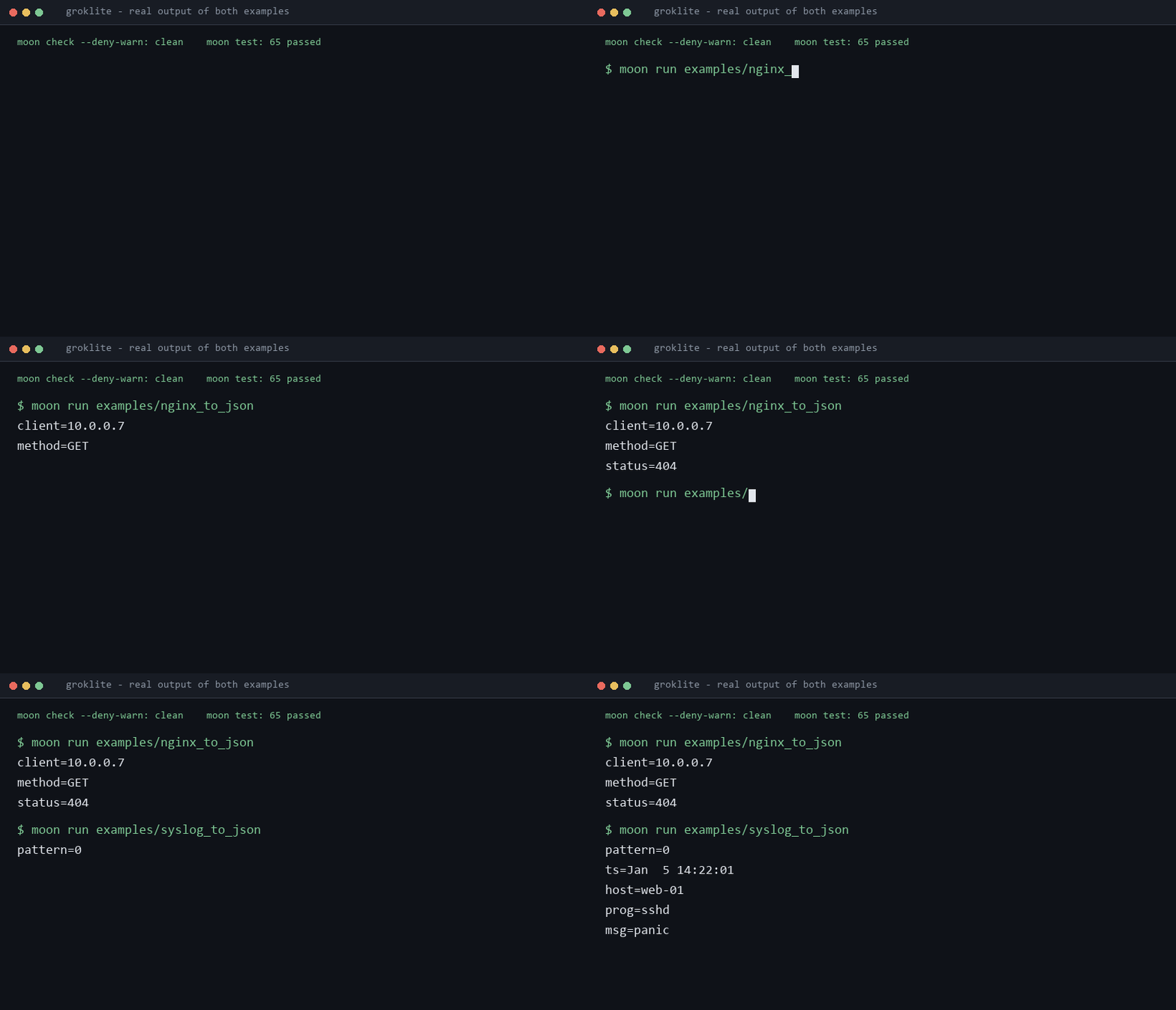
The first block reads an access-log line; the second reads a syslog line with the
syslog family. Nothing in the recording is typed by hand.
#Install
moon add qqq66668/grokliteThe module has one package with public exports, qqq66668/groklite/src. A consumer
declares it in moon.pkg:
import {
  "qqq66668/groklite/src" @groklite,
}
One call compiles a pattern against the curated rules; one call matches a line:
fn main {
  let pattern = "%{IP:client} %{WORD:method} %{STATUS:status}"
  match @groklite.compile_builtin(pattern) {
    Err(error) => println(@groklite.describe_compile_error(error))
    Ok(program) => {
      match @groklite.match_line(program, "10.0.0.7 GET 404") {
        Err(error) => println(@groklite.describe_match_error(error))
        Ok(fields) => {
          match @groklite.field_value(fields, "status") {
            Some(value) => println(value)
            None => println("no status field")
          }
        }
      }
    }
  }
}
It prints 404. Those are the same three calls examples/nginx_to_json makes,
and continuous integration runs that example, so the shape of the call stays honest.
#Shape
Four packages with one direction of dependency:
- src/syntax turns pattern text into ordered segments and reports offsets.
- src/registry maps a pattern name to a rule.
- src/compile expands references and lowers them into a matcher program.
- src/engine executes that program over one line.
src is the only package with public exports. docs/design.md states the invariants
and docs/limits.md states what the library refuses to do.
#What works today
Six capabilities, each covered by tests and exercised by the examples:
- parse turns pattern text into literal and reference segments, and reports a malformed pattern with an offset and a caret line.
- builtin ships 16 curated rules: the access-log core plus the syslog prefix.
- parse_rule reads a rule body into a node tree: bracket classes, shorthand escapes, groups, alternation, anchors and bounded repetition.
- compile lowers segments into a program with numbered capture slots and a field table, refusing a duplicate field, an unknown rule and a malformed body at compile time.
- match_line runs a program over one line and returns a field table. Matching is whole-line: a partial match is a failure, not a best-effort result. Every pass is bounded by a step budget, and running out is reported rather than hidden.
- match_first tries compiled programs in order and reports the first whole-line match, so a stream that mixes formats needs one pass instead of one branch per format.
65 tests cover those paths: unit tests beside each package, a corpus table that
drives the public facade, and the two examples continuous integration executes.
#Run the example
moon run examples/nginx_to_jsonIt prints the three fields of one access-log line:
client=10.0.0.7
method=GET
status=404
The same example runs in continuous integration, so this snippet is verified output, not
a claim. src/corpus_test.mbt is the black-box test file: it drives the public facade from a corpus
table of input line plus expected field map.
A stream normally mixes formats, so match_first takes compiled programs in order and
returns the first that matches the whole line, or one failure for the whole list. A step
budget failure stops the search instead of being read as a miss.
#A second format
A stream rarely carries one format. examples/syslog_to_json compiles two patterns and
tries them in order, printing the fields of the first one that matches the whole line:
moon run examples/syslog_to_jsonpattern=0
ts=Jan 5 14:22:01
host=web-01
prog=sshd
msg=panicBoth examples run in continuous integration.
#Provenance
The pattern syntax follows grok, the form Logstash popularised: a rule name in braces,
optionally followed by the field it should fill. Several rule names in the built-in
registry (WORD, NUMBER, INT, SPACE, NOTSPACE, HOST, IP, IPORHOST,
USER, MONTH, MONTHDAY, TIME, SYSLOGTIMESTAMP, PROG, SYSLOGBASE) come from
the vocabulary of logstash-patterns-core
(https://github.com/logstash-plugins/logstash-patterns-core, Apache-2.0). Names such as
STATUS are written for this project.
No code and no pattern body is copied from that collection. Every rule here is written
in this repository, restricted to the grammar in docs/limits.md, and exercised by a row
in src/corpus_test.mbt. What is shared is the vocabulary, not the implementation; where
this library refuses a construct that collection relies on, docs/limits.md records the
refusal.
#Verify the claims
moon check --deny-warn
moon test
moon run examples/nginx_to_json
moon run examples/syslog_to_json
bash tools/check_no_pii.sh
Continuous integration runs the same five steps and then the suite again on each target in the matrix, so a claim that drifts away from the
code fails the build instead of aging quietly in this file.
#Boundaries
No file input, no network input, no log shipping, no type coercion: a caller hands in
a string and gets a value back. The library is not a drop-in replacement for an
upstream pattern collection and makes no claim of parity with one. Every shipped
pattern carries a corpus line; anything else is not shipped.
#Licence
Apache-2.0. See LICENSE.
Install
Download zipTurn unstructured log lines into named fields with a bounded grok-style pattern engine.
loggrokpatternparserobservability

 Apache-2.0

 Updated 10 hours ago
 20 downloads