 README
MAKED
MAKED on MoonBit: rabbita SPA frontend + a Flask-style micro-framework on moonback
web
rabbita
moonback
sqlite
Author
Version
0.1.9
License
MIT
Repository
Last updated
6 days ago
Downloads
101
#MAKED
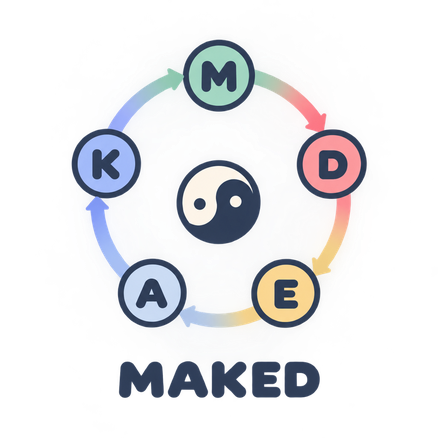


An adversarial knowledge loop that shows its working.
Current release: v0.1.9 — published as riantr/MAKED on mooncakes.io.
MAKED is a five-domain ring — Model → Data → Experience → Attack → Knowledge — in which
each domain is the adversarial overcoming of the one before it. The loop is driven by a
transition table: which slot can push a position is answered by the table, never by a
hard-coded guess, and a position the table cannot move is reported as blocked rather than
silently skipped.
One ring: 34 positions × 8 slots × 272 rules. One subject per domain, one group
across the domains (20 states), one society for the collective (13 positions × 8 phases
× 28 transitions). And 229 mutations across the three suites, every one of which has
to be accounted for — 228 killed by the tests, one deliberately equivalent.
Three layers sit on that ring:
| Layer | What it is |
|---|---|
| Subject | One state machine per domain — 34 positions × 8 slots × 272 rules, of which 228 have no way out |
| Group | Group states computed across the domains — Scattered → Converging → Common Tongue → Settled (20 states) |
| Society | The collective as a communicative whole — 13 positions × 8 phases × 28 transitions, from riantr/pyroduct |
The state machine is riantr/pyroduct@0.1.35. The front end is
rabbita, the server is a
Flask-style micro-framework on moonback,
and the storage is SQLite.
Everything a person would want to change is a file: the machine, the table that says what
a document means, the words for the collective, and the corpus the documents come from.
Everything another agent would want to drive is a tool: MAKED speaks the Model Context
Protocol over stdio or HTTP.
#Features
- A five-domain ringModel → Data → Experience → Attack → Knowledge, in that order, each domain initialising independently; the starting domain is one request away.
- Drive slots from the transition tableOf the 272 position/slot pairs, 228 are Block; the loop reports "no way out" instead of pretending to move.
- Undecided branches stay undecidedWhen the table offers several successors and none is preferred, MAKED lists them and lets the caller choose, and says which kind of edge each one is.
- The reader chooses how the loop runsThe panel says which mode is in force (structured, which follows the ring, or free, which lets any slot drive) and lets the reader change it; a run can also be started again from any domain of the ring.
- Your own records, and your own correctionsA record in the workspace can be written, corrected in place and removed; a correction keeps the record's number, its time and its place in the workspace's order.
- The pages say what you sayA page can be corrected in place: the page keeps its place in the navigation, the correction is in the language you wrote it in, and it is still there after the server restarts.
- The machine is a file, and you can change it while the server runsA model file (JSON or YAML) with its own domains, positions, slots and rules; MAKED_MODEL names it, and the index page's machine panel swaps the running machine for another one without a restart.
- The mapping table is a fileThe rules that say what a document means, read top down, first match wins; MAKED_RESEARCH names it.
- The corpus is yoursA corpus of arxiv, of an RSS feed, or of your own folder of .txt, .md, .markdown, .pdf and .json files; MAKED_CORPUS names it.
- The corpus says what it did not readA corpus of two hundred read as twenty is not a corpus of twenty, so the panel, the drive and the causal estimate all say how many the corpus holds and how many were read.
- The collectiveThe Society layer, with its 13 positions, 28 transitions and 8 phases; the English words are a file, so MAKED_SOCIETY can change them.
- The collective's words are checkedA vocabulary that names a position the machine does not have is a gap, and the gaps are reported rather than papered over.
- Causal estimates that say what they rest onDoubleML, with the treatment, the outcome, the controlled variables, the balance table, the overlap and the sensitivity all reported.
- Explorations you can take awayNamed sessions whose every step records why it was possible; replay, branch, rename, and export as Markdown or JSON.
- Two languages, written not translatedThe loop, the timeline, the measures, the exported document and the pages themselves all answer in English or Chinese; the Chinese is the table's own wording.
- An agent's serverThe Model Context Protocol (2026-07-28) over stdio or HTTP, seven tools, every answer in sentences.
- A discovery documentGET /api/agent, for an agent that does not speak the protocol: the same seven tools, the instructions, and the plain HTTP endpoints.
- A browser front endA rabbita single-page app served by the same process as the API; no second web server, no CORS configuration.
- A file that cannot be read stops the start-upA half-read machine answers every request confidently and wrongly, which is the worst thing a server can do.
#What you get
MAKED is a MoonBit module that ships two packages and three executables, and
it is used in three ways: as a library, as a server, and as an agent's server.
| You use | You get | Shape |
|---|---|---|
| riantr/MAKED/backend (native) and riantr/MAKED/frontend (js) | the loop, the API and the storage; the single-page app | two MoonBit packages |
| cmd/server | the API and the browser app in one process | HTTP |
| cmd/mcp | the agent's server | Model Context Protocol 2026-07-28, over stdio or HTTP |
| GET /api/agent | the discovery document: the seven tools, their argument schemas, the HTTP endpoints, the four files | JSON |
| GET /api/model | the machine as data: the domains, the positions, the slots, and the rule for every pair | JSON |
| GET /api/sessions/:id/export | one exploration, taken away | Markdown or JSON |
Every one of those is an explicit value, or a pure function of the files MAKED
runs on: there is no hidden global state and no clock in the answers, which is
why moon test can assert on them and why the gates can hold this document to
the tree.
The server and the agent's server are executables in this repository rather
than packages, because they are applications: they open a database and they
listen on a port.
#Install
#As a MoonBit package
moon add riantr/MAKEDThen add the package you want to your moon.mod:
///|
import {
  "riantr/MAKED/backend@0.1.9" @maked,
}
MAKED ships two packages: riantr/MAKED/backend (native — the loop, the API and the storage)
and riantr/MAKED/frontend (js — the single-page app). The server and the agent's server are
executables in this repository rather than packages, because they are applications: they
open a database and they listen on a port.
#As an application
The first barrier in this project is not the code, it is the installation: a MoonBit
toolchain, a C toolchain, and a build step. If you only want to look at MAKED, you should
have to install none of that.
docker compose up --buildThen open http://127.0.0.1:8080/. The image holds the server and the browser files it
serves; the database is created and seeded on first run and lives in a named volume, so your
records survive the container being replaced.
The image is also published, so the clone is not needed either:
docker run --rm -p 8080:8080 -v maked-data:/data ghcr.io/riantr/maked:latestA package on ghcr.io is private until someone says otherwise, and only the owner can say it: Settings → Package settings → Change visibility → Public, once, for riantr/maked.
Every release also carries a ready-to-run build for three platforms, with the browser files
beside the executable:
| Platform | Asset |
|---|---|
| Linux x86-64 | maked-<version>-linux-x86_64.tar.gz |
| macOS (Apple Silicon) | maked-<version>-macos-arm64.tar.gz |
| Windows x64 | maked-<version>-windows-x64.zip |
Unpack it, run the executable in that directory, and open http://127.0.0.1:8080/.
The agent's server is in the same directory, for an agent that drives MAKED instead of a
person. RUN.txt inside the archive says the same thing. Downloads:
https://github.com/riantr/MAKED/releases
#What the release was checked on
moon 0.1.20261102 (moonc v0.10.19) — the toolchain this tree is written
against, and the one every number in this file was measured on.
The workflow installs the toolchain from the official install script, which
serves the current release, so the runner's version moves with it. The
tree and the toolchain move together: when upstream changed the spelling of
derive, the tree was reformatted to the new one rather than pinned to the
old, because a pinned toolchain is not installable — the release server
publishes latest and nightly, and every versioned path answers 403.
That is the toolchain this release was verified against, not a tested
minimum: no older toolchain has been exercised here, and quoting a lower
bound nobody ran would be a claim, not a fact.
The release is checked by six jobs, and the same six run on every push:
| Job | What it does |
|---|---|
| Test | the backend and the frontend suites |
| Gates | the formatter, the mutation anchors, the typos gate, and the two document gates |
| Build (native) | the server and the agent's server, released |
| Build (js) | the browser bundle |
| Integration | the suite against a server that is really running |
| Container | the image, pushed to ghcr.io/riantr/maked |
The dependencies were checked against the registry before the release, not
after: eight of them moved to their newest published versions, the whole gate
suite was run again with them, and this file was written afterwards. A release
measured against an older pin is a release measured against something nobody
ships.
That check now runs inside the release, and there it is a failure rather
than a warning. tools/dep-check.sh --strict asks the registry for the current
version of every dependency in moon.mod, and the release stops if one has
moved — or if one could not be read at all, because "could not be queried" is
not "is current", and a release that cannot check its dependencies should not
ship. On a push the same script stays a warning: a push should not go red
because somebody published a new version of a dependency an hour ago.
Every job that installs the toolchain refreshes the registry index with
moon update before it resolves anything, so the versions it builds against
are the ones the registry has now. Refreshing the index is not the same thing
as moving the pin: moon update leaves moon.mod where it is, and the
upgrade is moon add --upgrade <package>@<version> — a change to the tree,
which goes through the gates like any other.
#What changed in 0.1.9
Six changes, and none of them breaks the published surface:
- The agent's server ships. cmd/mcp was built by the tree and tested by the suite, but the release workflow built only cmd/web and cmd/server, so an agent user had to compile the MCP server themselves. It is in the release assets now, and the table that names those assets says so.
- The reader can change the machine from the page. PUT /api/model and a machine panel on the index page: which machine is running, the machines the server can offer, the folder a machine file of the reader's own goes in, and a switch on a click — no terminal, no restart. A file the server cannot read is listed with the reason and gets no button, because a button that exists and cannot work reads as a broken page. The answer to a switch is a step's answer plus the machine, so one click is one hop; and every exploration keeps the machine it was run on, because a run of one machine is never described in the words of another.
- The panels are styled, and a gate says so. Of the 304 classes the views draw, 124 had no rule in the stylesheet: three whole panels — the causal estimate, the collective, the research list — rendered as browser defaults, and so did the button the machine panel switches with. Every one has a rule now, and a rule derives the class set twice, once from the views and once from the stylesheet, and prints the classes that are missing by name.
- The words follow the reader's language. The causal estimate carries a language dimension, a refusal speaks the language it was asked in, and the mapping table and the example machine have a Chinese name for every name they have — held by a gate, because a label that carries only the language it was written in is a label the other reader cannot use.
- A release fails when a dependency has moved. The dependency check warns on a push; it now fails on a release when a pin is behind the registry's latest, which is the last moment the difference can still be fixed cheaply. The sqlite3 pin moved to the version the registry names, and the gates for this release ran against the upgraded pins — that is what "current" has to mean here.
- The published surface has the house shape. The logo, the license the container image carries, and this README were brought to the shape this account publishes in, and each of the three gained a gate that holds it there: an image label, a logo and a document are all claims, and a claim nobody checks is a claim that rots.
#Packages and targets
The module holds two packages and three executables. The packages are
libraries and are imported by name; the executables are applications and
are run.
| Package | Target | What it is |
|---|---|---|
| riantr/MAKED/backend | native | the loop, the API and the storage |
| riantr/MAKED/frontend | js | the single-page app |
| Executable | Target | What it is |
|---|---|---|
| cmd/server | native | the API and the browser app in one process |
| cmd/mcp | native | the agent's server, over stdio or HTTP |
| cmd/web | js | the browser bundle |
A module dependency and a package dependency are two different things, and the
toolchain is strict about it. moon.mod names the module and pins the
version it resolved; moon.pkg names the package inside a module and takes
no version at all. A version in a moon.pkg import is not a newer
spelling — it is an import the toolchain cannot find:
Cannot find import 'riantr/MAKED/backend@0.1.9' in my/appFor the same reason there is no @latest: the version is parsed as semver, so
latest, ^0.1.9, >=0.1.9 and v0.1.9 are all rejected. A bare
moon add riantr/MAKED resolves the newest release and pins the concrete
version it found — that is the "latest" this toolchain has.
#The five domains
The ring has five domains and each one is the adversarial overcoming of the one
before it. The order is M → D → E → A → K, and the loop runs it as a ring
rather than a line: the starting domain is one request away from any other.
| Letter | Domain | What it holds |
|---|---|---|
| M | Model | the machine: the rules that say what may move where |
| D | Data | the corpus, and the mapping table that says what a document means |
| E | Experience | the runs: the explorations, their steps and their measures |
| A | Attack | the question the loop cannot answer, and the refusals it returns |
| K | Knowledge | what the ring has worked out, and what it writes down |
Each domain is a state machine of its own, and they initialise independently:
the pointer moves, the states do not reset. Whether a slot can push a position
is answered by the transition table and never by a hard-coded guess, and a
position the table cannot move is reported as blocked rather than silently
skipped. Of the 272 position/slot pairs, 228 are Block, and the loop says so
in words rather than pretending to move.
Three layers sit on that ring:
| Layer | What it is |
|---|---|
| Subject | one state machine per domain — the machine the loop runs on |
| Group | the group states computed across the domains — Scattered → Converging → Common Tongue → Settled |
| Society | the collective: its own vocabulary file, its own phases and its own moves |
The collective's words are a file (MAKED_SOCIETY), not a string in the
binary, and a vocabulary that names a position the machine does not have is a
gap the panel reports out loud.
The mark draws the same five letters, clockwise from the top: M at the top, D
at the right, E at the lower right, A at the lower left and K at the upper
left. The browser app draws it as SVG rather than as a bitmap, so it scales
and themes with the rest of the site.
#Running it
#Command line
# The web server: the API and the browser app, one process.
moon run --release --target native cmd/server

# The agent's server, over stdio. Spawn this; speak MCP to it.
moon run --release --target native cmd/mcp

# The agent's server, over HTTP, on the port you name.
MAKED_MCP_PORT=8735 moon run --release --target native cmd/mcp
From source, build.ps1 builds the browser bundle, stages it where the server looks for it,
type-checks the backend, runs every test, and builds the server:
.\build.ps1
moon run --release --target native cmd/server#API Reference
#The HTTP API
| Method | Path | What it does |
|---|---|---|
| GET | /api/status | is the server up, how many pages, which domains |
| GET | /api/pages | the ten pages the server holds, in the language asked for |
| GET | /api/pages/:slug | one page by slug |
| PUT | /api/pages/:slug | correct what one page says |
| GET | /api/domains | the five domains in ring order |
| GET | /api/bootstrap | pages, workspace entries and session state in one call |
| GET | /api/entries | the workspace entries |
| POST | /api/entries | put your own record in the workspace |
| PUT | /api/entries/:id | correct one |
| DELETE | /api/entries/:id | remove one |
| GET | /api/sessions | the named explorations |
| POST | /api/sessions | start one |
| GET | /api/sessions/:id | one exploration, with its timeline |
| POST | /api/sessions/:id/activate | bring one to the front |
| POST | /api/sessions/:id/replay | re-run a run |
| POST | /api/sessions/:id/branch | fork an exploration |
| POST | /api/sessions/:id/rename | rename one |
| DELETE | /api/sessions/:id | delete one |
| GET | /api/sessions/:id/export | one exploration as markdown or json |
| GET | /api/loop/status | where the loop stands |
| GET | /api/loop/slots | the eight-slot vocabulary |
| GET | /api/loop/continuations | what the machine says could happen next |
| GET | /api/loop/mode | the current mode |
| POST | /api/loop/mode/:mode | change it |
| POST | /api/loop/step/:slot | take a move with a named slot |
| POST | /api/loop/step | take a move and let the table choose |
| POST | /api/loop/reset | back to Model with an empty history |
| POST | /api/loop/reset/:domain | back to a chosen domain |
| GET | /api/model | the machine as data |
| GET | /api/models | the machines the server can offer: the built-in one and the files beside the running one |
| PUT | /api/model | change the machine the server runs, without restarting it |
| GET | /api/agent | the discovery document: the seven tools, the instructions, and the HTTP endpoints |
| GET | /api/research/documents | the documents the corpus holds |
| POST | /api/research/drive | drive a document through the loop |
| GET | /api/research/config | the mapping table, and whether it can be written back |
| PUT | /api/research/config | put a table of your own |
| GET | /api/research/corpus | the corpus, and whether it can be written back |
| PUT | /api/research/corpus | put a corpus of your own |
| GET | /api/research/causal | the causal estimate, and what it rests on |
| GET | /api/society | the collective: where it stands, what it can do |
| POST | /api/society/step | take a move for the collective |
#The language
The model has two vocabularies — the English reading MAKED was built with,
and the table's own Chinese — and the endpoints that answer about the loop,
the timeline, the research, the pages and the reader's own workspace take
?lang=:
| ?lang= | What comes back |
|---|---|
| (absent) | English |
| zh | Chinese |
GET  /api/loop/status?lang=zh
GET  /api/loop/slots?lang=zh
GET  /api/loop/continuations?lang=zh
POST /api/loop/step?lang=zh
GET  /api/sessions/1?lang=zh
GET  /api/pages?lang=zh
GET  /api/pages/model?lang=zh
GET  /api/bootstrap?lang=zh
GET  /api/research/causal?lang=zh
POST /api/entries?lang=zh
PUT  /api/entries/1?lang=zh
PUT  /api/research/config?lang=zh
PUT  /api/research/corpus?lang=zh
The Chinese is the table's own rather than MAKED's translation of it: a
position is called 立位 because pyroduct calls it that, and the sentences are
written in Chinese rather than translated from the English ones.
GET /api/model needs no parameter, because the model carries both
vocabularies and a client can choose for itself. A model file with no
Chinese in it is still read, and a reader who asks for Chinese gets the
English names rather than a blank. That is the only rule about the fallback.
The collective (/api/society) answers in Chinese as well: its position
names, its glosses and its phases are pyroduct's own, because the
vocabulary file — the reader's own words — is written in English.
The mapping table answers in Chinese as well, and in a different way from the
rest: the table is the reader's own file, so the Chinese in it is the reader's
own too. A rule may carry a Chinese name, a Chinese note and the Chinese words
that make it fire; the words a rule matches are not the reader's language — the
corpus is the reader's own and may hold either — but the name of the rule that
fired is, and that is the one the reader reads.
The measures and the export answer in Chinese as well, and the export is
the one that matters most: it is the thing the reader takes away, and it is
written twice rather than translated, because the shape of an English report
is not the shape a Chinese reader expects.
GET  /api/sessions/1/export?format=md&lang=zh
GET  /api/sessions/1/export?format=json&lang=zh
The measures are the same numbers in both languages — the measures read the
run, and the run does not change with the language — and the sentences
beside them are not. A reader who cannot read the sentence cannot trust the
number next to it.
The causal estimate answers in the language asked for as well: the treatment it
names, the outcome it scores, the variables it controls for, the reading of the
overlap and the reading of the sensitivity are all written in the language the
request named — and so is a refusal, because a refusal is a sentence too. The
numbers are the same in both languages; the corpus does not change with the
language.
A refusal is in the language asked for on the write paths too. When a record
is refused because its domain is not one of the five, when a mapping table is
refused because it names a slot the model does not have, when a corpus is
refused because it names a source it cannot read — the reason says what is
wrong in the language the request named, because that reason is the one answer
a person who has just typed something wrong is guaranteed to read, and the one
that says what to change.
The agent's server takes the same switch as an argument: maked_status,
maked_options, maked_step, maked_society, maked_sessions and
maked_export all accept lang.
#The language in the browser
The page has a switch too, at the top right of the header. It names the
language it switches to, so a reader who cannot read the language in force
can still read the button. Pressing it moves the whole interface: the words
the client owns come from the client's own table, and the words the machine
owns come back from the server in the language that was asked for.
The choice is not remembered across a reload. It is a question the reader
asks of the page, and a page that has just been opened has not been asked.
The export links carry the language with them, so the document a reader
downloads is in the language the page is in.
There is nothing left in English for a reader to work around. The pages are
written in both languages and the server sends the one that was asked for, so
the prose of the five domain pages is Chinese in a Chinese interface. That
prose is the project's own writing rather than the machine's, which is why it
lives in the database beside the English of it.
#The agent's server
Seven tools. Every answer is in sentences, with the ids beside them for when you want to be
exact.
| Tool | Arguments | What it answers |
|---|---|---|
| maked_status | lang | where the loop stands, what the last move did, what the run adds up to, whether it is still finding ground |
| maked_options | depth, lang | the slots that can move, the slots that cannot and why, the successors the table declined to choose between |
| maked_step | slot, target, lang | take a move, and say what happened |
| maked_model | — | the machine as data: domains, positions, slots, and the rule for every pair |
| maked_society | trigger, lang | where the collective stands; with a trigger, take that move |
| maked_sessions | lang | the named explorations, and which one is in front of us |
| maked_export | session_id, format, lang | one exploration as Markdown (to read) or JSON (to process) |
The suggested order is: maked_status → maked_options → maked_step. maked_step with
no slot lets the table choose; with a slot you choose; with a target you answer a question
the table asked.
#The discovery document
GET /api/agent is the same information for an agent that does not speak the Model Context
Protocol — or that has never heard of it. It carries the seven tools with their argument
schemas, the instructions for calling them, the plain HTTP endpoints that ask the same
questions, and the four files MAKED runs on.
curl -s http://127.0.0.1:8080/api/agentThe tool list in the document and the tool list the protocol server offers come from one
place in the code, and the integration suite compares them against the running server — two
lists of tools are two lists of tools, and the one that drifts is the one nobody is looking
at.
The same material is in AGENT.md, for an agent that reads the repository
rather than the server. The integration suite checks that it names the same seven tools.
#The four files
| File | Format | Named by | What it decides |
|---|---|---|---|
| The machine | maked.model.v1 (JSON or YAML) | MAKED_MODEL | the domains, positions, slots and rules the loop runs on |
| The mapping table | maked.research.v1 (JSON or YAML) | MAKED_RESEARCH | what a document means — which words make a rule fire, and which slot it drives |
| The society vocabulary | maked.society.v1 (YAML) | MAKED_SOCIETY | the English words for the collective's positions and moves |
| The corpus | maked.corpus.v1 (YAML) | MAKED_CORPUS | where the documents come from: arxiv, an RSS feed, or your own folder |
A .yaml or .yml file is read as YAML; every other file is read as JSON. The extension
decides, because a file written in one and read as the other is a file that half-reads.
#Changing the machine while the server runs
The index page carries a machine panel. It says which machine is running, lists the ones the
server can offer, and switches on a click — no terminal, no restart. The machines on offer are the
built-in one and the machine files that sit beside the running one: models/ by default, or the
folder MAKED_MODEL names. The panel states that folder, so drop your own machine file there and
it is on the list. A file the server cannot read is listed with the reason and gets no button: a
button that exists and cannot work reads as a broken page.
The same two things over HTTP:
GET /api/models lists the machines the server can offer, marking the one that is running.
PUT /api/model switches to one of them:
curl -X PUT http://127.0.0.1:8080/api/model \
  -H 'Content-Type: application/json' \
  -d '{"path": "models/product-iteration.yaml"}'
The file is read before anything changes. A file that cannot be read as a machine is refused
with the reason, and the machine in force keeps running — half a machine is worse than the
one that was there.
The answer to the switch is a step's answer plus the machine: the loop status with the session
state folded in, in the same body. A switch resets the loop and opens a new exploration, so a
client that had only the machine back would be showing the old run's position under the new
machine's names — and the browser is a client whose request chain is the shape it is known to
survive, so the status travels in this answer rather than in a second request.
The exploration does not change with the machine. A session's steps belong to the machine they
were taken on, so every session carries the machine it was run on and is read through that
machine: a run of one machine is never described in the words of another. A change opens a new
exploration on the new machine and leaves the old one where it is, and opening that old
exploration brings its machine back with it.
The change lasts as long as the server runs. MAKED_MODEL still decides what the next
start-up runs on.
#Environment Variables
| Variable | Default | Meaning |
|---|---|---|
| MAKED_PORT | 8080 | listen port |
| MAKED_HOST | 127.0.0.1 | listen address — 0.0.0.0 to be reachable from other machines |
| MAKED_DB | maked.db | SQLite file path |
| MAKED_DIST | frontend/dist | frontend build output directory |
| MAKED_MODEL | (unset) | a machine to run instead of the built-in one |
| MAKED_RESEARCH | (unset) | a mapping table that says what a document means |
| MAKED_CORPUS | (unset) | a corpus file: where the documents come from |
| MAKED_SOCIETY | (unset) | a vocabulary file: the English words for the collective |
| MAKED_MCP_PORT | (unset) | a port: the agent's server speaks HTTP instead of stdio |
An empty value counts as unset, because an empty environment variable is a mistake rather
than a filename.
#Error handling
There is no auth. That is a real limitation rather than an oversight, and it is stated here
because it is the first thing to change before this is exposed beyond a local process:
anyone who can reach the port can read and delete every entry.
Apart from that, the rules are these:
- A refused request is an answer, not a crash. A slot that does not exist comes back as 400 with the name of the slot that was asked for. A step that cannot move comes back with the reason it cannot, in words.
- A file that cannot be read stops the start-up. The reason is printed on stderr, and the server does not serve. Unset the variable that names it to run the built-in one.
- A rule that names a slot the machine does not have is refused. It is a rule about nowhere, and reading it would mean inventing a slot to hold it.
- A vocabulary that names a position the collective does not have is a gap. The gaps are reported, in the panel and in the API.
#Project Structure
MAKED_moonbit/
├── backend/                          # the loop, the API and the storage (native)
│   ├── model.mbt                     # the machine: domains, positions, slots, rules
│   ├── loop.mbt                      # the subject loop and the group states
│   ├── society.mbt                   # the collective
│   ├── step.mbt                      # one step, shared by the API and the agent
│   ├── agent.mbt                     # the agent's payloads, in sentences, and the discovery document
│   ├── bootstrap.mbt                 # the start-up: plan → read → install
│   ├── version.mbt                   # the version the agent reports
│   ├── api.mbt                       # every HTTP route
│   ├── app.mbt                       # the Flask-style app: the route table and the middleware chain
│   ├── maked_app.mbt                 # the app, assembled
│   ├── request.mbt                   # the request wrapper
│   ├── response.mbt                  # the response helpers
│   ├── pages.mbt                     # the content model, and the ten public pages
│   ├── entries.mbt                   # the workspace: the things the reader brings
│   ├── research_config.mbt           # the mapping table
│   ├── research.mbt                  # what a document means
│   ├── corpus.mbt                    # the corpus
│   ├── corpus_sources.mbt            # where the documents come from: arxiv, a feed, a folder
│   ├── datafile.mbt                  # a file that may be JSON or YAML
│   ├── causal.mbt                    # the causal estimate
│   ├── narration.mbt                 # the sentences
│   ├── i18n.mbt                      # the language switch
│   ├── export_words.mbt              # the exported document's words, in both languages
│   ├── metrics.mbt                   # the measures, in both languages
│   ├── session.mbt                   # explorations, timelines, exports
│   ├── database.mbt                  # SQLite
│   ├── *_test.mbt                    # 469 tests
│   └── *_wbtest.mbt                  # 16 tests
├── frontend/                         # the single-page app (js)
│   ├── app.mbt                       # the TEA loop and the messages
│   ├── i18n.mbt                      # the words the client owns
│   ├── loop_state.mbt                # the loop's state, and why a step may do nothing
│   ├── society.mbt                   # the society panel
│   ├── session.mbt                   # the explorations panel
│   ├── entries.mbt                   # the workspace panel
│   ├── causal.mbt                    # the causal panel
│   ├── page.mbt                      # the page, and how it is decoded
│   ├── logo.mbt                      # the ring
│   ├── views.mbt                     # the views
│   └── frontend_test.mbt             # 185 tests
├── cmd/
│   ├── server/main.mbt               # the web server
│   ├── mcp/main.mbt                  # the agent's server
│   └── web/main.mbt                  # the browser bundle
├── models/                           # example machines
│   ├── product-iteration.json
│   └── product-iteration.yaml
├── research/                         # example tables, corpora and vocabularies
│   ├── product-iteration.yaml
│   ├── society.yaml
│   ├── corpus-arxiv.yaml
│   ├── corpus-local.yaml
│   └── notes/                        # the corpus the local example names
│       └── failed-launch.md
├── tools/
│   ├── integration-test.ps1          # 490 checks against a running server
│   ├── mutate-backend.ps1            # 148 mutations of the backend
│   ├── mutate-frontend.ps1           # 65 mutations of the frontend
│   ├── mutate-loop.ps1               # 16 mutations of the loop
│   ├── check-mutation-anchors.ps1    # 229 anchors, and whether any is dead
│   ├── check-readme.ps1              # the claims this document states, against the tree
│   ├── check-readme.sh               # the same gate, in bash
│   ├── check-docs.ps1                # the other documents' claims, against the tree
│   └── check-docs.sh                 # the same gate, in bash
├── .githooks/                        # the pre-commit hook, and the note beside it
│   ├── pre-commit                    # the hook itself
│   └── README.md                     # what it runs, and how to install it
├── AGENT.md                         # how to drive MAKED from another agent
├── AGENTS.md                        # how to work on MAKED
├── maked.png                        # the logo, at the size the README shows it
├── maked_Logo.png                   # the same mark, at full resolution
├── moon.mod  moon.pkg
├── build.ps1                         # build the bundle, check, test, build the server
├── ci.sh                             # 18 gates
└── Dockerfile docker-compose.yml#Usage Tips
#Start the loop anywhere
The loop may start at any domain; the starting domain is one request away:
curl -X POST http://127.0.0.1:8080/api/loop/reset/knowledgeThe five domains are model, data, experience, attack and knowledge. Each domain's
state machine initialises independently — only the pointer moves.
#Ask before you move
GET /api/loop/status carries the slots that are open from where the loop stands, and
GET /api/loop/continuations tells you what the machine says could happen next and how
far away it is. The same information in one place, with the reason each slot cannot move,
is what the agent gets from maked_options.
#Read the run as numbers
Every session carries five measures: New ground, Settling, Slots used, Domains visited
and Positions covered. They are reported together with the comparison of the last window of
steps against the first, so a measure can be checked rather than believed.
#Keep the table and the machine together
A machine of your own has slots of your own, and the built-in table names slots it does not
have. MAKED says so at start-up — but the panel stays quiet until you give it a table that
fits. Keep the two files next to each other, and set both variables.
#Common Pitfalls and Best Practices
#✅ DO:
- Give the machine and the table together. A table whose rules name slots the running
machine does not have is refused at start-up, on purpose.MAKED_MODEL=models/product-iteration.json \ MAKED_RESEARCH=research/product-iteration.yaml \ moon run --release --target native cmd/server
- Ask what the table offers before taking a move. maked_options lists the slots that can move and the ones that cannot, and says why. A slot with no road out of a position is not a failure of the caller.
- Let an undecided branch stay undecided. When the table offers several successors and none is preferred, take the target as an argument rather than picking one for the subject.
- Read a refusal as an answer. A refused request comes back with the reason, in words, and names the thing that was asked for.
#❌ DON'T:
- Don't treat the ring order as evidence that anything moved. The ring order M → D → E → A → K is the order the logo draws. It is presentation, not state.
- Don't mix the protocols on one stream. The agent's server speaks MCP on stdout. Diagnostics belong on stderr — a line of prose in the middle of a protocol stream is a line the client cannot parse, and the reason MAKED refused to start is lost in the noise.
- Don't read a file you cannot read whole. MAKED refuses a file it cannot read rather than half-reading it, and the start-up stops. Keep that: a half-read machine answers every request confidently and wrongly.
- Don't hand a table to a machine it does not fit. A rule that names a slot the machine does not have is a rule about nowhere, and reading it would mean inventing a slot to hold it.
#Roadmap
#Contributing
- Fork the repository
- Create a feature branch
- Add tests for new behaviour
- Ensure all gates pass with bash ci.sh
- Submit a pull request
The contributor's guide is AGENTS.md: what the gates check, how the mutation
batteries work, and the pre-commit hook.
The gates that matter most are the two that check the tests themselves: moon fmt --check
(the formatter rewrites the source, and a mutation anchor that pointed at a line the
formatter has since re-wrapped stops matching — the mutation then never happens and the
suite reports a survivor that is really a claim about nothing), and
tools/check-mutation-anchors.ps1 (an anchor that does not occur in the file is a guard
that cannot fail).
Contributions should keep the three rules that the rest of the project rests on: a file that
cannot be read is refused rather than half-read; a rule that names a slot the machine does
not have is refused; and an answer that is a refusal says why, in words.
#Quick Start
Two ways in: the loop in a browser, and the agent's server over the Model
Context Protocol. Both are the same machine; the second one just speaks the
protocol an agent speaks.
#Run the loop
docker compose up --buildOpen http://127.0.0.1:8080/. The panel shows where the loop stands, what the last move
did in words, and which slots the table offers from here. Take a move, and the run is written
down — every step with the reason it was possible.
#Run it from another agent
The short version:
curl -s http://127.0.0.1:8080/api/agentThat is the discovery document: the seven tools with their argument schemas, the
instructions for calling them, the plain HTTP endpoints that ask the same questions, and the
four files MAKED runs on. An agent that reads it needs nothing else.
MAKED also speaks the Model Context Protocol, version 2026-07-28. Build the agent's
server and point your agent at it:
moon build --release --target native cmd/mcp{
"mcpServers": {
"maked": {
"command": "/path/to/MAKED_moonbit/_build/native/release/build/cmd/mcp/mcp.exe"
}
}
}The agent's server speaks stdio by default; set MAKED_MCP_PORT and it speaks HTTP
instead, on the port you name.
The agent's server is in the published release artifacts: the archive carries the web server, the browser bundle and the agent's server. Unpack it and an agent can drive MAKED over MCP without a toolchain.
Two things about this protocol version are worth knowing before you wire it up:
- There is no handshake. initialize is not a method in 2026-07-28; the server answers it with -32601 Method not found. The entry point is server/discover.
- Every request carries its own version. Each request's params._meta must contain io.modelcontextprotocol/protocolVersion (a string) and io.modelcontextprotocol/clientCapabilities (an object). A request without them is refused with -32602.
Over HTTP there are two more: the MCP-Protocol-Version: 2026-07-28 header, and an
Mcp-Method: <method> header naming the method the body carries.
#Write a machine of your own
MAKED_MODEL=models/product-iteration.json \
MAKED_RESEARCH=research/product-iteration.yaml \
moon run --release --target native cmd/serverThe loop now runs on your domains, positions and slots — and the table is read against
your machine, so a rule that names a slot your machine does not have is refused at
start-up rather than ignored.
#Example
Every one of these is a file you write yourself, and every one of them is
refused when it does not fit the machine it is run against — which is the
point: a table that names a slot the running machine does not have is a rule
about nowhere.
#A machine of your own
{
  "format": "maked.model.v1",
  "name": "One small machine",
  "domains": [
    {
      "id": "idea",
      "letter": "I",
      "title": "Idea",
      "title_zh": "想法",
      "role": "the idea",
      "role_zh": "这个想法",
      "anchor": "raw"
    }
  ],
  "positions": [
    {
      "id": "raw",
      "label": "Raw idea",
      "label_zh": "原始想法",
      "gloss": "Nobody has built it yet.",
      "gloss_zh": "还没有人动手做它。",
      "domain": "idea"
    },
    {
      "id": "asked",
      "label": "A question asked",
      "label_zh": "问过了",
      "gloss": "Somebody was asked.",
      "gloss_zh": "有人问过了。",
      "domain": "idea"
    }
  ],
  "slots": [
    {
      "id": "ask",
      "designation": "Ask",
      "designation_zh": "询问",
      "gloss": "Talk to somebody who would use it.",
      "gloss_zh": "去和一个会用到它的人聊。"
    }
  ],
  "rules": [
    {
      "from": "raw",
      "slot": "ask",
      "outcome": { "kind": "moved", "edge": "A customer said no", "to": "asked" }
    }
  ],
  "edges": [
    { "en": "A customer said no", "zh": "客户说不行" }
  ]
}
Every name can carry a Chinese twin — title_zh, role_zh, label_zh, gloss_zh,
designation_zh, and a table of move names — and the server shows the twin when the
request asks for ?lang=zh. A name with no twin is shown in English, so a machine
written only in English still runs; it just answers in English.
The example that ships with the repository is models/product-iteration.json: three domains,
seven positions, four slots. It is a complete machine, not a fragment. A rule that names a
position or a slot the machine does not define is refused at start-up, and so is a domain
whose anchor is not a defined position — such a domain starts nowhere.
That example speaks both languages — every one of its names has a Chinese twin — and it
also ships as models/product-iteration.yaml. A test holds the two to each other: the
same machine, name for name, in either syntax.
#A mapping table of your own
format: maked.research.v1
mapping:
  - label: A question worth asking
    label_zh: 一个值得问的问题
    keywords:
      - question
      - why
      - unclear
    keywords_zh:
      - 问题
      - 为什么
      - 不清楚
    slot: ask
    notes: The document opens a question rather than answering one.
    notes_zh: 这份文档提出的是问题,而不是答案。
fallback:
  label: Anything else
  label_zh: 其他
  slot: ask
The order is the priority: the table is read from the top and the first rule that matches
wins. A rule that names a slot the running machine does not have is refused at start-up.
A rule can carry Chinese as well as English: label_zh is the rule's name in Chinese,
notes_zh is its note, and keywords_zh are the words that make it fire on a Chinese
document. The words a rule matches are not the reader's language — the corpus is the
reader's own and may hold either — but the name of the rule is, so ?lang=zh shows the
rule in Chinese while the table still reads everything it is given. A rule with no
Chinese name is shown in English, exactly as a name of the machine's is: a table written
only in English still runs, it just answers in English. The table that ships,
research/product-iteration.yaml, is written that way: every rule of it has a Chinese
name, a Chinese note and Chinese words.
#A corpus of your own
format: maked.corpus.v1
source:
  kind: local
  path: ./notes
  max_results: 20
kind is arxiv, rss or local. A local corpus is a folder of the reader's own
files: .txt, .md, .markdown, .pdf and .json. A .json file is read as a
Zotero export, and a .pdf is read as the text of its pages. MAKED reads them, and
the documents it read are the ones it drives.
#A vocabulary of your own
research/society.yaml names the collective's 13 positions, 8 phases and 18 triggers in
English. The ids are pyroduct's own names — an id the file names that pyroduct does not
define is refused, and a position pyroduct defines that the file does not name is a gap the
panel says out loud.
#A record of your own
The pages are the server's and the records are yours: the workspace is the one part of the
server a reader is meant to change. A record is a domain letter, a title and a body:
curl -X POST http://127.0.0.1:8080/api/entries \
  -H 'Content-Type: application/json' \
  -d '{"domain": "M", "title": "The failure I want to keep", "body": "The loop reached a position it could not leave."}'
The domain is one of M, D, E, A, K — the ring's own letters — and the server
assigns the number and the time. A record is refused, with the reason, when the domain is
not one of the five, when the title is empty, when the title is longer than 200 characters,
or when the body is longer than 20,000.
A record can also be corrected, and it stays the same record — the same number, the same
place in the workspace's order, the same time:
curl -X PUT http://127.0.0.1:8080/api/entries/1 \
  -H 'Content-Type: application/json' \
  -d '{"domain": "M", "title": "The failure I want to keep, corrected", "body": "The loop reached a position it could not leave."}'
The same rules apply to a correction as to a new record: a change the create path would
refuse is not a change, and a record that is not there cannot be corrected.
#Correcting a page
The pages were the project's own words, seeded on every start-up, and there was no way to
change them — so "editable content" meant the workspace and nothing else. A page can now
be corrected too, and the correction is stored beside the seeded words rather than over
them, so it survives the next start-up:
curl -X PUT http://127.0.0.1:8080/api/pages/model \
  -H 'Content-Type: application/json' \
  -d '{"title": "The model I read it as", "body": "What the model is, in my own words."}'
What a correction may change is what the page says: its title and its body. The slug,
the letter, the role and the place in the navigation are the site's shape, and a reader
who could move a page into the navigation bar would be editing the site rather than its
content.
A correction belongs to the language it was made in, because a page is said twice:
curl -X PUT 'http://127.0.0.1:8080/api/pages/model?lang=zh' \
  -H 'Content-Type: application/json' \
  -d '{"title": "我读出来的模型", "body": "用我自己的话说。"}'
The English page keeps the English prose until it is corrected in English too. The answer
says whose words these are — the page carries a corrected flag and the time of the
correction — and the reader's own words are shown as text, never as markup, because they
are the reader's and not the project's.
A correction needs a title: a page with no name is not a page. A page that is not there
cannot be corrected, and the refusal says which one is missing.
#Driving it from another agent
$ MAKED_MCP_PORT=8735 moon run --release --target native cmd/mcp &
$ curl -s http://127.0.0.1:8735/mcp \
    -H 'MCP-Protocol-Version: 2026-07-28' \
    -H 'Mcp-Method: tools/list' \
    -H 'Content-Type: application/json' \
-d '{"jsonrpc":"2.0","id":1,"method":"tools/list","params":{"_meta":{"io.modelcontextprotocol/protocolVersion":"2026-07-28","io.modelcontextprotocol/clientCapabilities":{}}}}'#Gates and drift detectors
moon fmt --check, the two moon check targets, the backend and the frontend
suites, and typos on the prose are the baseline. The rest run on top of that,
because a green suite says nothing about a claim written in prose:
| Detector | Catches |
|---|---|
| tools/check-readme.sh and tools/check-readme.ps1 | a number, a listing or a path this file states and the tree does not have |
| tools/check-docs.sh and tools/check-docs.ps1 | the same, for the architecture documents, their graphs and their evidence tables |
| tools/check-mutation-anchors.ps1 | an anchor that names a line the code has left behind — a guard that cannot fail, and a survivor that means nothing |
| tools/mutate-backend.ps1, tools/mutate-frontend.ps1, tools/mutate-loop.ps1 | a behaviour the tests do not pin: every mutation has to be killed, and one that survives has to be accounted for |
| tools/integration-test.ps1 | a claim about the running server, checked against a server that is really running |
| tools/dep-check.sh | a pin that has moved under the version that names it — a warning on a push, a failure on a release |
The two document gates are twins: the same invariant written twice, once in
bash and once in PowerShell, because the CI runner is ubuntu and carries bash,
and a gate written only in PowerShell is a gate that does not run where the
build runs. Both print the same lines and they go red together.
Every class a view draws has a rule in the stylesheet. A class with no rule
is a panel that renders as the browser's default, which is what the loop panel
was before the stylesheet grew a block for it, and what the button the machine
panel switches with still was after it: no test draws a page, so no test can see
a rule that is not there. The gate derives the class set twice — once from the
views, once from the stylesheet — and prints the classes that have no rule by
name. An id is not a class, and neither is the label that points at one, so the
form fields are not demanded to carry rules they do not need.
Current release: v0.1.9 · Repository: https://github.com/riantr/MAKED
#Test and gate counts
| What | How many | How it is checked |
|---|---|---|
| Backend tests | 485 | moon test --target native backend |
| Frontend tests | 185 | moon test --target js frontend |
| Integration checks | 490 | tools/integration-test.ps1 — against a server that is really running |
| Backend mutations | 148 | tools/mutate-backend.ps1 |
| Frontend mutations | 65 | tools/mutate-frontend.ps1 |
| Loop mutations | 16 | tools/mutate-loop.ps1 |
| Mutation anchors | 229 | tools/check-mutation-anchors.ps1 — and whether any is dead |
| CI gates | 18 | ci.sh |
#Running the tests
moon check --target native          # type-check the backend
moon fmt --check                    # the formatter is a gate
moon test --target native backend   # the backend
moon test --target js frontend      # the frontend
bash ci.sh # everything, including the slow gates#Used By
- riantr/MAKED/backend and riantr/MAKED/frontend — the two packages, used as a library: the loop, the API and the storage on one side, the single-page app on the other.
- cmd/server, cmd/mcp and cmd/web — the three executables in this module: the web server, the agent's server, and the browser bundle.
- riantr/pyroduct — the state machine, the group states and the collective that the ring runs on.
- riantr/moonbit_doubleML — the causal estimate.
Outside this repository: none that the registry knows about. The registry
lists 0 dependents for riantr/MAKED, and nothing is claimed here that
cannot be named.
#Attribution
- License: MIT (see LICENSE).
- The state machine, the group states and the collective are riantr/pyroduct, and MAKED is the ring that runs on them.
- The front end is rabbita, and the HTTP server the micro-framework sits on is moonback.
- The causal estimate is riantr/moonbit_doubleML.
- The protocol the agent's server speaks is the Model Context Protocol, version 2026-07-28.
- The language is the MoonBit Language Guide.
#License
MIT License. See LICENSE for details.
Install
Download zipMAKED on MoonBit: rabbita SPA frontend + a Flask-style micro-framework on moonback
webrabbitamoonbacksqlite

 MIT

 Updated 6 days ago
 101 downloads