 README
tesseract
Tiny multi-key JSON value database over a 4D sudoku lattice (1..215 cells per axis, 81 by default), with a SQL surface and sudoku digit constraints.
sudoku
database
key-value
lattice
4d
Dependencies
#Tesseract — 4D, 3 cells per axis by default
A tiny multi-key JSON value database stored over a 4D sudoku lattice, with a
SQL surface and sudoku digit constraints.
This is the MoonBit port of the C#/Avalonia tesseract project, and the C#
project itself has been lifted to the same 4D lattice. The two implementations
were run against the same 26-statement sequence and produce identical output —
same success flags, error codes, positions, coordinates and digits.
#Install
moon add riantr/tesseract@0.1.0The library is the package riantr/tesseract/src/tesseract:
///|
import {
  "riantr/tesseract/src/tesseract",
}cmd/main, cmd/persist and cmd/gui are the three executables in the same
module — the command line, the file-backed store, and the window. Registry entry:
mooncakes.io/docs/riantr/tesseract@0.1.0.
#The lattice
| C# original | this version | |
|---|---|---|
| shape | flat 9-cell ring shown as 3x3 | 3x3x3x3 lattice, 81 cells (default) |
| addressing | grid_position 1..9 | grid_position 1..81, or (x,y,z,w) |
| sudoku | none | digits 1..3, one set per axis-parallel line |
| structure | 9 rows / 1 box | 4 axes x 27 lines = 108 lines, 12 slabs |
#Cells per axis is a value, not a constant
side — how many cells each of the four axes has — is chosen when the database
is built. Everything above follows from it:
| side = 3 (default) | side = 4 | |
|---|---|---|
| cells | 81 | 256 |
| digit domain | 1..3 | 1..4 |
| lines | 108 | 256 |
| slabs (each) | 12 of 27 cells | 16 of 64 cells |
| peers per cell | 8 | 12 |
The sudoku rule is unchanged by this: digit(x,y,z,w) = (x+y+z+w) mod side + 1
steps by one along every axis for any side, so every axis-parallel line is a
permutation of 1..side. A side-4 lattice solves with 0 line violations and
0 slab imbalances, checked in the test suite at every side from 1 to 4.
The range is 1..215, and the upper bound is storage rather than arithmetic.
Array is indexed by Int, which is 32-bit on this toolchain, so side^4
cells have to stay addressable and 215^4 = 2,136,750,625 is the largest count
that fits. With Int64 index arithmetic alone the root would be 55108; lifting
it needs storage that is not one flat array. lattice_of refuses a side above
the limit and says which rule it applied rather than truncating.
moon run cmd/main -- --side 4 .status
moon run cmd/main -- --side 4 .solve .verify
Omitting --side gives 3, the lattice every existing .tsr and .db file was
written under, so an invocation without the flag behaves exactly as before.
Two numbering schemes coexist deliberately:
- coordinates (x, y, z, w) are 0-based, matching array indexing;
- positions 1..total are 1-based, matching the C# grid_position column, so stored SQL and .tsr files keep the same shape.
position = 1 + x*side^3 + y*side^2 + z*side + w (row-major, x slowest)The mapping is exact in both directions for every cell.
#Importing across sides
A position number only means something relative to the side it was written
under: 78 of the 81 positions in a 3-per-axis lattice name a different cell
once the side is 4 (position 40 is (1,1,1,0) at side 3 and (0,2,1,3) at
side 4). So .tsr import places a record by the coordinates the file
carries, and consults the position number only for a record that has no
coordinates at all. A coordinate the target lattice cannot hold is an error
naming that coordinate — never a clamp, and never a fall-through to a number
that would quietly address a different cell.
#What the sudoku constraint is at this size
Worth stating plainly, because the 2D intuition misleads here.
A 2D sudoku has two constraint families: 9 rows/columns of 9 cells, and 9
boxes of 3x3. Both draw from one digit domain of 9. Along a 3-long axis the row
rule still works — 3 cells, digits 1..3 — but the box rule degenerates: a box is
only non-trivial when the axis length is at least the digit domain, and at side 3
the only box is the whole grid.
So what survives as a real constraint is the line family: 4 axes x 27 lines x
3 cells, each line a permutation of 1, 2, 3. Two cells share such a line exactly
when they agree on three of four coordinates, and each cell has exactly 8 peers.
Slab balance — each digit appearing 9 times in a 27-cell slab — is a consequence
of the line rule, not an independent one: a slab is exactly nine lines parallel to
any axis within it, and each contributes one of every digit. The code checks this
rather than assuming it (slab_violations), and solve_lattice produces solutions
by independent backtracking so the implication is tested on solutions nobody
designed, not only on the closed form.
A closed-form solution exists and is used as the default fill:
digit(x,y,z,w) = (x + y + z + w) mod 3 + 1Stepping one cell along any axis adds 1 mod 3, so every axis-parallel line cycles
through all three digits.
#Layout
src/tesseract/
  text.mbt       ASCII helpers: trim, case folding, integer parse, split/join
  coords.mbt     the lattice: coordinates, positions, neighbours, shares_line
  lattice.mbt    lines, slabs, planes, peers
  sudoku.mbt     digits, the line rule, slab balance, backtracking solver
  txn.mbt        transactions: the undo journal, savepoints, statement atomicity
  types.mbt      GridCell, Record, Computed, DBResponse, DBStatus, formatting
  logger.mbt     bounded log ring (100 entries, matching the C# logger)
  clock.mbt      the injected clock and its ISO-8601 rendering
  db.mbt         the store, and the in-place resize between shapes
  lexer.mbt      the SQL tokenizer
  ast.mbt        the parsed shape of a statement
  parser.mbt     recursive descent, precedence climbing
  exec.mbt       the executor: expressions, aggregates, ordering, transactions
  serialize.mbt  .tsr JSON, .md table, .sql dump, lattice rendering
cmd/main/        command line front end
cmd/gui/         the proton desktop window
  main.mbt       the App: entry point, page asset, command registration
  state.mbt      the store the window drives, and its JSON projections
  commands.mbt   the seven typed commands the page can call
  web/index.html the page itself - inline CSS and JS, no build step
proton.project.json   bundle identity, backend package, packaging settings
gui-smoke.mjs         end-to-end smoke test driven through Chromium DevTools
The library has no external dependencies: the core library in this toolchain
carries no file I/O and no stdin reader, so what the package needs is implemented
here rather than pulled in. cmd/main inherits that. It does carry a clock —
@env.now() from moonbitlang/core/env, which is the toolchain rather than a
mooncakes import — so the wall clock cost one line of moon.pkg, not a
dependency.
cmd/gui is the one exception, and only because it needs a window: it depends on
moonbit-community/proton@0.3.4. Proton is native-only, so that package declares
supported_targets = "native" and the rest of the module stays target-agnostic.
#The window
proton is Electron-shaped: the page is HTML/CSS/JS, the windows and lifecycle
live in MoonBit, and the two talk over a typed command bridge. The page never
touches the lattice directly — it calls seven operations and renders what comes
back, so the store's rules still decide everything:
| operation | what it does |
|---|---|
| app:state | occupancy, cursor, digit count, the current side × side plane, sudoku health, log tail |
| app:lattice | change side; rebuilds the store in place and reports kept/dropped |
| app:write | insert / update / delete / clear / cursor, plus solve and demo |
| app:query | one SQL statement, returning rows and a repaint |
| app:geometry | line / slab / peers around a cell, with the covered positions |
| app:export | .tsr, .md, .sql, or the ASCII lattice |
| app:import | load a .tsr, .md or .sql dump back in |
A digit collision in the window returns the same SUDOKU_CONFLICT and the same
message the CLI prints, because it is the same Tesseract::insert call. solve
and demo run the CLI's .solve and .demo statement for statement, and the
smoke test pins the end state: after demo the store holds 2 records and 1
digit, with user_002 still at {"age": 30} — the same numbers
moon run cmd/main -- .demo prints.
Three things the window refuses to do, all because the library's own semantics
would otherwise make a mistyped form destructive:
- A position outside 1..side⁴ is an error, not "use the cursor." The page omits position only when the box is empty; anything the user actually typed goes through, so 999 gets INVALID_POSITION at side 3 instead of quietly landing on the cursor cell.
- delete needs a key or a position. With neither, the library means "empty the whole lattice", which is what 清空整个点阵 is for; the delete verb refuses that form with INVALID_INPUT rather than wiping 81 cells from an empty form.
- delete in the window is cell-scoped. A bare key is the library's "remove every cell carrying it" form, and this button sits in a form framed around one cell — so a key with no position (and nothing selected) is refused at the page rather than removing rows that are not on screen. Deleting all cells by key stays reachable in the SQL console, where the statement says so.
The 清除 digit button is likewise a no-op on a cell that is already empty: it
used to take the insert branch and materialise a cell_N record carrying
nothing but the string 0. And 「无」 in the digit select is sent as an explicit
digit: 0, because update reads 0 as "drop the digit" — omitting the field
would have kept the old one, so the select and the digit row disagreed about
the same intent.
示例数据巡演 starts with DELETE FROM tesseract;, so it is marked as destructive
and its button says 「先清空」: it cannot preserve what is already stored.
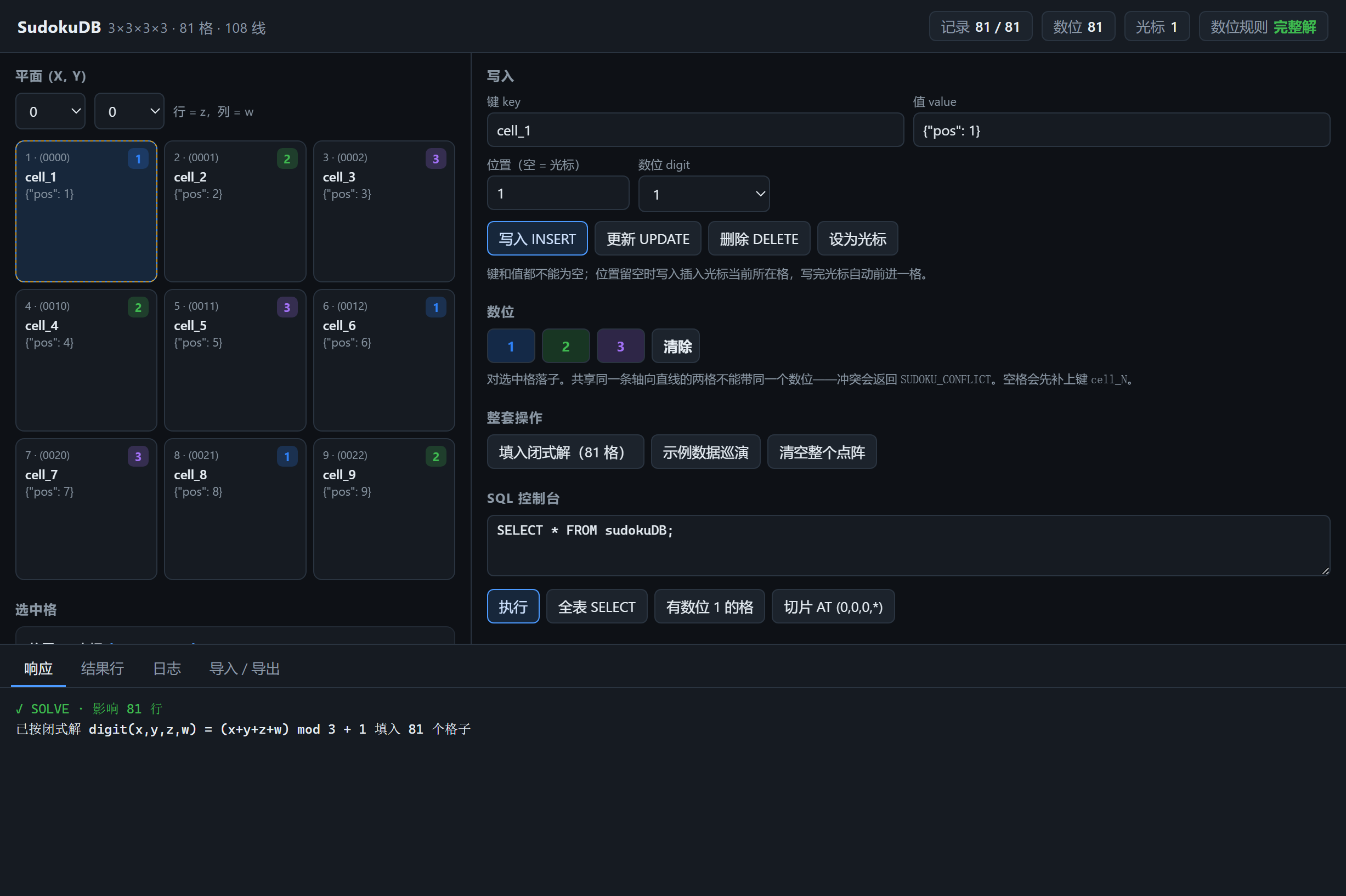
The page picks one of the (x, y) planes — side of them — and shows it as a
side × side grid over (z, w), addressed exactly as the library does. At the
default side 3 that is one classic sudoku box, which is where the picture below
was taken.
The selector beside the plane pickers changes the side. It offers 1..9, not the
full 1..215 the library accepts: side 9 is 6561 cells, which a window cannot draw,
and the SQL console and --side still reach the whole range. The page is not
allowed to remember the shape between snapshots — app:state carries side every
time — because a page holding a stale shape would offer a digit the store refuses.
Changing the side calls Tesseract::set_side, which resizes in place and carries
records by coordinate, the same rule .tsr import uses. It does not re-solve: a
side-3 solution carried to side 4 stays 81 digits in 256 cells, and the badge says
无冲突(81/256)rather than 完整解, because there is nothing there to be a solution
of yet.
Two things about that bridge are worth writing down, because both cost a debugging
round:
- Optional request fields are omitted, never sent as null. MoonBit's decoder for Int? accepts a number or no key at all, and treats an explicit null as a type error. Sending position: null fails the whole dispatch with InvalidPayload before the handler runs.
- is_solution means "no rule is broken", not "every cell is filled." The library's line and slab checks skip empty cells, so a lattice with one hole still reads as a solution. The window's chip shows the placed count alongside the verdict for exactly that reason.
solve runs the closed form through SQL inserts, so it obeys the digit rule like
everything else: filling a partially-filled lattice can legitimately be refused
at some positions. Both surfaces name the first refusal — the window in its
response, the CLI as placed 80 digits first refused at position 1:SUDOKU_CONFLICT (Digit 1 already used at position 55).
#SQL
A real lexer, a real AST and a real executor: lexer.mbt → parser.mbt →
exec.mbt. Not SQLite, and not a hand-rolled scan either — the earlier version was
932 lines of repeated string scanning whose WHERE was a struct holding at most
one predicate per field, and the shape of that struct was the bug.
The rule the executor is built around: a clause the parser accepts is a clause the
executor applies, or the statement is refused. The version it replaced parsed
LIMIT 1 and ORDER BY key DESC as nothing, dropped them, and reported success
— so LIMIT 1 returned all three rows and ORDER BY ... DESC returned them in
insertion order. A filter that silently answers a different question than the one
asked is worse than a filter that fails, so nothing here can fail that way.
| before | now | |
|---|---|---|
| WHERE key='a' AND key='b' | 1 row — the last conjunct overwrote the first | 0 rows |
| WHERE key='a' OR key='b' | INVALID_SYNTAX | 2 rows |
| LIMIT 1 | 3 rows | 1 row |
| ORDER BY key DESC | insertion order | sorted |
| WHERE digit=1+1 | INVALID_SYNTAX | evaluates |
The C# statement shapes and error codes still work, so existing dumps load:
CREATE DATABASE tesseract;
INSERT INTO tesseract (key, value) VALUES ('user_001', '{"age": 25}');
SELECT * FROM tesseract WHERE key = 'user_001';
SELECT * FROM tesseract WHERE value LIKE '%age%';
UPDATE tesseract SET value = '{"age": 26}' WHERE key = 'user_001';
DELETE FROM tesseract WHERE key = 'user_001';
The 4D additions:
-- explicit address, as a position or as coordinates
INSERT INTO tesseract (key, value) VALUES ('k', 'v') AT 42;
INSERT INTO tesseract (key, value) VALUES ('k', 'v') AT (1,2,0,2);

-- sudoku digits, enforced against the lines through the cell
INSERT INTO tesseract (key, value, digit) VALUES ('k', 'v', 2);
UPDATE tesseract SET value = 'v', digit = 3 WHERE grid_position = 42;

-- coordinate predicates
SELECT * FROM tesseract WHERE x = 1 AND y = 2;
SELECT * FROM tesseract WHERE digit = 1;

-- geometry
SELECT * FROM tesseract WHERE line(42, 0);   -- the 3-cell axis-parallel line
SELECT * FROM tesseract WHERE slab(42, 1);   -- the 27-cell slab
SELECT * FROM tesseract WHERE peers(42);     -- the 8 cells sharing a line
Every condition in a WHERE applies, including alongside a geometry predicate —
line(42, 0) AND digit = 2 is the digit-2 cell of that line, not the whole line:
SELECT * FROM tesseract WHERE peers(42) AND key = 'user_001';#Expressions
WHERE is an expression tree, so a conjunction over one column is a conjunction
rather than the last one winning, and NOT negates a comparison rather than the
whole clause. Operators, loosest first:
OR  <  AND  <  NOT  <  = <> != < <= > >= LIKE IN IS NULL
    <  + -  <  * / %  <  unary -  <  literals, columns, ( ), functions
SELECT * FROM tesseract WHERE key = 'a' OR key = 'b';
SELECT * FROM tesseract WHERE digit = 1 + 1;
SELECT * FROM tesseract WHERE key IN ('a', 'b', 'c');
SELECT * FROM tesseract WHERE NOT (x = 1 AND y = 2);Three-valued throughout: NULL is unknown, AND/OR/NOT propagate it, and a
row is kept only on a known true. WHERE digit = NULL is therefore not digit =0 — it matches nothing, which is the difference between "no digit" and "digit
zero".
Columns are key, value, position (or grid_position), digit, timestamp,
x, y, z, w and side. An unknown one is INVALID_COLUMNS, including on
an empty table — whether the table has data is not a fact that decides whether a
statement is well formed, and a filter evaluated against no rows used to make an
unknown column look acceptable.
Functions: length, upper, lower, abs, coords, digits, the three
geometry predicates, and the aggregates count, sum, min, max, avg.
#Grouping, ordering, limits
SELECT digit, count(*) FROM tesseract GROUP BY digit;
SELECT sum(digit) FROM tesseract WHERE digit > 0;
SELECT key FROM tesseract ORDER BY key DESC, digit ASC;
SELECT key FROM tesseract ORDER BY key LIMIT 10 OFFSET 20;
SELECT DISTINCT value FROM tesseract;
ORDER BY is stable: rows whose sort keys tie keep their position order, so
LIMIT after a tie picks the same rows in two runs of the same query.
Record has a fixed shape, so a narrower select is an emptied row rather than a
narrower one, and an aggregate cannot live in a cell column. Non-column select
items are evaluated into Record.computed, each under the label it was written
with (count(*), sum(digit), length(key)), and format_response prints them.
SELECT DISTINCT value compares what was selected: the projection empties
position and coords when they were not asked for, which is what makes three
cells holding one value collapse to one row.
#Transactions
BEGIN;
INSERT INTO tesseract (key, value) VALUES ('a', '1') AT 1;
SAVEPOINT sp;
INSERT INTO tesseract (key, value) VALUES ('b', '2') AT 2;
ROLLBACK TO sp;     -- the 'b' insert goes; the transaction stays open
COMMIT;

ROLLBACK;           -- or undo the whole thing
Implemented as an undo journal of before-images, not a snapshot, so a
transaction costs what it wrote rather than what the lattice holds — a copy of all
81 cells per statement would make side = 215 impossible in a way it currently is
not. Every mutation goes through one function (Tesseract::write_cell), so a
transaction cannot quietly cover six of the seven write paths.
Two properties worth stating separately:
- Every statement is atomic, with or without BEGIN. Each one opens an implicit savepoint, so a multi-row UPDATE refused on its last row commits none of its earlier ones. This is the case the journal exists for.
- ROLLBACK TO sp keeps sp and drops only the savepoints after it, matching SQL. RELEASE sp forgets it and keeps the work — the opposite effect, under the same kind of name, which is why both have their own test.
BEGIN inside a transaction is refused rather than nested; SAVEPOINT is the
supported way to have a rollback point inside one.
LIKE follows the SQL spelling rather than being a substring test: %x% is a
contains test and a bare literal is equality. So value LIKE 'hello' matches
the value hello exactly, and value LIKE '%hello%' matches any value
containing it. An unwrapped literal used to be stripped to "no predicate" and
matched every row, which is the direction a filter must not be wrong in.
A malformed literal is an error rather than a value: WHERE key = 'a and
WHERE key = 'a' garbage both return INVALID_SYNTAX instead of quietly
becoming a key that matches nothing. Both \' and the standard '' spell an
embedded quote.
Error codes: INVALID_INPUT, INVALID_DIGIT, INVALID_POSITION,
INVALID_COLUMNS, INVALID_SYNTAX, KEY_NOT_FOUND, POSITION_NOT_FOUND,
POSITION_EMPTY, POSITION_OUT_OF_RANGE, SUDOKU_CONFLICT, UNSUPPORTED_SQL,
EMPTY_SQL. That list is the complete set this port emits — every code in it is
reachable and nothing outside it is produced.
#Running it
#Command line
moon check --target all     # type-check every backend
moon test                   # 220 tests
moon fmt --check            # canonical formatting

node cli-smoke.mjs          # both CLIs, as real processes (builds them first)
node gui-smoke.mjs          # the window, over CDP (needs `proton_cli dev` running)

moon run cmd/main -- .help
moon run cmd/main -- .status
moon run cmd/main -- .demo
moon run cmd/main -- .solve .verify
moon run cmd/main -- "INSERT INTO tesseract (key,value) VALUES ('a','1') AT 5;" "SELECT * FROM tesseract;"
moon run cmd/main -- .export tsr > dump.tsr

# 256 cells, digits 1..4
moon run cmd/main -- --side 4 .status
moon run cmd/main -- --side 4 .solve .verify
--side N (or --side=N) sets the cells per axis for the run and may appear
anywhere among the commands; only the first occurrence counts. A value that is
not an integer, is below 1, or is above 215 is refused before any statement
runs:
$ moon run cmd/main -- --side 999 .status
--side side 999 is above the maximum 215 (cells are stored in one flat array indexed by a 32-bit Int)#Persistence
cmd/persist is the same store and the same SQL parser with a .db file behind
it. It is a separate binary, not a flag on cmd/main, because
moonbit-community/sqlite3
builds for native and wasm only — adding it to cmd/main or to
src/tesseract would drop those packages from js and wasm-gc and break the
zero-dependency core. cmd/main is untouched, and so is every behaviour in
src/tesseract; the one change to the library is that Tesseract::insert_stamped
is now pub rather than private, so this adapter can restore timestamps the way
import_tsr already did.
moon run cmd/persist --target native -- .open sudoku.db \
  "INSERT INTO tesseract (key,value,digit) VALUES ('user_001','{\"age\": 25}',1) AT 1;" \
  .save .status .verify

# a second process reads the same file back
moon run cmd/persist --target native -- .open sudoku.db .status| command | effect |
|---|---|
| .open <path> | replace the store with the file's contents |
| .save [path] | write the store out, to <path> or to the last .open |
| .status | occupancy, digits, cursor, and the file in use |
| .verify | line and slab check over the digits in the store |
Everything else runs as SQL through the same parser cmd/main uses, so the sudoku
digit rule still decides what happens: an INSERT that clashes on a shared line
comes back SUDOKU_CONFLICT whether the store came from memory or from a file.
Three things to know before relying on it:
- It is a snapshot, not a mirror. The lattice lives in memory between .open and .save; nothing is written back on exit. A session that opens a file and never saves says so rather than losing the work quietly.
- Timestamps round trip. Each cell is written with its timestamp and loaded back through the public Tesseract::insert_stamped, the same call import_tsr makes, so a reopened .db carries the stamps it was saved with instead of ones minted from this process's log counter. What does not carry over is the log: sequence numbers continue from where the new process started, so stamps made after a load do not continue the saved file's numbering. .tsr is the format when that continuity matters — .db restores what it stored.
- A load replaces, it does not merge, the same way import_tsr clears first. Rows the store refuses — a hand-edited file can hold two cells with the same digit on a shared line — are reported as rejected rather than dropped, because "loaded 3 of 4" and "loaded 4" are different answers.
The CLI is driven by its arguments, one statement or .command each, run in
order against one shared database. MoonBit's core library exposes no stdin reader
and no file I/O, so exports go to stdout for the shell to redirect, and a REPL is
a shell loop over the same commands:
A command and its argument are two arguments, as a shell splits them —
.export md is .export and md, and the two are rejoined before matching.
cli-smoke.mjs covers that, because matching only the joined form is what once
let .export md write an .tsr document under a .md name and .open fall
through to the SQL parser as Unsupported SQL statement: .open.
while read -r line; do moon run cmd/main -- "$line"; done#Static analysis
src/tesseract_sa and cmd/sa run
riantr/moonbit_static_analysis over this project and
keep the result in a SQLite database, so a scan is queryable history rather than
text that scrolled past.
moonx riantr/moonbit_static_analysis@0.4.1 . > scan.tsv
moon run cmd/sa --target native -- store scan.tsv scan.db
moon run cmd/sa --target native -- runs scan.db
moon run cmd/sa --target native -- show scan.db
moon run cmd/sa --target native -- files scan.db
moon run cmd/sa --target native -- unparsed scan.db| table | holds |
|---|---|
| sa_runs | one row per scan: coverage, counts, target |
| sa_files | each file the analyzer reported on, with outcome, defects, notices, shown |
| sa_findings | the findings that were actually rendered |
| sa_by_kind | the per-.mbt/.mbti/.mbt.md rollup the tool prints |
| sa_unparsed | per reason: how many files, and up to three example paths |
Runs accumulate, so a 0.3.5 scan and a 0.4.0 scan of the same tree sit in one
file and runs prints them side by side. The parser accepts both formats;
refusing the older one would mean a database that can only ever hold scans from
one version of the tool.
Six things to know before reading a number out of it:
- Quote the coverage, not the finding count. The analyzer's frontend covers a subset of MoonBit, so most .mbt files come back unread and their findings are withheld — they measure what the analyzer does not understand, not what your code does wrong. actionable is the only column that describes the code.
- 0.4.0 splits every file into three outcomes. clean and found mean the file was read end to end; partial means it was read up to its first parse error and nothing after it was looked at. sa_files.read_up_to and sa_files.not_shown keep where that line was. On this project all 12 fully read files carry defects=0 and every actionable finding sits on a partially read file — so 30.7% coverage is the honest context for the number 4.
- Three of the four counters do not describe your code. notices are constructs outside the analyzed subset, unreliable are findings from a partial read, withheld are findings on files never read. They are stored in their own columns precisely so they cannot be summed into a defect count.
- The database keeps the truncation visible. The tool prints at most three examples per unparsed reason and only a few findings per file, so sa_files.defects/notices (what the header reported) and sa_files.shown (what was rendered) are both stored. A list shorter than the count is a sample, and the table says so.
- Withheld findings have nowhere to go on purpose. There is no column for them, because a database that held 1487 rows of them would read as 1487 problems.
- A run that did not finish is refused. The tool exits 0 even when it cannot find its target, printing only an ERROR line. parse treats a missing SUMMARY as the failure it is, so a failed scan cannot be stored as a clean one.
One thing about the tool itself, pinned in the tests rather than corrected here:
0.4.0 labels its SUMMARY line (actionable+notices+unreliable+withheld =total), and that identity does not hold. On this project 4 + 67 + 5122 +1487 = 6680 against a reported total of 5193; the sum that does hold omits
withheld. sa_runs.total stores what the tool printed rather than a
recomputation.
The counts quoted above come from src/tesseract_sa/testdata_scan.tsv, a
captured run of the tool that is kept frozen so the parser has a fixed input to
be tested against. Re-running the analyzer today gives slightly different
numbers — the tree has changed — and that is expected; refresh the capture with
_verify/capture.ps1 and update the pinned values in sa_test.mbt with it.
moonx is invoked separately and its output read from a file, because the tool
is designed so the analysed project neither depends on it nor is modified.
#The window
Pin proton_cli to the same version as the proton dependency, then install
the CEF runtime once:
moon update                                        # refresh the registry index
moon install moonbit-community/proton_cli@0.3.4   # match the library version
proton_cli cef setup                               # CEF runtime + subprocess helper

proton_cli doctor                  # identity, toolchain and runtime
proton_cli dev                     # run the window
proton_cli build                   # native build
proton_cli package --dry-run       # check the packaging plan
proton_cli package                 # produce dist/
proton_cli and the CEF layout it installs are both version-keyed, so a CLI left
on an older version still works — it resolves the same CEF build — but it prints
an upgrade notice on every run. Matching them keeps doctor output meaningful.
proton_cli dev builds cmd/gui for the native target and launches it with the
resource directory pointed at the repository root, so cmd/gui/web/index.html is
found relative to that root. Editing the HTML and re-running dev is the whole
edit loop; there is no bundler and no generated front end.
Packaged builds resolve the same relative path against Resources/ beside
proton-package.json, so the page has to be declared or the shipped app starts
with nothing to show. That is what package.resources in proton.project.json
does — each entry is copied to Resources/<its path relative to the repo root>,
which lands the page exactly where @proton.asset looks for it:
"resources": [ "cmd/gui/web" ]proton_cli dev opens a Chromium DevTools endpoint; a packaged build does not,
because debug mode is off by default. Set TESSERACT_DEBUG=1 to get the same
endpoint out of a packaged build — that is how the packaged path is checked with
the same tooling as the dev path.
gui-smoke.mjs drives the running window through Chromium's remote-debugging
endpoint — it clicks the real buttons and asserts on what the page renders, so it
covers HTML → bridge → typed command → lattice → JSON reply, not just that the
binary starts:
node gui-smoke.mjs#Export formats
| format | role |
|---|---|
| .tsr | JSON, the native save format; round-trips key, value, position, digit and timestamp losslessly |
| .md | Markdown table, human-readable and diffable |
| .sql | SQL dump this package's own parser re-imports |
The C# exporter's .sql dialect still loads: backticked `key` / `value`
quoting is stripped and a timestamp column is accepted and ignored.
#Deliberate departures from the C# original
Each of these is a behaviour change, so each is deliberate:
- The grid is 81 cells, not 9, and is addressable by coordinate. The cell count per axis is a value rather than a constant, so 81 is the default rather than the only shape; --side 4 gives 256.
- current_count is computed from occupancy, not accumulated. The C# counter saturated at 9 on the first wrap and then only decremented, so it drifted away from the number of stored records; reporting the real occupancy is what GetStatus was always asking for.
- A malformed address never resolves to another cell. Out-of-range positions and unparsable coordinates are errors, not clamped values — a silent clamp would write to a cell the caller never asked for.
- Out-of-range positions give a clean error code instead of the C# KeyNotFoundException surfacing as a generic failure. Which code depends on the verb, and the split is deliberate: POSITION_OUT_OF_RANGE for the verbs that address an existing record (update, delete, the geometry queries), and INVALID_POSITION for INSERT, whose position names a target to write rather than a record to find.
- Timestamps are stamped, not read at the call site. The C# original put DateTime.UtcNow in the logger. MoonBit's core library does carry a clock — @env.now(), milliseconds since the Unix epoch, implemented for native, js and wasm — so a real one was available without a dependency and without pinning the package to a target. It is injected as a Clock rather than called inline because a clock read at the call site makes every stamp a function of when the process started. cmd/main, cmd/persist and the window read the host; the library default is a logical sequence number, which is what keeps the test suite byte-comparable between runs. So log lines and records show 2026-10-16T19:45:00.123Z, and a .tsr written by either clock still imports into the other.
- There is a window, and it is not Avalonia. The C# original was Avalonia; this is a proton app — the same HTML/CSS page surface and native-window model, rebuilt on a different runtime. The CLI is still there and still shares the library.
- The store lives in memory, and so does the window's copy of it. The C# app had the same in-memory model; there is no file backing either, so closing the window discards what is in it. The export formats are the way out — and, if you want a file that a SQL engine can read, cmd/persist below.
Three format caveats: the Markdown table writes newlines as <br>, so a value
containing that literal text comes back as a newline — .tsr is the lossless
format. The SQL dump escapes \n, \r, \t, \' and \\, matching what
the parser reverses. And the Markdown table escapes TAB and CR as \t and
\r rather than reformatting them, which is why all three formats round-trip
these values.
Timestamps are restored by .tsr and by the .db adapter below, both of which
reinsert through Tesseract::insert_stamped. The other two formats do not:
import_markdown re-stamps from the log counter, and import_sql ignores the
column — so .md exports carry a timestamp column that its own importer throws
away, and .sql carries none. Use .tsr or .db when the stamps matter.
An import replaces the store rather than merging into it, so a failed load
leaves an empty database instead of a half-overwritten one, and a record with
no usable address is refused by name rather than being written to cell 1.
Install
Download zipTiny multi-key JSON value database over a 4D sudoku lattice (1..215 cells per axis, 81 by default), with a SQL surface and sudoku digit constraints.
sudokudatabasekey-valuelattice4d

 Apache-2.0
 Updated 5 hours ago
 2 downloads
Dependencies