 README
- UCompiled
- UFillStyle
- USketchOptions
- ::messageRenderError::message
- Vcompile
- Vrender_svg
- Vrender_svg_sketch
- Vscene_json
- Vsvg_of
- Vsvg_sketch_of
- Vversion
moon_vegalite
Spec-driven Vega-Lite renderer: Vega-Lite JSON in, backend-neutral scenegraph and SVG out.
vega-lite
visualization
chart
svg
declarative
Author
Version
0.2.0
License
Apache-2.0
Repository
Last updated
6 days ago
Downloads
28
#moon_vegalite
A spec-driven Vega-Lite renderer written in MoonBit.
A Vega-Lite JSON specification goes in; a backend-neutral scenegraph and an SVG string come out.
It runs on the wasm-gc, js and native backends; the library packages use the MoonBit core library and, for the hand-drawn style,
moon_rough (a port of rough.js); only the vl2svg tool uses moonbitlang/x, to read and write files.
#Quick start
A Vega-Lite specification (JSON text) in, an SVG document out
(examples/hello, a complete project you can run):
let spec : String =
  #|{
  #|  "data": {"values": [{"a": "A", "b": 28}, {"a": "B", "b": 55}, {"a": "C", "b": 43}]},
  #|  "mark": "bar",
  #|  "encoding": {
  #|    "x": {"field": "a", "type": "nominal"},
  #|    "y": {"field": "b", "type": "quantitative"}
  #|  }
  #|}

fn main {
  let svg = @moon_vegalite.render_svg(spec) catch {
    e => {
      println("error: " + e.message())   // names the JSON path of an unsupported feature
      return
    }
  }
  println(svg)
}
git clone https://github.com/sayoi7799/moon_vegalite
cd moon_vegalite/examples/hello
moon run cmd > bar.svg # open bar.svg in a browserThe same chart from the command line, with the vl2svg tool of this repository:
cd moon_vegalite
moon run cmd/vl2svg --target native -- examples/bar_basic.vl.json bar.svg   # SVG file (stdout without the second argument)
moon run cmd/vl2svg --target native -- --scene examples/bar_basic.vl.json   # scenegraph JSON, with the bounds of every item
The library API (moon_vegalite.mbt):
let svg = @moon_vegalite.render_svg(spec_json)        // SVG document
let c = @moon_vegalite.compile(spec_json)             // scenegraph + view metadata
let scene = @moon_vegalite.scene_json(c) // the scenegraph as JSON#Installation
Requirements: the MoonBit toolchain (developed and tested with moon 0.1.20261016).
The module sayoi7799/moon_vegalite is not on mooncakes.io yet, so it is used from a local checkout through a
moon.work workspace. In your own module (see examples/hello for the whole layout):
// moon.mod
import {
  "sayoi7799/moon_vegalite@0.2.0",
}
// moon.work, next to your moon.mod
members = [
".",
"../moon_vegalite", // the checkout
]// your package's moon.pkg
import {
"sayoi7799/moon_vegalite",
}#Hand-drawn style
The shapes of a chart can be drawn by moon_rough, a MoonBit port of rough.js 4.6.6: the
rectangles, lines, paths and symbols become sketchy, hatched, hand-drawn shapes, text stays exactly as it is.
let svg = @moon_vegalite.render_svg_sketch(
  spec_json,
  options=@moon_vegalite.SketchOptions::new(seed=42, roughness=1.5, fill_style=CrossHatch),
)
vl2svg --sketch --seed 42 --roughness 1.5 spec.vl.json chart.svg # also --decimals 2 for a smaller fileSketchOptions: seed, roughness, bowing, fill_style (Hachure by default, Solid, Zigzag, CrossHatch, Dots, Dashed,
ZigzagLine), hachure_gap, fill_weight and fixed_decimals (rounds the coordinates, which makes the SVG much smaller).
| Scenegraph shape | Drawn by rough as |
|---|---|
| rect (bars, cells, legend swatches) and the frame of a plot | rectangle |
| rule (axis lines, ticks, grid lines, rule marks) | line |
| line, area, symbol (points, circles, squares, ...) | path, with the transform of the symbol kept |
| text | not touched |
| gradient fills (continuous colour legends), the page background | not touched |
A shape that has a fill but no stroke (a bar) gets an outline in the colour of its fill. Opacity is kept.
Reproducible. The same specification and seed give the same bytes, on js, wasm-gc and native. Every shape gets a seed of its
own, a hash of the base seed and the position of the shape in the scenegraph (item, mark, item, ...), in [1, 2^31-2]: the bars do not
all wobble alike, and adding or removing a data point does not change the other shapes. The output is tested against the official
packages: for 16 cases (bars, layers, symbols of every shape, areas, arcs, MoonFrame, other fill styles, roughness, bowing, hachure gap and
weight, rounding) the SVG equals what vega-lite 5.23.0 + vega 5.33.1 + rough.js 4.6.6 give (scripts/lib/sketch.mjs,
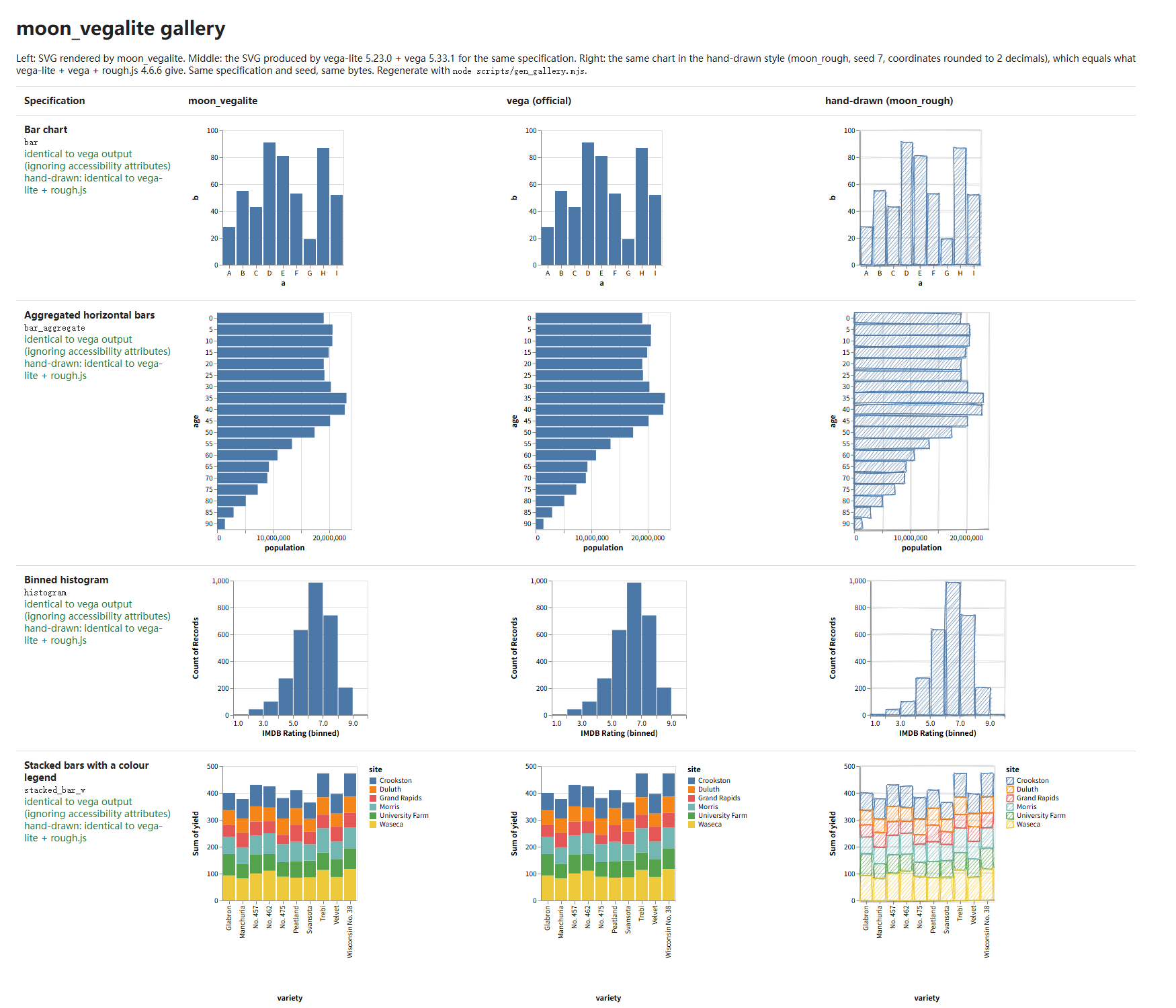
fixtures/sketchcases), byte for byte; so do all 32 charts of the gallery, which shows every chart in the three versions.
The online demo has a hand-drawn switch with a seed and a roughness slider.
#Online demo
https://sayoi7799.github.io/moon_vegalite/ — edit a Vega-Lite specification and see this library's SVG (compiled to
JavaScript, running in your browser) next to the official vega-embed rendering, with a badge that says whether the two SVG
texts are identical. Examples include official and layered charts, specifications generated by MoonFrame, and a few
unsupported features, which show their error with the JSON path. The page is built by .github/workflows/pages.yml
from site/ and the web package (moon build --target js --release); to run it locally:
moon build --target js --release
node scripts/build_site.mjs && node scripts/serve_site.mjs # http://localhost:8080/#From a CSV file with MoonFrame
examples/moonframe_demo reads a CSV with MoonFrame,
summarises it, lets MoonFrame generate the Vega-Lite specification and renders it to SVG with this library, all in one
MoonBit program and without the Vega editor. The three SVG files it writes are identical to the official vega output.
MoonFrame 0.7.0 needs a small setup step with the current toolchain, which the demo's setup.sh performs and its README explains.
#Feeding errors back to a language model
Models often answer with Vega-Lite that is wrong or uses unsupported features, and the errors of this library start with the
JSON path of the offending property. examples/llm_feedback takes recorded model replies (no API key,
no network): a reply that renders becomes an SVG, one that fails becomes a correction prompt with the JSON path and the reason,
ready to be sent straight back to the model.
#Side by side with the official output
Left: this library. Middle: vega-lite 5.23.0 + vega 5.33.1; apart from the accessibility attributes the SVG text is identical. Right: the hand-drawn style (see below).
Open gallery/index.html directly in a browser (no server needed) for all 32 charts, each in the three versions.
| Chart | moon_vegalite | official vega | hand-drawn |
|---|---|---|---|
| stacked_bar_v | |||
| point_color | |||
| layer_bar_line | |||
| layer_histogram | |||
| layer_color_legend_left | |||
| layer_circle_independent_color |
#Positioning and differences from other charting libraries
- It follows Vega-Lite, not a new grammar. The goal is the same picture the reference implementation draws (vega-lite 5.23.0 + vega 5.33.1), not a similar one: axis ticks, label formats, legends, layout and mark bounds are ported from vega-lite / vega, including their JavaScript number and text-measurement quirks.
- Scenegraph first. Like Vega, the library produces a tree of marks and items with computed bounds. SVG is one renderer of that tree; other backends can consume it. Most MoonBit charting code draws directly; here the intermediate form is public.
- Specifications in, pictures out. Charts are data (JSON), so they can come from other tools. The test-suite feeds specs generated by MoonFrame (DataFrame → Vega-Lite) to the renderer.
- No browser, no JavaScript runtime. Rendering is a pure function, usable in a native CLI, in WebAssembly, or in JS.
- Honest about scope. It is a subset renderer. Anything outside the subset fails with an error that names the JSON path (encoding.color.condition 暂不支持) instead of drawing something different.
#Support
What is implemented. Anything else raises an error that names the JSON path (encoding.color.condition 暂不支持, mark.tooltip 暂不支持),
including a property of something that is supported: nothing is silently ignored (vl/validate.mbt, vl/errors_test.mbt).
| Area | Supported |
|---|---|
| Data | inline data.values. data.url and datasets are not read, data.format.parse is rejected: embed the values |
| Marks | bar, line, point, circle, square, area, rule, tick, rect, text, arc |
| Mark properties | color, filled, opacity, interpolate (linear, step, step-before, step-after, monotone); size for rule and line (the stroke width); rule: strokeDash; text: align, baseline, dx, dy, fontSize, text, x, y ("width" / "height" or pixels); arc: innerRadius, outerRadius, padAngle, cornerRadius, stroke, strokeWidth |
| Position channels | x, y (a field, or a numeric datum), x2, y2 (on rule, bar, rect: ranged bars and rects, rules across the plot), theta (on arc) |
| Other channels | color (nominal fields with the category scheme, ordinal fields with a blues ramp sampled per value, quantitative fields with a blues ramp and a gradient legend, constant values), size, opacity (also constant), shape (nominal), text (with format); aggregate: count without a field works on size, colour, opacity and shape |
| Field types | quantitative, ordinal, nominal, temporal |
| Aggregates | count, sum, mean, average, min, max, median, distinct, … (the vega aggregate ops) |
| Transforms | filter (expression or predicate), calculate (expression subset), aggregate, bin, timeUnit, fold; field-level bin, timeUnit, aggregate |
| Time units | year, quarter, month, week, date, day, hours, minutes, seconds, milliseconds and combinations (UTC; "local" time is UTC) |
| Scales | linear, log, sqrt, pow, time, utc, band, point, ordinal with domain, domainMin, domainMax, range, zero, nice, reverse, clamp, base, exponent (position channels); the angle scale of arc takes range |
| Stacking | default stacking for bar and area (stacked areas are imputed, as vega-lite does); stack: zero / center / normalize / null; arc stacks theta around the circle (zero, normalize) |
| Sorting | sort on discrete x / y: ascending, descending, a value list, -x / -y, {op, field, order} |
| Axes | grid, ticks, labels with flush / overlap removal, title; the properties domain, grid, labels, ticks, format, labelAngle, labelFlush, labelOverlap, tickMinStep, titlePadding, offset, position and the colour / width / size family; axis: null |
| Legends | symbol legends (size, shape, opacity, colour, merged when the channels share a field), gradient legend for quantitative colour (the default blues ramp); legend.orient: left or right; legend: null |
| Layers | layer with nested layers and inherited data / transform / encoding; position scales shared by default (domains merged, a band scale wins over a point scale) or independent with resolve.scale.x / y (each with its own axis, the second on the opposite side); colour scales and legends shared, or independent with resolve.scale.color; one size scale with independent legends (resolve.legend.size); layers that bin the same field identically share one bin and one binned scale; axis and legend titles merge as in vega-lite |
| Arcs | mark: arc with theta and color: pie and donut charts, in a 200 × 200 view without a frame |
| Layout | one view or layer; width / height as numbers or {step}; padding; background; a single-string title |
| Hand-drawn style | render_svg_sketch / vl2svg --sketch: rects, rules, lines, areas, symbols, arcs and plot frames drawn by moon_rough, text unchanged (see above) |
| Config | config.scale.zero only; every other config key is rejected with its path |
| Accepted, no effect on the picture | description, name, usermeta |
Not supported, each raising an error with its path: interaction (params, selection, tooltip, condition), projection and geo marks,
facet, concat (hconcat / vconcat), repeat, autosize, a title given as an object, the radius / theta2 channels and polar text, trail,
boxplot, errorbar, errorband, the transforms window, joinaggregate, flatten, loess, regression, density, pivot, lookup
and the full Vega expression language (only the subset calculate and filter need), the scale types symlog, quantile, quantize,
threshold, bin-ordinal and sequential and scale options (scheme, range) on non-positional channels, any config except
scale.zero, and axis / legend options that are not listed above.
#Accuracy against the official implementation
A short walkthrough of the pipeline, of why the output can be identical to the official one and of how the tests are made: docs/defense.md (in Chinese).
Every expected value in the tests comes from the official packages, never from this repository:
| Layer | Reference | Where |
|---|---|---|
| number formatting, ticks, nice, time formats, scales | d3 / vega-format / vega-scale as bundled in vega 5.33.1 | fixtures/{numfmt,ticks,formatcases,timecases,scalecases} |
| expressions, data transforms | vega-expression, vega-transforms | fixtures/{exprcases,transformcases} |
| scenegraph bounds, SVG | vega-scenegraph | fixtures/scenecases |
| end to end: 80 official Vega-Lite examples (15 of them layer_*, 2 of them arc_*), edge cases, MoonFrame specs | vega-lite 5.23.0 compile + vega scenegraph and SVG | fixtures/vlexamples |
For the end-to-end cases the scenegraph (every mark, item property and bounds, numbers within a relative 1e-9) and the
SVG text (exactly, ignoring only the accessibility role / aria-label attributes) must equal the official output.
The cases cover the 80 official examples listed in examples/official.txt, the edge cases in examples/edge_*.vl.json, the channel specs in examples/channel_*.vl.json
(empty data, all-null column, single-value domain, log scale with non-positive values), and six charts generated by MoonFrame
(examples/moonframe). Invalid JSON and unsupported features are covered by vl/errors_test.mbt.
moon test passes on wasm-gc, js and native.
#Fixture provenance and regeneration
Fixtures are MoonBit files generated by scripts/gen_fixtures.mjs with the versions pinned in scripts/package-lock.json
(vega-lite 5.23.0, vega 5.33.1, vega-datasets 3.2.1) on Node.js 24 (some expected values depend on V8's Math functions, so the Node major version matters). The process time zone is fixed to UTC.
cd scripts
npm ci
npm run fixtures            # downloads the example specs of the vega-lite tag, regenerates ../fixtures
npm run gallery             # regenerates ../gallery (needs: moon build --target native cmd/vl2svg)
CI regenerates the fixtures and fails if any committed generated file differs.
util/pow10_table.mbt holds 10^k for integer k in [-330, 310]. It is generated as Number("1e" + k) (the correctly rounded value) and not with Math.pow(10, k): V8 is not consistent about Math.pow, which differs by one ulp for a few exponents between Linux, macOS and Windows builds of Node 24 (and for about 70 exponents between Node 22 and 24). js_pow10 therefore matches V8 on most builds rather than on one particular build. Compared with the Windows build that produced the previous table, only 10^23 changed, and the full test-suite, including the end-to-end comparison with the official output, passes unchanged.
examples/moonframe/*.vl.json were produced by ihb2032/MoonFrame 0.7.0 (@chart.format_vega_lite). MoonFrame 0.7.0 does
not currently build with the latest MoonBit toolchain (its dependencies NyaCSV and quickcheck still ship moon.mod.json, and
three NyaCSV tests use a removed Buffer API), so the specs were generated in a scratch project after migrating those
manifests and removing the three tests locally. The generated JSON is committed unchanged.
#Performance
Two scenarios, the same specification for every column (generated by benchmarks/data.mbt; scripts/bench/specs.mjs implements the same
generator and the test pins checksums computed in JavaScript). Each run starts from the specification text, like render_svg does.
"to SVG" is the whole pipeline; "to scenegraph" stops before the SVG text is written. Mean ± standard deviation of 10 batches.
| Scenario | native | js | wasm-gc | Node 24 + vega-lite 5.23.0 + vega 5.33.1 |
|---|---|---|---|---|
| 10,000 rows, mean per category, bars: to SVG | 21.5 ± 0.4 ms | 9.5 ± 0.2 ms | 8.6 ± 0.7 ms | 5.9 ± 0.8 ms |
| 10,000 rows, mean per category, bars: to scenegraph | 21.4 ± 0.6 ms | 9.6 ± 0.4 ms | 7.9 ± 0.2 ms | 4.5 ± 0.3 ms |
| 100,000-point scatter plot: to SVG | 1.68 ± 0.03 s | 0.83 ± 0.03 s | 0.68 ± 0.04 s | 0.88 ± 0.04 s |
| 100,000-point scatter plot: to scenegraph | 0.66 ± 0.02 s | 0.32 ± 0.03 s | 0.28 ± 0.03 s | 0.17 ± 0.01 s |
For both scenarios the SVG is identical to the official one (15.8 MB for the scatter plot), checked by scripts/bench/vega_bench.mjs --check.
moon bench --release --target js -p sayoi7799/moon_vegalite/benchmarks        # also wasm-gc and native
moon build --target native cmd/vl2svg                                          # the identical-SVG check runs this binary
cd scripts && npm ci && npm run bench                                          # the vega side, with the identical-SVG check
What the numbers say:
- On the small chart, vega on Node is faster (5.9 ms against 8.6 to 9.5 ms for wasm-gc and js): a warmed-up JIT and no start-up work.
- On the 100,000-point scatter plot wasm-gc (0.68 s) and js (0.83 s) are as fast as vega on Node (0.88 s) end to end. Building the scenegraph is slower than vega's (0.28 to 0.32 s against 0.17 s); writing the SVG is faster (0.40 and 0.52 s against 0.71 s).
- native is the slowest, about twice as slow as wasm-gc and js on this allocation-heavy work. This was only measured, not investigated or optimised.
Measured on one machine (AMD Ryzen 9 7945HX, Windows 11), one run per configuration, moon 0.1.20261016 in release mode, Node 24.20.0.
The vega side was timed after three warm-up iterations and includes JSON.parse of the specification text. Treat the numbers as indications, not as a claim.
#Layout
| Package | Content |
|---|---|
| util, stats, format, time, value | JavaScript-compatible numbers (V8 libm), d3 ticks, d3-format, time intervals / formats, dynamic values |
| scale | continuous, band, point, ordinal and sequential scales, colour schemes |
| expr, transform | the expression subset, aggregate / bin / stack / timeunit / fold / filter / formula |
| scene, svg | scenegraph, mark bounds, path generation, SVG renderer |
| spec | strict reader of Vega-Lite JSON (unsupported features raise errors with paths) |
| vl | the compiler: data pipeline, scales, axes, legends, layout |
| sketch | the hand-drawn style: the shapes of the scenegraph drawn by moon_rough |
| web | the entry point of the demo page (js): render, render_sketch |
| benchmarks | moon bench for the performance table (not part of the library) |
| cmd/vl2svg | command line tool (native) |
#Development history
Most of the work before 24 October 2026 was done locally, without committing step by step. On 24 October 2026 the
existing code was organised into commits by module (low-level numeric and time libraries, scales, expressions and
transforms, scenegraph and SVG, specification reader, compiler stages, tests, CI). The history on GitHub was rewritten
once at that time, to fold a few follow-up CI fixes into one commit. Since then every change is made on its own branch
for a GitHub issue and merged through a pull request that closes the issue.
#License
Apache-2.0. Parts of the code are ports of vega, vega-lite and d3 (BSD-3-Clause / ISC) and of fdlibm as adapted in V8; their notices and licence texts are in THIRD_PARTY_LICENSES and the file headers.
The hand-drawn style depends on moon_rough (MIT), a port of rough.js (MIT).
Compiled
The result of compiling a specification: see @vl.Compiled.
FillStyle
fillStyle. rough.js treats unknown names as hachure.
SketchOptions
The options of the hand-drawn style: the seed, roughness, bowing and fill_style.
RenderError
pub suberror RenderError {
  RenderError(String)
}
An error raised for malformed JSON, unsupported Vega-Lite features
(the message names the JSON path) or rendering failures.
compile
Compile a Vega-Lite specification (JSON text) into a scenegraph.
render_svg
Render a Vega-Lite specification (JSON text) as an SVG document.
scale multiplies the pixel size of the image (the viewBox is kept).
render_svg_sketch
fn render_svg_sketch(spec : String, options? : SketchOptions, scale? : Double) -> String raise RenderErrorRender a Vega-Lite specification (JSON text) as a hand-drawn SVG document: the
rectangles, lines, paths and symbols are drawn by moon_rough (rough.js), the text is
left as it is. The same specification and options.seed always give the same bytes.
scene_json
The scenegraph of a compiled specification as JSON: a view object (size,
origin, background) and the scene tree with the bounds of every mark and
item. This is the format the test-suite compares with vega's scenegraph.
svg_of
Render an already compiled specification as SVG.
svg_sketch_of
fn svg_sketch_of(c : Compiled, options? : SketchOptions, scale? : Double) -> String raise RenderErrorRender an already compiled specification as a hand-drawn SVG.
Source Files
Install
Download zipSpec-driven Vega-Lite renderer: Vega-Lite JSON in, backend-neutral scenegraph and SVG out.
vega-litevisualizationchartsvgdeclarative

 Apache-2.0

 Updated 6 days ago
 28 downloads