 README
- VDESCRIPTION
- VVERSION
- Vexecute
- Vexecute_with
- Vstream
- Vstream_with
- Vversion
moonlake
Embeddable analytical query engine for MoonBit: run SQL over CSV/Parquet files, native and WebAssembly from one codebase.
sql
olap
query-engine
csv
parquet
columnar
Author
Version
0.6.4
License
Apache-2.0
Repository
Last updated
5 days ago
Downloads
153
#moonlake

An embeddable, columnar SQL engine for analytics, written in MoonBit: run SQL over
CSV and Parquet files in-process, native or in the browser, from one codebase.
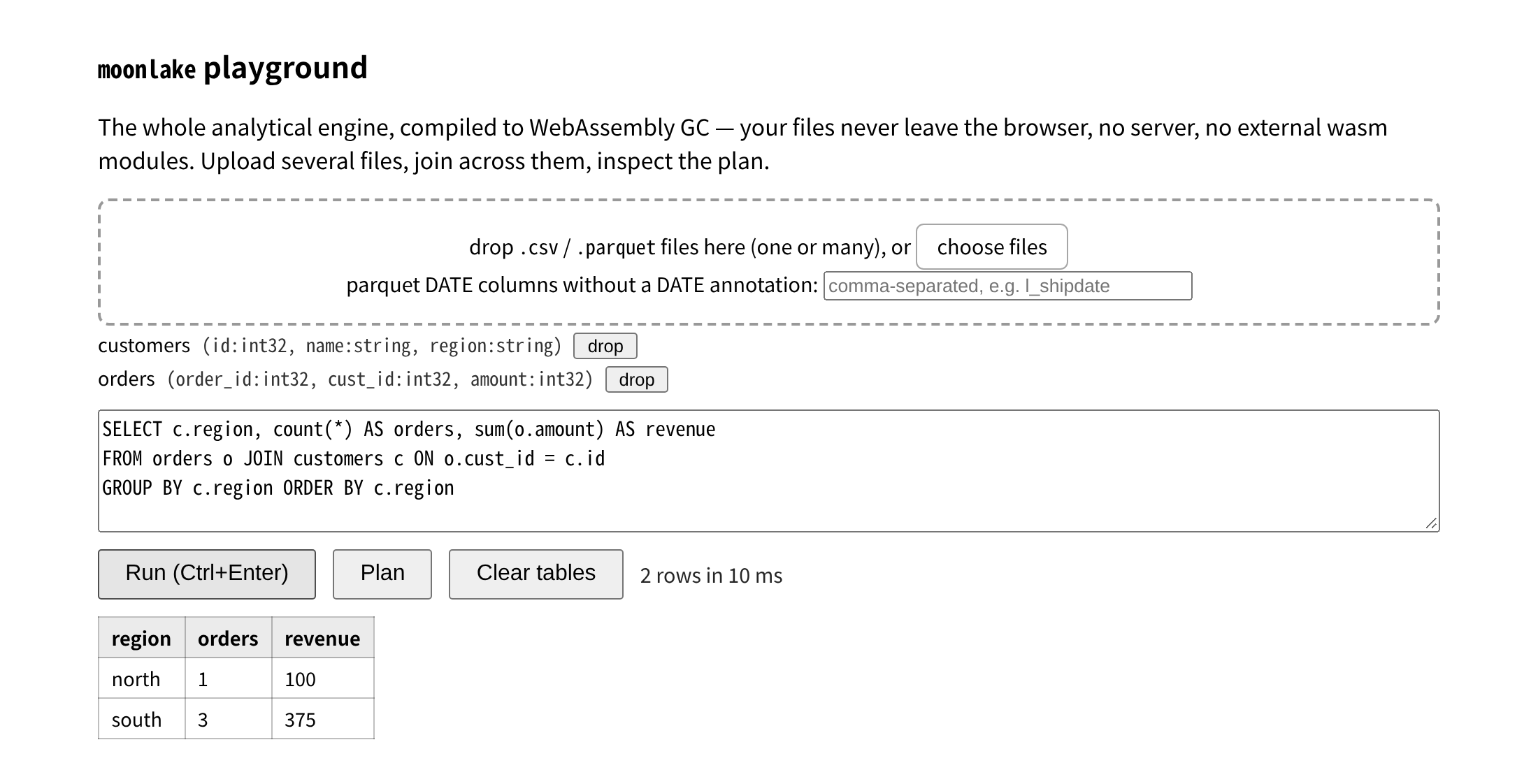
Open the playground — the whole engine
as wasm-gc, all client-side. Drag in one or more CSV/Parquet files, write SQL, get a
columnar result, inspect the physical plan. No install, nothing uploaded.
Latest release 0.6.4 (2026-10-31) on
mooncakes, Apache-2.0. This README
and the playground track main; CHANGELOG.md records each release.
#What it is
- A query engine over files, not a database. Register CSV/Parquet files as tables, run SQL, get columnar result batches. There is no storage engine, no server and no FFI binding to a database: the parser, binder, planner, vectorized operators, hash join, aggregates, windows and spill store are all in this repository
- Two data sources, read and written in-house. CSV types are inferred (integers widen instead of wrapping, a ragged row is refused by row number). The Parquet reader and writer handle a stated subset of the format and refuse the rest with a pointed error rather than guessing — docs/sources.md
- Native and browser from one build. The same packages produce a single native binary for the command line and a wasm-gc module for the playground; it also builds for js. Only the filesystem differs: a small private POSIX stub (platform/io) gives native reads and writes their byte ranges and streaming, and wasm-gc/js read whole files because their host has no ranged read
- Larger-than-memory queries degrade honestly. Under --memory, a blocking ORDER BY spills to sorted runs and streams its result back; large joins and GROUP BYs partition their inputs and aggregate one partition at a time. What cannot be made to fit is refused with the reason, not OOM-killed
- Verified against DuckDB. All 22 TPC-H queries pass on their official texts within a 1e-9 relative tolerance, plus property tests, a pushdown fuzzer and the Parquet testing corpus — see docs/verification.md
#Quickstart
git clone https://github.com/superbigcup325/moonlake && cd moonlake
moon update
moon run cmd/main -- exec --csv harness/data/sf001/lineitem.csv \
  "SELECT l_returnflag, sum(l_extendedprice) FROM lineitem WHERE l_shipdate <= date '1998-09-02' GROUP BY l_returnflag ORDER BY l_returnflag"
# l_returnflag|sum_2
# A|532348211.6499983
# ...
The checkout carries the SF0.01 TPC-H data, so that query runs as written. CI pins
moonc 0.10.18 (0.10.18+6c83a7f62); the supported floor is 0.10.16, and a nightly
job checks latest separately.
#Install the binary
moon build cmd/main --target native --release
install -m755 _build/native/release/build/cmd/main/main.exe ~/.local/bin/moonlake
moonlake exec --csv lineitem.csv --file q6.sql     # SQL from a file: no shell quoting
Every flag, output mode, plan and spill behaviour: docs/cli.md.
#Use it as a library
moon add superbigcup325/moonlake, then name the packages you import in the moon.pkg
of the package that uses them (moon new puts main in cmd/main, so that is the
file to edit):
import {
  "superbigcup325/moonlake",
  "superbigcup325/moonlake/catalog",
  "superbigcup325/moonlake/sources/csv",
}
// a @catalog.Catalog with registered table entries — @csv/@parquet
// scan into one; note the argument order: content/name, not name/content.
// registration is lazy: the schema is available at once, and a query decodes
// only the columns it projects, in 2048-row batches
///|
fn main raise {
let cat = @catalog.Catalog::new()
cat.register(@csv.scan_string("region,amount\nnorth,100\n", "events"))
// read results back cell by cell: names() gives the columns,
// row_count() the rows, get(row, col) a @types.Scalar (null via Null)
let result = @moonlake.execute(
"SELECT region, count(*) FROM events GROUP BY region", cat,
)
for r in 0..<result.row_count() {
println(result.get(r, 0).to_string() + "|" + result.get(r, 1).to_string())
}
}examples/basic/ is the snippet above as a compiled package, and examples/stream/
is the streaming snippet: moon run examples/basic, moon run examples/stream.
Batches instead of collected results: docs/streaming.md.
#SQL surface
- SELECT (including *) / FROM (multi-table) / WHERE / GROUP BY / HAVING / ORDER BY / LIMIT, INNER / LEFT / RIGHT / FULL / CROSS joins, UNION [ALL] / INTERSECT / EXCEPT, derived tables, non-recursive WITH CTEs
- Expressions, aggregates (count(DISTINCT), median, string_agg, and the explicit approx_count_distinct / approx_quantile sketches), window functions, and correlated subqueries anywhere an expression may appear — three-valued NULL logic throughout, integer overflow raises instead of wrapping
- Semantics follow DuckDB and PostgreSQL where the engines could differ — rounding, division, integer-literal widening, float → integer casts — and every deviation from C/SQLite/MySQL is stated
Each refusal, and what is out of scope on purpose, is in
docs/sql-surface.md; approximate-aggregate rules are in
docs/sketches.md.
#Verification
SQL correctness is differential testing against DuckDB over TPC-H: all 22 queries
pass on their official texts (annex parameter values, dbgen directives stripped),
every result within 1e-9 relative tolerance on SF0.01. The whole chain runs in CI —
job tpch regenerates the data and DuckDB's answers from scratch, then diffs every
query:
uv run --with duckdb python harness/gen_tpch.py   # TPC-H SF0.01 data + goldens
bash harness/check_all.sh                         # 33 goldens: all PASS (22 TPC-H + parquet + encoding variants)
MOONLAKE_DATA=harness/data/sf01 bash harness/check_all.sh   # same at SF0.1 (regenerate first: gen_tpch.py 0.1)
One documented deviation: Q15's official text materializes a view with
CREATE VIEW ... ; SELECT ...; DROP VIEW ..., and the engine executes single
statements, so the harness runs its sanctioned WITH spelling of the same query
(harness/queries/q15.sql), which DuckDB answers identically.
420 unit tests, the 33 goldens, a real-browser playground run and Parquet writer
interop run on every push; the report that explains each result is
docs/verification.md, section by section, with the command
that reproduces it.
#Performance, for information
SF0.01, best of 3, one machine, both engines, via harness/bench.py, refreshed
2026-10-31. Times include process start and reading the CSV from disk:
| query | moonlake native | duckdb |
|---|---|---|
| Pricing Summary Report (q1) | 100 ms | 3.5 ms |
| Forecasting Revenue Change (q6) | 68 ms | 1.1 ms |
| Product Type Profit Measure (q9) | 93 ms | 4.7 ms |
| Shipping Modes and Order Priority (q12) | 89 ms | 2.6 ms |
All 22 queries land between 10 ms and 129 ms against DuckDB's 1.1 ms to 6.1 ms;
harness/bench.py prints the set. DuckDB is in-process over pre-loaded tables — the
same q6 from a fresh read_csv_auto costs it 49 ms, where moonlake's own byte-level
reader plus the columnar evaluator lands at 67 ms. The four queries measured against
the original row-at-a-time build took 539–995 ms on this machine. Release-to-release
records and the machine they belong to: docs/bench-baseline.md.
--explain prints the plan and --analyze adds per-stage rows and times plus what a
budgeted run spilled; a scan line says what it will read (row groups: k of n read
when statistics eliminated some).
#Docs
- Playground (open, the plan panel and a result): register several CSV/Parquet files in a visible session, run cross-file joins, inspect the physical plan, drop tables or clear the session — the whole engine as wasm-gc, all client-side
- docs/DEMO.md: the reproducible demo, from running the engine to the DuckDB cross-check and the benchmark
- docs/cli.md: the moonlake command — inputs, output modes, plans, memory budgets and spilling
- docs/sql-surface.md: the SQL that is accepted, the semantics it follows, and what is refused
- docs/sources.md: CSV inference and ranged scans, the Parquet reader and writer scope, streaming IO per target
- docs/streaming.md: stream / next() — which shapes are pulled rather than collected, and the lifecycle
- docs/verification.md: the correctness and performance report (differential and property testing, pushdown fuzzing, memory and spill numbers)
- docs/bench-baseline.md: the release performance baseline and the machine it belongs to, with a committed JSON record and a --compare mode
- docs/spill-survey.md: how six systems handle larger-than-memory queries, and where moonlake's design lands
- docs/devlog.md: the build log, week by week
- docs/ROADMAP.md: what is being worked towards, what is refused on purpose, and what would start a direction currently on hold
- CHANGELOG.md: release notes
#Where moonlake sits
MoonBit's ecosystem had SQL parsers and format readers, but no query engine over them.
moonlake fills the compute layer and sits next to, not on top of, its neighbours:
| project | what it is | boundary with moonlake |
|---|---|---|
| moonbit-community/sqlparser | SQL lexer/parser (AST) | parsing only, no execution; moonlake runs its own front-end (sql/) because sqlparser's select-statement AST is not destructurable cross-package, so the relationship is upstream cooperation, not a planned swap-in |
| apache/parquet-format | Parquet format and encoding specs | moonlake implements the decoding itself, diffed against DuckDB answers; the specification stays upstream |
| shunge/arrow (MoonArrow) | Arrow IPC format read/write | memory-format interchange; a future to_arrow bridge is cooperation, not competition |
| uiwcvb/moonsql | embedded OLTP database (row storage, CRUD, persistence) | different species — SQLite to moonlake's DuckDB: transactional storage vs external-file analytics |
| f4ah6o/duckdb, mizchi/duckdb | DuckDB C++ bindings | FFI route; the wasm-gc target is a stub upstream and the binding build is unstable, so moonlake is pure MoonBit and runs natively in the browser |
#Repository layout
| path | what lives there |
|---|---|
| sql/ | lexer, parser and AST |
| types/ | Scalar, DataType, DataBatch and value encodings |
| catalog/ | table registration and the scan interface |
| sources/csv/, sources/parquet/ | CSV inference and scanning; the in-house Parquet reader and writer |
| engine/ | binder, plan, vectorized operators, joins, aggregates, windows, streaming |
| spill/ | the spill store used by the larger-than-memory operators |
| cmd/main/ | the moonlake command-line binary |
| playground/ | the wasm-gc browser page |
| examples/ | the README's library snippets as compiled packages |
| harness/ | TPC-H generation, golden comparisons, benchmarks and CI drivers |
| docs/ | demo, verification report, roadmap, devlog and design surveys |
#Development
moon check           # type-check
moon test            # run tests on the preferred target (wasm-gc)
moon test --target native  # filesystem/native backend tests
moon fmt             # format
moon run cmd/main    # run the CLI
git config core.hooksPath hooks   # once per clone: pre-commit gate
The pre-commit hook runs a fast local subset of CI: interface freshness (moon info),
formatting, moon check --deny-warn and native tests. CI also runs the wasm-gc / js
test matrix, regenerates TPC-H goldens, and checks the spill lifecycle, the real
browser page and Parquet writer interop. A separate consumer runs the packaged library
on native / wasm-gc / js with freshly resolved dependencies; it checks CSV queries,
Parquet raw/Snappy round-trips, DATE/NULL values and table removal. Reference tools
are pinned in harness/requirements.txt.
Building from source. main depends on superbigcup325/colenc@0.1.3, published on
mooncakes, so a plain checkout builds — no workspace file needed:
moon update   # refresh the registry index; the graph downloads on the first check
moon check
Hacking on colenc and moonlake together still works: add a moon.work that lists
the sibling checkout, and the workspace version shadows the registry one:
ln -s ../colenc .colenc
printf 'members = [".", "./.colenc"]\n' > moon.work
Remove both again before checking what a consumer actually installs.
A release page is the CHANGELOG.md section for that version, not a second copy of it:
python3 harness/release_notes.py <version> prints the body (the title is the bare
version), --check <version> asserts that a published body still matches its section,
and --lint keeps the file in Keep a Changelog shape.
#Acknowledgements
moonlake is built on these open-source packages:
- moonbitlang/x (Apache-2.0) — filesystem, argument parsing and encoding utilities
- moonbitlang/quickcheck (Apache-2.0) — property-based testing
- superbigcup325/colenc (Apache-2.0) — Parquet DELTA, BYTE_STREAM_SPLIT and RLE encoding/decoding primitives
- apache/parquet-format (Apache-2.0) — the Parquet format and encoding specifications that sources/parquet implements; its parquet-testing corpus supplies the files the reader is verified against
- The TPC-H query texts in harness/queries/ are the official benchmark texts, used here for correctness validation against DuckDB; TPC-H is a trademark of the Transaction Processing Performance Council
#License
Apache-2.0 © 2026 The moonlake Authors. NOTICE carries the
copyright statement and the licenses of the packages moonlake builds on.
VERSION
let VERSION : StringVersion of the superbigcup325/moonlake module, kept in sync with moon.mod.
execute
Parse, bind and execute a single SELECT over the catalog and return
the result as a columnar batch with output names.
execute_with
Execute with explicit options: a memory budget turns the blocking
ORDER BY of non-aggregate queries into an external sort backed by
opts.spill. See @engine.ExecOptions.
stream
Execute a SELECT and consume it as it runs, instead of collecting the whole
result first.
A single-table scan is pulled: the filter, the projection and an
OFFSET/LIMIT window run per batch, so a caller that wants the first few
rows reads only the batches those rows live in, and nothing accumulates
between the source and the caller. Every other shape — a join, ORDER BY,
DISTINCT, a window function, a derived table, a set operation — has to see
all rows before it can produce the first one, so it is executed eagerly and
next hands that result back as one batch. An aggregate is the case in
between: it must see every row too, but a single-table GROUP BY or a global
aggregate folds the scan's batches as they arrive, so it holds its group
state and not its input — its answer is still one batch. Both deliveries run
the same plan, so they agree on rows.
let s = @moonlake.stream("SELECT * FROM t LIMIT 3", cat)
while s.next() is Some(batch) {
  inspect(batch.row_count())
}stream_with
stream under explicit options. A budget changes what can be pulled rather
than collected, never the rows:
- Ordered rows are pulled from a spilled sort rather than handed back whole: a sort over budget writes runs into opts.spill and the stream is their merge, so it removes the run files when the merge ends, when it is closed, or when it fails. A stream is the one caller that can outlive the call, so it takes ownership of those files.
- A two-table join is pulled with or without a budget: the build side is resident, and the probe side arrives a batch at a time.
- A GROUP BY under a budget, and any shape a pull cannot express — a chain of joins, a RIGHT or SEMI/ANTI join, a cross join, or ORDER BY / GROUP BY / DISTINCT / a window above the join — is executed eagerly before this returns, and the stream hands back its one batch.
execute_with is the right call when the caller wants the budget to do the
work and the result whole. (A global aggregate is neither: it folds the scan
under a budget too, running, and hands back one batch.)
Source Files
Install
Download zipEmbeddable analytical query engine for MoonBit: run SQL over CSV/Parquet files, native and WebAssembly from one codebase.
sqlolapquery-enginecsvparquetcolumnar

 Apache-2.0

 Updated 5 days ago
 153 downloads